She has long been a staple of English literature courses, but 85 years after her death, Virginia Woolf has transcended academia to become an unexpected cultural phenomenon. The author of Mrs Dalloway and To the Lighthouse, whose innovative prose redefined the modern novel, is captivating new audiences through a series of high-profile adaptations.
New Film Adaptation: Night and Day
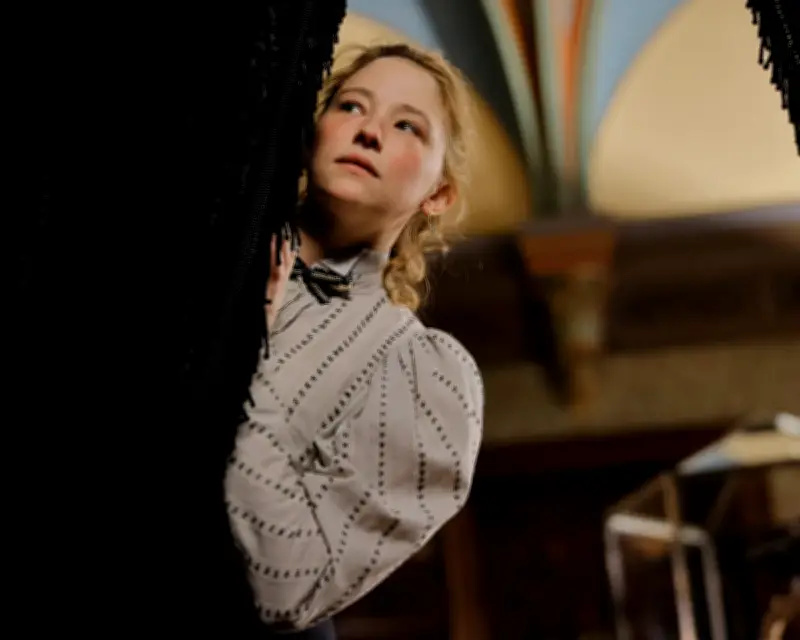
This Friday sees the cinematic release of Virginia Woolf’s Night and Day, an adaptation of Woolf’s novel of the same name. The romantic comedy stars Haley Bennett, Timothy Spall, Jennifer Saunders, Jack Whitehall, and Lily Allen. It follows a female astronomer whose orderly life unravels as she becomes entangled in a love triangle, forcing her to confront romantic desire and the patriarchal constraints of Edwardian society.
Director Tina Gharavi, known for the BAFTA-nominated I Am Nasrine, said she has long been a fan of Woolf. “She was an iconic lesbian author who wrote about intimate personal experience. I thought she was extraordinary in the way she carried herself in a world that diminished women’s stories and voices.”

Gharavi initially discussed directing 2018’s Vita & Virginia, but felt a stronger connection to Night and Day. Working with screenwriter Justine Waddell, they expanded Woolf’s single reference to astronomy into the film’s emotional core. “I wasn’t familiar with Night and Day, but when I read it I immediately connected with Katharine Hilbery’s story, her ambition and fear of love, because at that time it often led to children and domestic servitude. She wanted to avoid that, and I understood that,” Gharavi said.
She added, “I was curious about why Virginia was writing this book. There was something beautiful about this woman who wants to be an astrophysicist, just looking at the sky. I loved the metaphor of a woman looking at the heavens as a perspective on existence – how silly it is to reduce women to lesser roles.”
Gharavi noted the serendipity of making this film while “living with the consequences of the Iranian war.” Woolf wrote Night and Day in 1919 but set it in 1910, on the brink of global conflict. “There must have been a reason she chose that moment,” Gharavi said. “Most of the men, like Ralph Denham, would have gone to war and died. Woolf also wrote this book when she was in a mental institution, but it is actually a romcom – it’s whip smart and funny. That’s what’s so great about comedy, and why we need a film like this. We need to be able to stand how difficult it is to live right now – with war, with genocide. We need to be reminded of our better selves and what connects us all is laughter.”
Modern Reimagining: Clarissa
Another adaptation, Clarissa, a modern-day reimagining of Mrs Dalloway set in contemporary Lagos, Nigeria, became the talk of Cannes last month. Starring Sophie Okonedo, David Oyelowo, and Ayo Edebiri, the film follows a high-society woman preparing to host a party in Lagos, where she unexpectedly encounters figures from her past.
Directed by brothers Arie and Chuko Esiri, Clarissa is expected to screen widely on the autumn festival circuit. Chuko Esiri first read Woolf’s novel as a teenager at a British boarding school. “I didn’t understand it, but I felt it,” he told the New York Times. Over time, he began to see “pieces of everybody I knew cached in these characters.”
He said present-day Nigeria and 1920s England were “eerily similar … specifically how conservative the cultures are.” The brothers have even named a writing desk Virginia. “[Chuko] literally does say things like, ‘I’ve got a meeting with Virginia’,” Arie Esiri said.
Woolf’s Enduring Influence
Woolf’s work has long proven ripe for adaptation due to its intensely internal nature – its focus on consciousness, voiceover, and monologue. This quality underpinned Stephen Daldry’s The Hours (2002), which interwove the lives of three women connected by Mrs Dalloway. Sally Potter’s Orlando (1992), starring Tilda Swinton, offered a radical interpretation, transforming the novel into a playful, gender-fluid meditation on identity and time.

This spring, a stage adaptation of The Waves at London’s Jermyn Street Theatre was a critical hit, while a touring production of Mrs Dalloway, featuring Kit Green playing 16 roles, has also drawn attention.
Beyond stage and screen, Woolf’s presence has seeped into contemporary culture, particularly among younger audiences who circulate quotes from Mrs Dalloway and A Room of One’s Own on social media. This autumn, the West End hosts a revival of Edward Albee’s Who’s Afraid of Virginia Woolf?, starring Gillian Anderson and Billy Crudup. While not based on Woolf’s texts, the title reflects how her name has become shorthand for intellectual, emotionally volatile interior drama.
“She invented a type of novel that centred female lives; we owe a debt of gratitude to her,” said Gharavi, who also teaches at Newcastle University. “Woolf was a modernist and I think we should be modernists in how we make adaptations relevant today. What would Virginia think and do today? I’m sure she would say: make it more radical. That’s why we have black, queer, trans characters in our story.”
Gharavi said audiences need to “find their own relationship” with Woolf. “We still don’t have women’s voices equal to men’s, even today, 100 years after she wrote this book. That’s insane. There must be a reason she’s in the zeitgeist. She’s more relevant now than ever.”