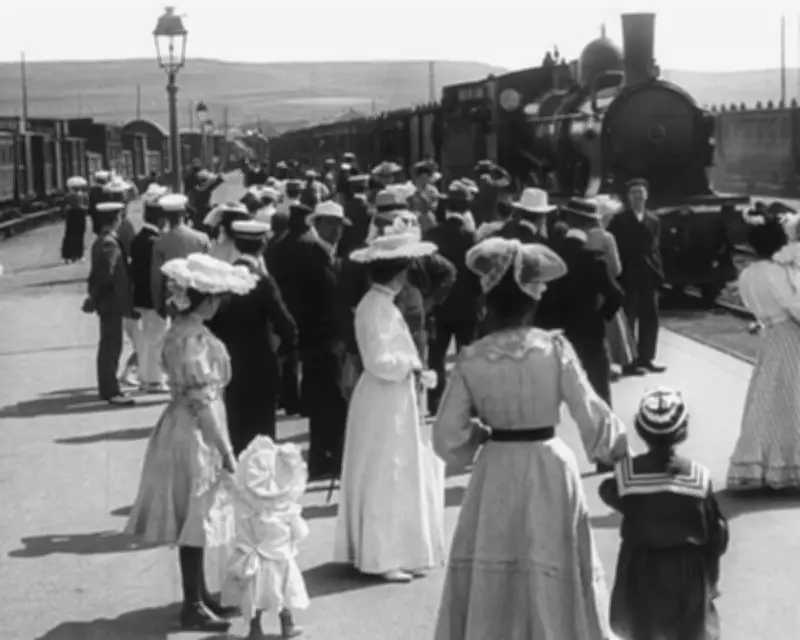
Trains Documentary Review: A Magnetic Cine-Essay on Rail Liberation
Polish director Maciej Drygas presents Trains, a compelling archival documentary that examines the profound social revolution unleashed by steam locomotives. Constructed entirely from historical footage without narration, this cinematic essay explores how railway technology accelerated modern society while simultaneously derailing humanity's progress.
The Dual Nature of Railway Revolution
The film opens with a powerful sequence showing a steam engine being assembled, reminiscent of ancient worshippers constructing a massive idol. This visual metaphor establishes Drygas's central thesis: while trains promised liberation and optimism, they also carried society toward darker destinations. Early footage captures 1920s flappers gazing brightly from train windows, embodying the hopeful possibilities of newfound mobility.
Yet this optimism is immediately undercut by a prefacing quote from Franz Kafka: "There is plenty of hope, an infinite amount of hope ... But not for us." Drygas suggests that the very technology that promised freedom ultimately led humanity off course, with railways becoming instruments of destruction and control.

Railways in Wartime: From Liberation to Destruction
The documentary dedicates significant attention to railways' crucial role in both World Wars. Black-and-white footage shows munitions supply lines transporting newly forged shell casings destined for railroad howitzers, their metallic surfaces glowing with what the film presents as an unholy light. These images of industrial warfare give way to haunting shots of shellshocked soldiers convulsing in trauma, reduced by the filmmaker's perspective to broken-down machines themselves.
Drygas draws a chilling parallel between mass adulation for entertainment and political figures. Charlie Chaplin appears being borne aloft by adoring crowds from a passenger carriage at the dawn of mass stardom. This celebratory moment immediately transitions to footage of Adolf Hitler saluting supporters from a first-class railway car, suggesting how the same transportation infrastructure that enabled celebrity culture also facilitated the rise of authoritarianism.
Postwar Reflections and Modern Ambiguity
The film's tone shifts somewhat in its postwar section, focusing more on individual human experiences. Faces dreaming on escalators and passengers expectantly consulting timetables receive more lingering attention. Yet even these more personal moments exist within Saulius Urbanavicius's cavernous sound design, which creates a sense of perpetual motion without clear destination.
The documentary concludes with abstract shots of intersecting and diverging railway tracks, suggesting modernity's uncertain trajectory. Throughout the film, occasional smiles directed at the camera—including Nazi officers mugging for an early handheld device—remind viewers that this is not just a history of transportation but also a tribute to cinema itself. The movie camera emerges as the train's contemporary companion in documenting space and time.
A Cinematic Journey Through Railway History
Trains operates like Koyaanisqatsi with an Interrail pass, using purely visual storytelling to survey the sweeping transformations railways brought to 20th-century life. From revolutionizing logistics and leisure to enabling mass travel and war mobilization, trains introduced both new consumer opportunities and abrupt psychocultural disruptions.
The documentary screens at Bertha DocHouse in London beginning March 20th, offering audiences a unique perspective on how railway technology shaped—and continues to shape—our collective journey through modernity. Without voiceover or contemporary interviews, Drygas allows archival images to speak for themselves, creating a magnetic cinematic experience that challenges viewers to reconsider transportation's complex legacy.