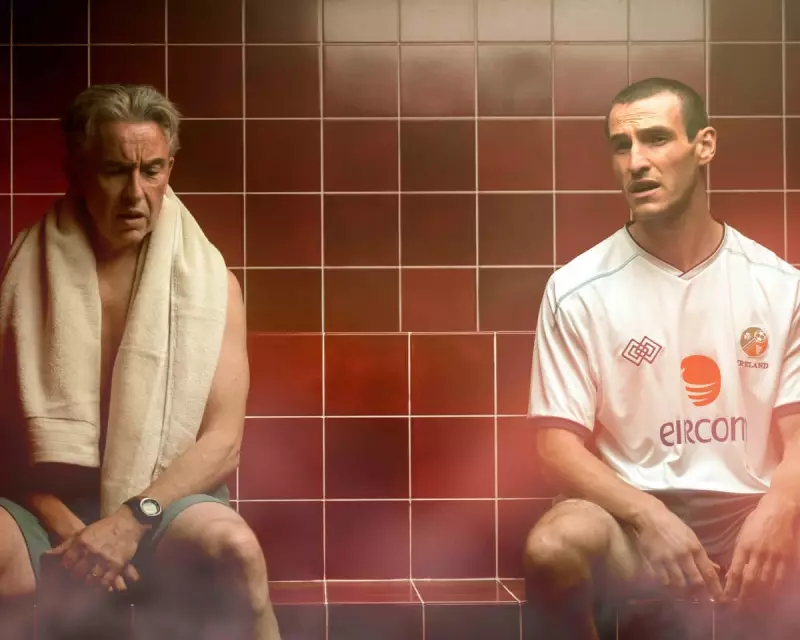
A new feature film tackling one of the most divisive episodes in Irish sporting history has landed, but its approach raises fundamental questions about dramatising recent, well-documented events. 'Saipan', directed by Glenn Leyburn and Lisa Barros D’Sa, dramatises the explosive fallout between Republic of Ireland captain Roy Keane and manager Mick McCarthy on the Pacific island of Saipan just days before the 2002 FIFA World Cup.
The Problem of Painstaking Recreation
The film, released in Ireland on Boxing Day and set for a UK release on 23 January, is notable for its obsessive attention to period detail. Tracksuits, kits, and settings are recreated with startling accuracy. Scenes cut seamlessly between actors and genuine archival footage from press conferences, highlighting the filmmakers' dedication to visual authenticity.
This meticulousness, however, leads to a central quandary. If the original events were so thoroughly captured on camera at the time, what is the purpose of a dramatic reconstruction? The film's climax—Keane's infamous "stick it up your bollocks" tirade in a hotel restaurant—was not filmed, justifying its dramatisation. Yet, seeing Steve Coogan impersonate McCarthy in a press conference we can easily watch online feels like a redundant exercise in mimicry.

Factual Liberties and a Shifting Dynamic
Where the film departs from recorded history, it stumbles. Crucially, it invents a motivation for Keane's fury, suggesting he attacked McCarthy for not being "Irish enough." This is a significant fabrication. Multiple accounts confirm this was not part of the argument, and it misleadingly frames the conflict as an Anglo-Irish issue, ignoring that many squad members, including those who sympathised with Keane afterwards, were English-born.
Casting choices also alter the story's fundamental power dynamic. Éanna Hardwicke delivers a strong performance as the 30-year-old Keane, but Coogan, while compelling, was 16 years older than McCarthy was in 2002 and is shorter than his co-star. In reality, McCarthy was the taller, older, and physically imposing authority figure. On screen, the confrontation risks appearing as a hyper-fit young athlete bullying a smaller, older man, which skews the perception of the real-life standoff.
Missed Context and Narrative Simplicity
The film's most engaging moments come from the real archive clips: the crackle of RTÉ's satellite phone broadcasts, the passionate studio debates featuring Bill O'Herlihy and Eamon Dunphy, and the raw emotion of radio phone-ins. These glimpses capture how the saga truly split a nation.
Yet the drama fails to explore why it resonated so deeply. It barely touches on how Keane was seen by many as a symbol of a new, professional, and demanding Ireland—the Celtic Tiger era—while McCarthy represented a more traditional, perhaps less rigorous past. Reducing this complex cultural schism to a hotel blow-up and some broad caricatures of drunken FAI officials and players sells the reality short.
Other creative choices are questionable. Portraying Keane's explosive Irish Times interview as a journalistic betrayal, published earlier than agreed, is factually incorrect and lessens Keane's own accountability. The film's uneven tone, veering from nuanced character study to cartoonish comedy, further undermines its authority.
In the end, 'Saipan' feels like an aesthetic experiment in hyper-realistic recreation, akin to Gus Van Sant's shot-for-shot Psycho remake. But when the source material is already so visual and immediate, such mimesis can seem futile. The film offers a simplified, and at times inaccurate, narrative consolation. The true story of Saipan—with all its conflicting testimonies, cultural weight, and enduring mystery—remains far more compelling than this flawed dramatic retelling.