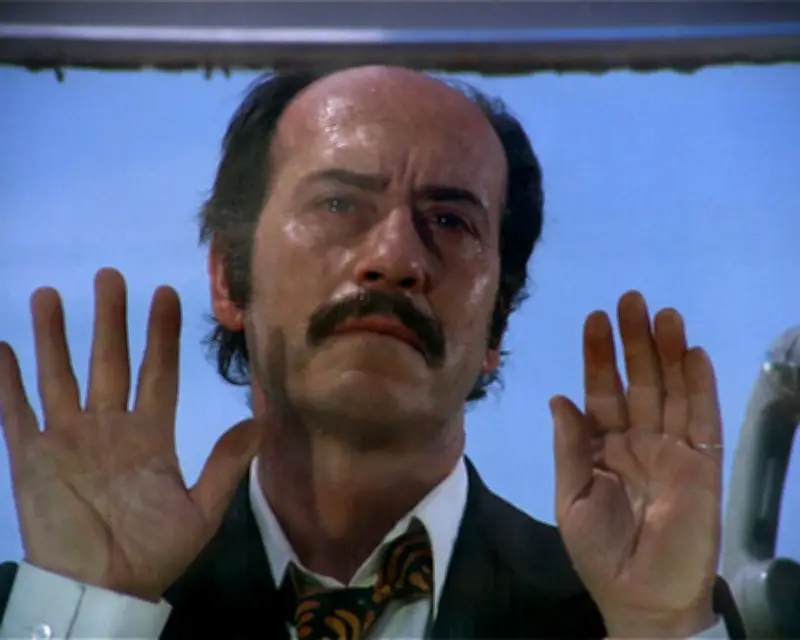
Two macabre Spanish TV plays from the 1970s are being released as a double bill: Antonio Mercero’s La Cabina (★★★★★) is a cult 1972 surreal short film lasting just 35 minutes but encompassing an entire dreamworld of anxiety. It was conceived for television in the spirit of Alfred Hitchcock Presents or Roald Dahl’s Tales of the Unexpected, but I can imagine it shown in cinemas as a curtain-raiser before Buñuel’s The Exterminating Angel.
La Cabina: A Phone Booth Nightmare
La Cabina is a black comic nightmare in which a fussy middle-aged man, played by veteran Spanish comedy actor José Luis López Vázquez, steps into a phone booth that has just appeared in a suburban sidestreet. But the phone doesn’t work and then he can’t get out; the door is jammed. What to do? There’s no mobile phone to reach for; in 1972, the phone booth was the mobile phone. He gesticulates and waves in panic through the glass, though seems mysteriously robbed of the power of speech and is clearly inhibited by how ridiculous he must look. Crowds cluster round and try ineffectually to help. A callous, carnivalesque atmosphere develops. The man sees himself reflected in a mirror that one onlooker is carrying: trapped, absurd, bourgeois homo sapiens as zoo animal.
When the telecoms engineers finally show up and load the booth with him in it on to their van and cart him away, he might assume that these are the experts who can take him to some specialist warehouse where he can be released. But no. Could it be that this is not an accident? What is the meaning of it all? La Cabina could be a parable of surveillance and tyranny in Franco’s Spain; or a vision of death with the phone booth as the vertical coffin; or just a meditation on how very strange phone boxes were (no surprise Doctor Who used a police phone box as the Tardis). And it also plays on the uncanny anonymity of the telephone call, the voice reaching out of the ether. You could compare this to Joel Schumacher’s claustro-thriller Phone Booth, with Colin Farrell as the creep who finds himself karmically trapped in the very New York phone booth he was using to make extramarital assignations. There’s also Graham Starks’ clever short film Lust from the 1971 anthology The Magnificent Seven Deadly Sins, starring Harry H Corbett as a sad, lustful loser who tries to seduce a woman in the neighbouring phone box.

El Televisor: A Satire on Television
By contrast, Spanish horror director Narciso Ibáñez Serrador’s El Televisor (★★★☆☆) from 1974 is frankly less interesting: a spirited, but rather overextended and pedantic satire on TV, and its attendant promotion of convenience and leisure. The director’s father Narciso Ibáñez Menta plays Enrique, a sad and mediocre little man who works all hours at his boring job to earn enough to provide for his wife Susana (María Fernanda D’Ocón) and their two children, with whom he spends no time at all. He dreams of buying all the mod cons imaginable, but the holy grail is a brand new colour TV set (and the state-of-the-art prestige of a colour TV now seems almost as obsolete as a phone box).
But once the precious TV set is installed in Enrique’s study, where he used to read and listen to classical music, Enrique forgets about work and everything else and becomes maniacally obsessed with watching TV all day, every day (though a quirk of this film is that it appears actually to be black-and-white). The TV programmes seem realer than reality itself, and certainly no more futile than the soul-sapping job that paid for the TV set in the first place. But his excitement and rapture soon curdle into horror; he broods about what he sees on the news: “… the napalm … the bodies of Palestinian guerrillas …” He obsesses about all the people who don’t win on the gameshows and the violence of the cartoons, and eventually he comes to believe that the people on TV are talking to him and trying to escape through the glass screen which he walls up with a sheet of cardboard. At around an hour’s running time, El Televisor finally gets round to a predictable twist ending, but the absurdism of it all is performed with a theatrical relish.
La Cabina/El Televisor is in UK cinemas from 19 June, and on Blu-ray from 20 July.