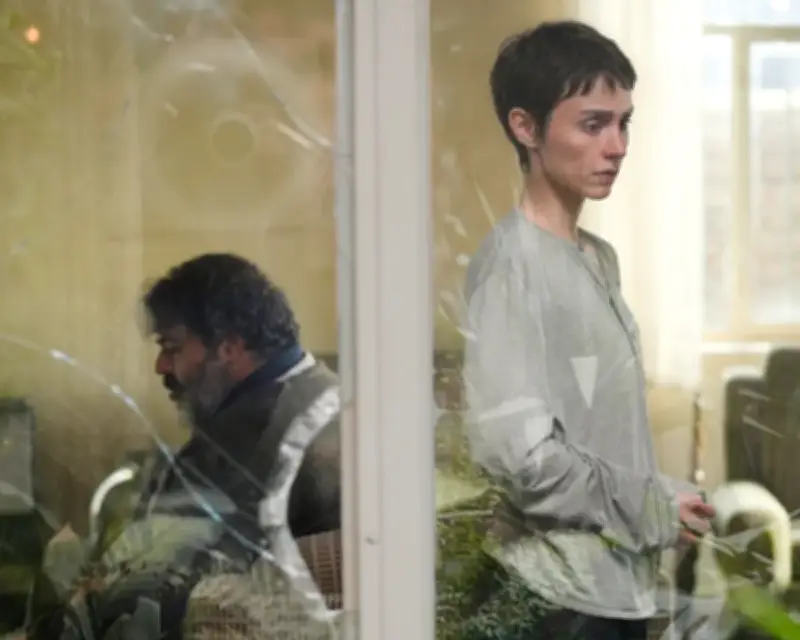
Mohsen Gharaei's hothouse domestic drama Falling House premiered in the Orizzonti section at the Venice Film Festival, delivering a fierce and unsubtle parable of life in the Islamic Republic. The film follows Rashid Hafizhi, a low-level jailer played by veteran Iranian actor Farhad Aslani, who returns from work to imprison his own family in a misguided attempt to protect them from the world and their own ambitions.
A jailer's tragicomic lockdown
Rashid is a burly bear of a man carrying an air of bewilderment and defeat, as though aware that everyone around him is smarter than he is. He has been falsely accused of aiding and abetting a jailbreak and faces imminent eviction from his rented family home. On the same day, he learns his cherished eldest daughter, Ensi (Laleh Marzban), plans to run off to Turkey to seek work as a model—a profession that is a non-starter in Iran, where she must cover her arms and neck for each job and contend with unstable power supplies that cut out mid-photoshoot.
Outside the family home, bulldozers rake the earth to prepare for a new housing estate. Inside, the jailer becomes a one-man wrecking ball, goaded into fury by the sight of Ensi's modelling portfolio. He first imprisons Ensi, then his wife Zitab (Rina Raminfar), and finally his plucky youngest daughter. “This is my prison,” he declares. “And I make the rules.”
From box office hit to angry parable
Gharaei's previous film, Without Everything, was a major box office hit in Iran in 2021 and lavished with awards at the Fajr film festival in Tehran. Falling House looks set for a rockier reception, assuming it is permitted to land safely at all. It is an angry, cornered beast of a movie—a rugged piece of old-school social realism and a thinly veiled parable of life in the Islamic Republic. Escape, it suggests, is the only reasonable option, but that requires money, a passport, and a key to open the door.
The film's message—that Iran is a prison and everybody is inside, cons and non-cons, parents and their children—is hammered home with terrific force and conviction. Some dialogue is perhaps a little on the nose: “Rashid, I know you're in a bad place,” wails Zitab as the house goes into lockdown. “How unlucky are we?” says Ensi later. “The people coming to demolish our house are our only hope.”
Black comedy or brutal realism?
These lines might be intentional jokes, judiciously deployed to lighten the glowering mood. Falling House spins an anguished, brutal tale, but it could play just as well as an absurdist black comedy, and Gharaei leaves the door ajar for an alternative parallel reading. He whips up a robust, potent, powerfully acted affair—a film that's altogether more sturdy than the Hafizhis' frail house on the landfill, and sturdier than the broken family inside.