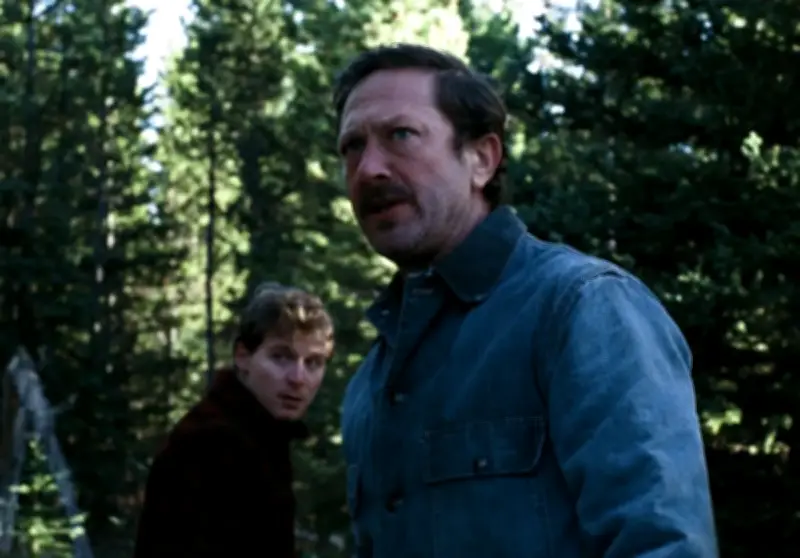
Andrew Haigh's mysterious and beautiful new film, A Long Winter, premiered at the Telluride Film Festival. Adapted by Haigh from a 2006 story by Colm Tóibín, the film transplants the action from the 1930s Spanish Pyrenees to the wintry, vertiginous landscapes of Colorado around the time of the Korean War. It is a poignant, subversive study of grief and desire, and the terrible, infantilised loneliness of men without women.
A family in limbo after the mother vanishes
Lester, played by Ebon Moss-Bachrach, is a grizzled, hardened farmsteader in the remote hills. His family has a certain sufficiency from their livestock, and he makes a precarious living breeding rabbits for their meat and fur. One son, Tommy (Kit Connor), is leaving for military service, leaving behind his shy brother Mikey (Fred Hechinger). Mikey has secret gay longings, nourished by furtive glimpses of glossy Cosmopolitan magazines with their impossibly exotic visions of big-city fashion and design.
The magazines belong to Mikey's mother, Louise (Caitríona Balfe). Her own inner imaginative life and thwarted yearnings, indirectly revealed by her LP records, have been crushed by this hard existence and her increasingly boorish and uncaring husband. He once played the mandolin, a hint of the now withered playful and creative side that may have once attracted her; he also once had a talent at furniture-making.
Wretched Louise is a semi-functioning alcoholic whose damaged feminine mystique is an enigma to her stolid menfolk. She is given to booze-breakdowns, an open secret with the relatives and neighbours but withheld from the boys, an ongoing humiliation which has caused Lester to be even meaner.
An unconventional winter of male bonding
In the midst of one such collapse, Louise simply vanishes in the depths of winter. The shrugging cops and search-party volunteers finally greet the event by saying that the only thing for it is to wait for the snows to melt to carry on the search, which will be much grimmer by this stage. But what is the truth? The long winter commences, and Lester, utterly hopeless at cooking and looking after the household, takes in a local biracial boy called Jimmy (D'Pharaoh Woon-a-Tai) to do surrogate-wife chores. Jimmy excites Lester's ugly homophobic abuse, and is the object of Mikey's attraction.
The film shows that the mood is not simply anguish and trauma. On the contrary, a bizarre and parodic new mood of bachelor freedom settles on this masculine household. Perry Como's crooning song A Dreamer's Holiday swarms onto the soundtrack, perhaps a feature of Louise's abandoned vinyl collection. It accompanies this unquantifiable new feeling that nothing can be done for the moment, nothing confronted, nothing felt. They are at liberty to explore a kind of alternative existence without family responsibility, which Mikey perhaps thinks himself permitted to enjoy because he doesn't yet believe his mother is dead. In a sense, she is a sorrowing ghost.
Fierce acting and stunning cinematography
Mikey and Jimmy roam through the glorious snowy landscape like adventurous kids, exploring an empty house. Lester and the boys take turns with the preciously rationed bathwater in the tub, a moment which might be expected to disclose some kind of intimate resentment or violence but doesn't. Haigh shows that however heartless their behaviour arguably is, and however terrible also their deferred grief and denial, they are now exhibiting a strange capacity for happiness which would otherwise be an impossible dream.
The movie dramatises what might be the unacknowledged, unmentionable side of death and loss: the delirious, almost hallucinatory sense of freedom from normality. This is their long winter holiday from the uphill work that they had been accustomed to think was their harsh birthright; yet the thaw, which is also the freeze, must come. It is a fascinating, affecting and enigmatic study in what a later age would call male fragility and male resilience. A Long Winter screened at the Telluride Film Festival.