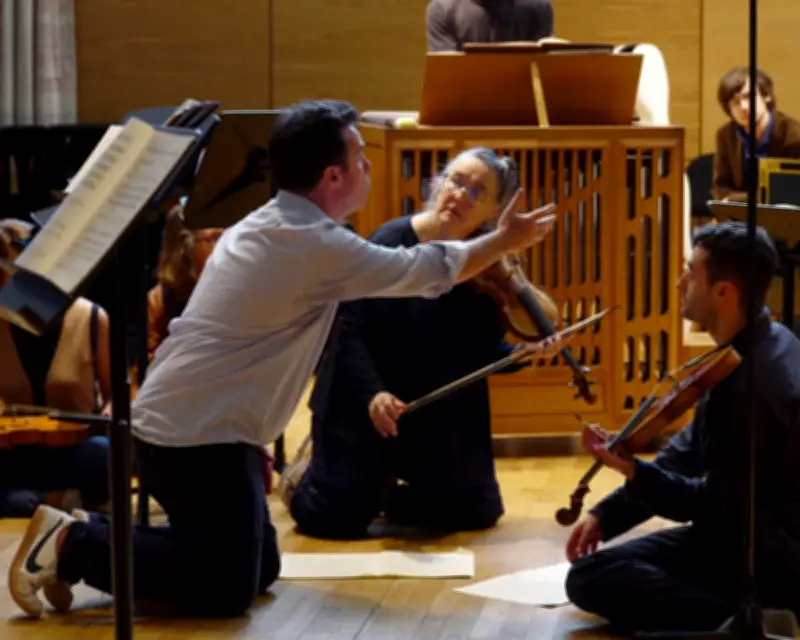
Professor Bettina Varwig of the University of Cambridge is leading a project that challenges the passive listening norms of classical music, drawing on historical evidence of how 17th- and 18th-century audiences experienced music physically. Her research reveals that listeners in Bach's time described music as contracting their innards, making their hearts leap, melting earwax, and even drawing the soul out of the body.
Historical evidence of embodied listening
Varwig's research unearthed testimonies from philosophers, music theorists, theologians, and medics who described music as moving, ravishing, painful, and curative. Listeners reported music softening the heart, piercing the brain, making teeth grate and rattle, and constricting the chest like ropes. Music could enter through skin pores and spread contagiously between people.
Workshop with Royal Academy of Music
With musicians Margaret Faultless (violinist) and Nicholas Mulroy (tenor) at the Royal Academy of Music, Varwig conducted a two-day workshop on Bach's St John Passion. The musicians were invited to let the music guide them without constraints. They ended up dancing, kneeling, and gesticulating, amplifying the emotional intensity of arias like "Ach, mein Sinn" and "Erwäge, wie sein blutgefärbter Rücken."

Faultless described the experience as "cosmically messy" and "unbearable" in its confrontation with the music's meaning. The singer and musicians knelt, entreating heaven with outstretched hands, listening more intensely than in conventional performances.
Historical continuity and modern implications
Embodied listening persisted into the 19th century. Hector Berlioz, trained as a doctor, described Beethoven's Op 131 quartet in 1829: "A heavy weight seemed to press on my breast as in a horrible nightmare, I felt my hair tingling, my teeth chattering, all my muscles contracting." Promenade concerts, starting in 1895, allowed audiences to move, but by the late 19th century, silence and stillness became the norm. Stendhal noted in 1824 at the Paris opera: "What will result from this scrupulous silence and continuous attention? That fewer people will enjoy themselves."
Varwig has "utopian visions where this level of physical and emotional engagement among performers and audiences becomes the norm in the classical music world." Faultless said the project was transformative: "We experienced the physicality of our own bodies and emotions. We were incredibly attuned to our fellow performers and listeners. We were free to inhabit the intensity of Bach's music, free to move, to breathe together and to respond to the power of the story through our shared humanity."
Keir Starmer's musical legacy
The article also touches on former Prime Minister Keir Starmer, a former flute-player, who mentioned Shostakovich in a conference speech and professed love for Beethoven's symphonies. However, his tenure saw no major boost to music education funding or Arts Council England's music portfolio. The author hopes his successor, possibly Andy Burnham, a culture secretary under Gordon Brown and fan of the Smiths and the Pogues, might usher in a new era of restoration for music education.