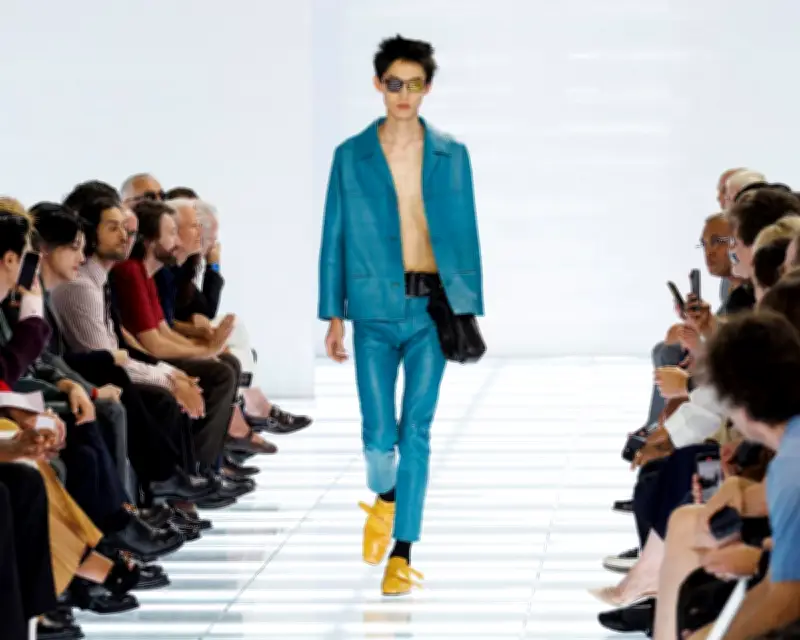
Miuccia Prada and Raf Simons presented a purified version of Prada at Milan Fashion Week on Sunday, describing their latest collection as a rejection of 'useless design' and a break from typical luxury stereotypes. Speaking backstage, the co-designers emphasized a minimalist vision focused on intentional and meaningful pieces.
Breaking Luxury Perceptions
Prada and Simons said they want to 'break the perception of what is perceived as typical luxury in high fashion right now.' The collection distills design to essential items, rejecting experimental shapes, techniques, and decoration. Simons compared the approach to pasta al pomodoro—'little ingredients but well executed.' Key components included jeans, a jeans jacket, a T-shirt, a timeless blazer, and a leather blouson.
Jeans as the Universal Starting Point
The design duo chose jeans as their starting point, calling them 'the most universal item in fashion.' The opening look featured white jeans, a white denim jacket, and a navy blazer. None of the 50 looks used blue denim; instead, white jeans were reimagined in leather versions in colors like banana, pink, and aubergine. Every jean and trouser was cut skinny, hitting above the ankle, styled with pointy buckled shoes. Jean jackets were cropped just above the hip bone, revealing flashes of skin.
Rejecting 'Useless Design'
Prada described 'useless design' as her new obsession, stating, 'There is nothing that I hate more in this period.' Simons, who has worked with Prada since 2020, explained that each item was 're-materialised, re-scaled or their use is reversed.' Leather jackets were shrunken and styled underneath sleeveless patterned knits. Gauzy versions of jeans and jackets appeared more like underlays than outerwear. The only accessories were small bag pouches hanging from belts, styled above trouser loops.
The Difficulty of Nothingness
The catalyst for this distillation was the realization that 'nothingness is very precise—to do this is far more difficult to achieve.' The designers previously explored removing or wearing pieces in different ways during their February womenswear show. For Sunday's collection, they are excited to see how audiences adopt and adapt the pieces.
Fashion from the Street
Simons noted that history shows important fashion often comes from the street, individual thinkers, or like-minded groups. 'To me, at least now, right now it feels that we have to think about that and we have to maybe stimulate that again. So it doesn't feel so much like it's only dictated by high fashion brands and their high fashion events.'
Reflecting on consumer choice, Simons recalled how in his early 20s it was easier to relate to fashion tribes. 'It was very easy to decide 'that's what I want' but now it can be very confusing.' He pointed to the 1990s when catwalk fashion heavily influenced high street wear. 'Right now, I think that's [happening] less. At the end of the day we like people on the street to wear our clothes.'