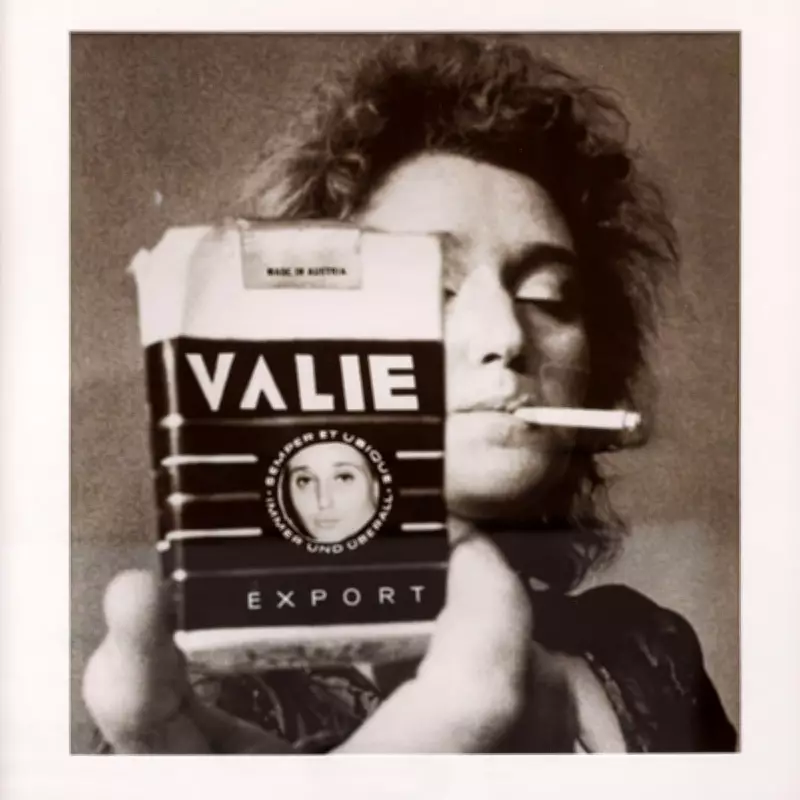
Valie Export, the fearless feminist performance artist who challenged patriarchal norms through provocative body art, has been remembered by the artists she influenced following her death last week. Her legacy, they say, lives on through her empowerment of others and her unflinching critique of societal structures.
Peaches: 'Her crotchless trousers are etched in my brain for ever'
Canadian musician and producer Peaches recalls first encountering the iconic poster of Export wearing crotchless trousers, legs spread, gun in hand. 'It was a fearless image that took my breath away,' she says. Export's 1968 performance Tapp-und-Tastkino (Tap and Touch Cinema), where she strapped a miniature theatre to her bare chest and invited passersby to reach through a tiny curtain, felt as important as Yoko Ono's Cut Piece. 'It was up to the spectators how they interacted with her, which could make for painful watching but always felt telling. I'm saddened that she is gone.'
Florentina Holzinger: 'The female body is not a polite object'
Austrian choreographer and theatre director Florentina Holzinger wrote a paper on Export at age 14. She reflects on Export's 1969 Genital Panic, where she walked into an experimental cinema in Munich wearing crotchless jeans, moving slowly row by row, forcing her exposed genitalia to eye-level with the seated audience. 'Fast forward to today: we are drowning in algorithmic thirst traps, free internet porn, and rotting political backlash trying to legislate bodies back into the dark ages,' Holzinger says. 'The core political necessity to subvert how we handle nudity and real bodies endures. Thank you, Valie, for paving the way and for articulating this reality with such crystal clarity: the female body is not a polite object.'

Joan Jonas: 'Passionate, brave and certainly generous'
American artist Joan Jonas describes Export as 'bold, radical, innovative, passionate, brave and certainly generous.' Her body was central, confronting architecture by men and serving as a vehicle for interactions. Unforgettable works include 1968's Grope and Touch, 1969's Genital Panic, and 1976's Encirclement. Export's own words about Homo Meter II (1976) explain her position: 'When I went out on the street with the loaf of bread tied around me and offered it as a gift, people were disturbed, perturbed and curious. They did not dare to cut off a piece with a knife. The loaf of bread was also meant as an extension of the body, a provocation... as an artist I was alone in many ways, and especially the confrontation with the public in the public space was something very isolating.'
Candice Breitz: 'She made a virtue of civil disobedience'
South African artist Candice Breitz says Export 'demonstrated to so many of us – with her fierce attitude and badass flair – that it was not necessary to live by the rules of those we could not respect. As a feminist provocateur, she made a virtue of civil disobedience, consistently claiming space that had for far too long been dominated by men.' In a 1968 intervention, she 'literally put patriarchy on a leash,' dragging curator Peter Weibel through Vienna on all fours. 'Her legacy will live on not only in her work, but also through her empowerment of those of us who continue in her footsteps.'
Shoair Mavlian: 'She understood the tools of mainstream media'
Shoair Mavlian, director of The Photographers' Gallery, London, notes that photography played a central role in Export's practice. In her Body Configurations series, she placed her body in urban public spaces, contorting to architectural structures. 'She understood the power of engaging with the tools of mainstream media and became one of the first female artists to critically examine representations of women in mass media using photography and film.' During her 2024 exhibition at the Photographers' Gallery, Export commented: 'We used the aperture of the film camera in the way to see things with our own eyes, with our own thoughts.' Her radical use of photography as a tool to document, record, and question influenced generations of female artists.