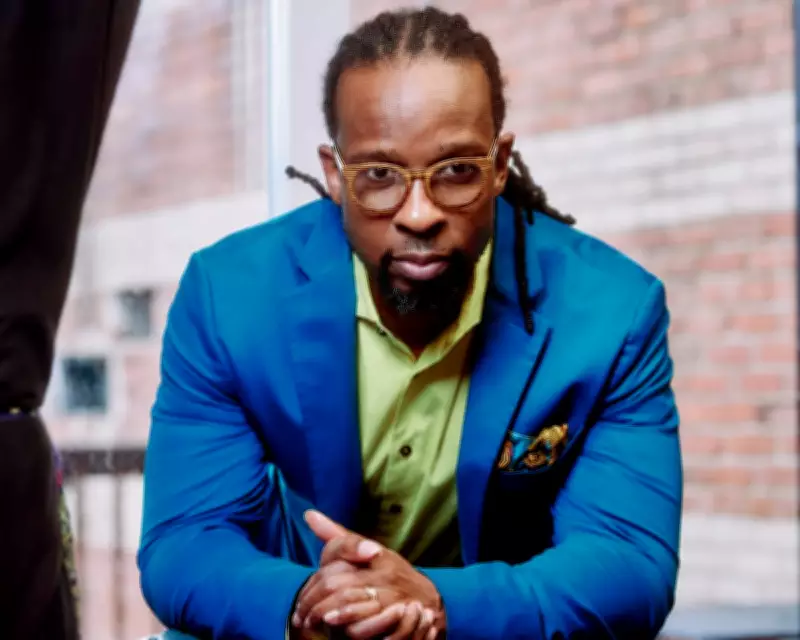
Historian Ibram X Kendi Issues Stark Warning on Global Political Trajectory
American historian Ibram X Kendi has articulated a dire prediction regarding the future of global governance, suggesting that within the next two decades, a significant portion of the world could be governed by racist dictatorships. In a comprehensive interview, Kendi delves into the mechanisms of far-right fear-mongering, the weaponization of divisiveness, and the alarming trend of book bans targeting his works.
The Binary Choice: Antiracist Democracy or Racist Dictatorship
Kendi, aged 43, presents an uncompromising framework in his latest publication, Chain of Ideas. He asserts that humanity confronts a critical dichotomy in the 21st century: the path toward antiracist democracy or the descent into racist dictatorship. "There is almost certainly a likelihood that in 20 years, the better part of Europe, and frankly the world, could be led by racist dictatorships," Kendi states. He traces this regression from monarchy to democracy to dictatorship, attributing it to pervasive fears of strangers and manipulated perceptions.
Confronting Book Bans and Character Assassinations
Kendi reflects on the personal and professional challenges he has faced, including the banning of at least seven of his books in the United States. According to PEN America, his works have been prohibited over 50 times across various school districts amid the anti-woke backlash. "I understood that the major reason why people were singling me out and demonising me was because they did not want people reading my books," he explains. When character assassinations proved insufficient, book bans became the tool of choice to suppress his narratives on racism.
Deconstructing Great Replacement Theory
The central focus of Chain of Ideas is the great replacement theory, a conspiracy theory that has transitioned from fringe to mainstream. Kendi analyzes how this theory posits that elites are facilitating the replacement of white populations through immigration, particularly by people of color. He connects this ideology to the rise of authoritarian governments globally, citing examples from Trump's America to Orbán's Hungary and Modi's India.
Kendi points out the theory's reliance on a racist binary between "eternal natives" and "eternal immigrants," where white people are seen as inherently belonging while people of color are perpetually foreign. He critiques this narrative by highlighting historical ironies, such as the extensive replacement enacted by white colonizers across continents, and the fact that immigrants often contribute more in taxes and commit fewer crimes than native-born citizens.
The Evolution of Racist Ideologies
As a scholar of racist ideas, Kendi emphasizes the progression and adaptation of racism. He draws parallels between contemporary far-right rhetoric and Nazi ideologies, noting that overt references to race or genetics have been replaced with coded language about cultural preservation and Christian identity. "They've essentially said that these people from Africa and the Middle East are changing the cultural makeup of Europe," Kendi observes, arguing that this reframing masks enduring prejudices.
He also discusses the proposed solutions by far-right movements, such as "remigration" and expansive detention facilities, which echo historical atrocities like concentration camps. Kendi warns that these policies are gaining traction, with parties like Reform UK advocating for the deportation of hundreds of thousands of individuals.
Personal Struggles and Resilience
Kendi's journey has been marked by significant adversity, including a battle with stage 4 colon cancer diagnosed in 2018. He underwent surgery and chemotherapy, which he credits with providing perspective amid external attacks. Additionally, he faced allegations of financial mismanagement at the Center for Antiracist Research at Boston University, which he founded with substantial funding. Kendi notes that he was ultimately cleared of all accusations, though the center closed in June last year due to dwindling support.
The Coordinated Backlash Against Antiracism
The historian details a coordinated effort by conservative activists to discredit critical race theory and related concepts. Christopher Rufo, a prominent figure in this movement, explicitly aimed to render the term "toxic" and labeled Kendi as "critical race theory's chief marketing officer." This campaign successfully shifted public discourse, overshadowing the genuine grievances of movements like Black Lives Matter with narratives of white victimhood.
Pathways to Accountability and Change
Kendi advocates for holding powerful figures accountable as a crucial step toward preventing authoritarianism. He references historical failures, such as the inadequate punishment of Hitler and his associates, and draws parallels to contemporary figures like Trump. "That is, frankly, the American tradition, which is to not hold, particularly racist, power accountable," Kendi remarks, linking this to ongoing societal struggles.
To foster antiracist democracy, Kendi emphasizes the need to improve material conditions for all people. By addressing poverty, inequality, and deprivation, societies can undermine the scapegoating narratives that blame immigrants and minorities. "The great replacement theory is a smokescreen for the real causes of poverty and deprivation: neoliberal capitalism and the huge inequalities it has created," he asserts.
Final Reflections on Human Manipulation
Kendi concludes with a poignant observation on human psychology and manipulation. "We're so easily manipulated into thinking that strangers are dangerous," he says. "The people who are dangerous are the people who are telling us that strangers are dangerous." This insight encapsulates his broader argument about the exploitation of fear to consolidate power and dismantle democratic institutions.
As Kendi prepares for a book tour across the United States, he remains both excited and apprehensive, aware of the risks inherent in speaking out during a polarized political climate. His work continues to challenge readers to confront uncomfortable truths and choose a path toward justice and equity.