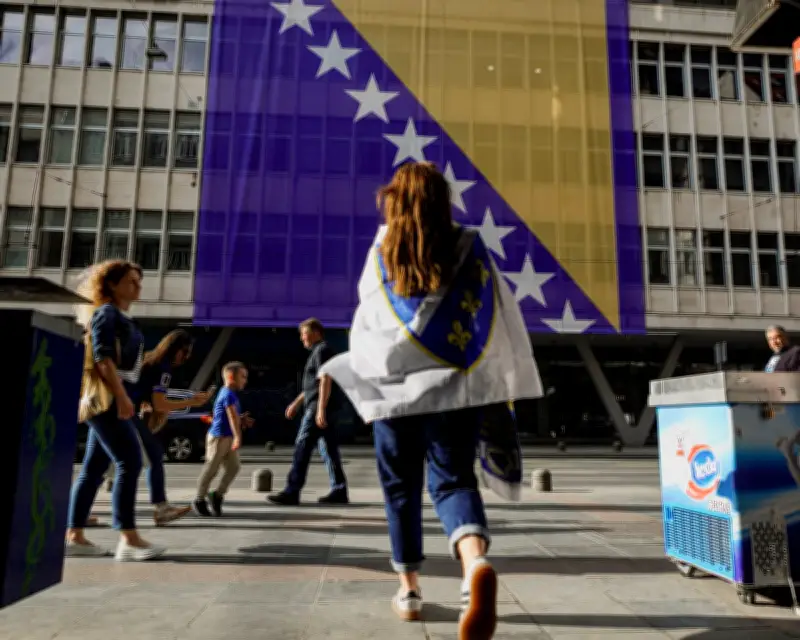
The historic lily flag is making a striking resurgence among Bosniaks during the World Cup, symbolizing defiance and a search for identity amid political uncertainty. The flag, featuring golden lilies on a blue shield against a white background, has deep roots in medieval Bosnia and was used during the 1992-1995 war. Its revival contrasts with the official national flag, a blue-and-yellow design imposed by the international community in 1998 after ethnic groups failed to agree on a symbol.
Symbol of Rejection and Hope
Reuf Bajrović, former energy minister and vice-president of the US-Europe Alliance, described the lily flag's resurgence as "basically a big FU" to the international community. He said it represents a "mass rejection" of foreign policies that have favored nationalist Serbs and Croats over Bosniaks. The official flag, while accepted as part of the peace deal that ended the war, evokes little emotional attachment, according to political analyst Ivana Marić. "People were prepared to put up with the new flag as a price of international acceptance, but nobody actually identified with it," she said.
Political Context and Generational Shift
The comeback comes as Bosnia faces deepening uncertainty. The US, once a key ally, has become unreliable under the Trump administration, which appears to support Serb separatists. The lily flag's popularity is especially strong among younger Bosniaks, who see it as a way to express ethnic identity unconstrained by external forces. A senior Bosnian army officer, who fought under the lily flag but now serves under the official flag, noted that his teenage daughter insists on using the lily flag. "For her, it is about pride in who we are as Bosniaks," he said. "It is all defiance. This younger generation believes in the nation even more than we did."
Football and National Division
The Bosnian football team reflects the country's ethnic divisions. While the squad includes seven Croats, the main Bosnian Croat nationalist party has suppressed celebrations in its areas, banning big screens for communal viewing. Manager Sergej Barbarez, from a mixed family, struggled to recruit Bosnian Serbs due to nationalist pressure. Milorad Dodik, the Serb leader, has quashed official support for the team, despite his nephew running the football federation. In Banja Luka, journalist Aleksandar Trifunović said the national team is "officially ignored," though people watch games privately.
Nuanced Popular Attitudes
Despite political divisions, popular attitudes are more nuanced. In Sarajevo, large crowds cheer for Croatia while wearing Bosnian kits. In East Sarajevo, streets display Serbian tricolors, but young men say they will watch Bosnia play and hope they win, calling the team "domaći" (domestic). In the Croat town of Kiseljak, a bar screened Croatia games to avoid provocations, but customer Stipo said most people cheer for Bosnia at home. "We are Croats, first and foremost, but we are Croats from Bosnia," he said.
Lily as a Reaction
Anes Hadžić, a Bosniak in Kiseljak, said the lily flag's return is a reaction to divisive behavior, such as a local bar flying the Swiss flag before a match. "Eighty per cent of the people here are fine," he said. "It is the politicians who are happiest when we are divided, so they can sell our land and our water from under us."