FCC Chair Claims Media Were Deceived in Colbert Censorship Dispute
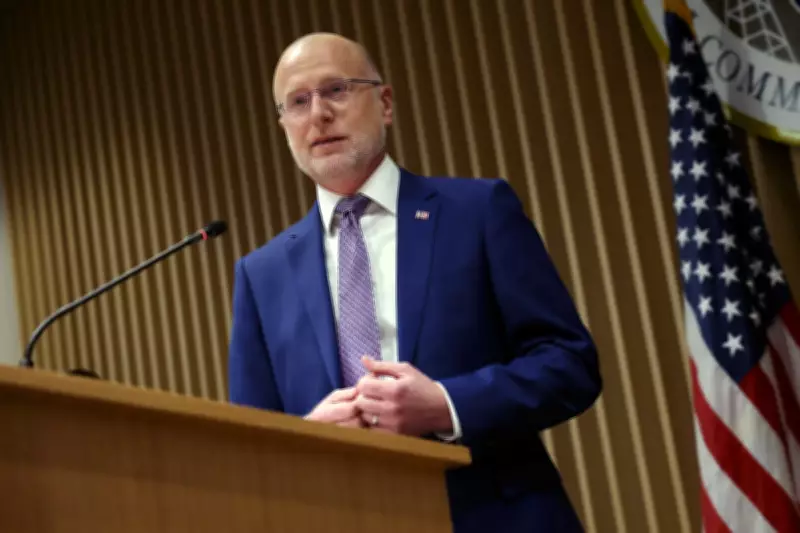
Brendan Carr, the chairman of the Federal Communications Commission (FCC), has made explosive claims that journalists were deliberately misled regarding the recent controversy involving late-night host Stephen Colbert. Speaking at a news conference following an FCC meeting at the agency's Washington DC headquarters on February 18, 2026, Carr asserted that media outlets had been "lied to" about Colbert's allegations of censorship.
Colbert's Allegations and CBS Response
The controversy began when Stephen Colbert, host of CBS's Late Show, claimed that both the Trump administration and his own network had prevented him from interviewing James Talarico, a Democratic candidate for Texas Senate. Colbert alleged this constituted censorship of political content on his program.
CBS quickly countered these claims in an official statement, clarifying that the network had not blocked the interview but had merely provided legal guidance. According to CBS, such an interview might trigger equal time regulations under the Communications Act of 1934, which would require Colbert to provide comparable airtime to Talarico's campaign rivals.

Carr's Strong Criticism of Media Coverage
"I think yesterday was a perfect encapsulation of why the American people have more trust in gas station sushi than they do in the national news media," Carr stated during his first public comments on the controversy. The avowedly pro-Trump FCC chairman added, "I think you guys should feel a bit ashamed for having been lied to and then run with those lies."
Carr emphasized that the FCC was simply enforcing existing regulations. "If you have a legally qualified candidate on, you have to give comparable air time to all other legally qualified candidates, and we're going to apply that law," he explained. "There was no censorship here at all."
Equal Time Rule and Network Exceptions
The equal time rule, enacted as part of the Communications Act of 1934, requires broadcasters to provide equal opportunities to all legally qualified political candidates. Networks can request exceptions for what are classified as bona fide news interviews, but Carr revealed that neither CBS nor ABC parent company Disney had pursued this option.
Historically, late-night and daytime talk shows had operated under the assumption that host-conducted interviews with politicians would qualify for the news interview exception based on past precedent. However, guidance issued by the FCC in January clarified that such programs would not automatically be eligible for exemptions.
Colbert's Response and Interview Outcome
Following his initial allegations, Colbert harshly criticized CBS's official statement contesting his version of events. The late-night host expressed surprise that the network had not consulted him before releasing what he described as a statement "written by a panel of lawyers."
Despite the controversy, Colbert ultimately aired his interview with Talarico exclusively on YouTube, where it accumulated nearly 5.5 million views—far exceeding the average traditional television viewership for The Late Show. The publicity proved beneficial for Talarico's campaign, which reported raising $2.5 million in the 24 hours following Colbert's initial comments.
FCC Enforcement Action Against The View
During the same news conference, Carr confirmed to reporters that the FCC has opened an enforcement action into ABC's The View regarding an appearance Talarico made on the program earlier in the month. While declining to provide specific details about the investigation, Carr emphasized broadcasters' responsibilities.
"Every single broadcaster in this country has an obligation to be responsible for the programming that they choose to air," Carr stated. "They're responsible whether it complies with FCC rules or not, and if it doesn't, those individual broadcasters are also going to have a potential liability."

Divergent Perspectives Within FCC
Anna M. Gomez, the lone Democrat on the FCC commission, offered a contrasting viewpoint. "This equal time rule issue is just one of a long pattern of this administration using the FCC to go after content it doesn't like," Gomez remarked in response to questions. "What you are seeing is using and weaponizing our enforcement process in order to pressure broadcasters to self-censor."
Gomez had previously criticized CBS for what she termed "corporate capitulation" in enforcing the equal time rule even before the network had received a formal complaint.
Industry Experts Voice Concerns
Gigi Sohn, who served as counselor to former FCC chair Tom Wheeler during the Obama administration, expressed concerns about potential unequal enforcement of regulations. "My feeling is that if Stephen Colbert is going to give James Talarico 20 minutes to basically give a campaign speech, then CBS should provide equal opportunity," Sohn stated in an interview. "In theory, I don't oppose what he's doing. What I worry about is that it's going to be unevenly unenforced."
Sohn further argued that the responsibility for requesting equal time opportunities lies with rival candidates rather than with the FCC proactively investigating programs. "It's not for the FCC to go around sniffing around what The View did three months ago," she noted. "If Carr sets his enforcement bureau out to find liberal bias shows and starts to go after them, that's not how the equal opportunities rule is supposed to work."
Colbert's Final Comments and Carr's Rebuttal
Colbert, whose show is scheduled to end in May, maintained that CBS lawyers had approved every word of his original script about the controversy. "They know damn well that every word of my script last night was approved by CBS lawyers who, for the record, approve every script that goes on the air," Colbert told viewers. "They told us the language they wanted me to use to describe that equal time exception. So, I don't know what this is about."
While emphasizing he didn't want an adversarial relationship with CBS, Colbert did take a shot at the network: "I'm just so surprised that this giant global corporation would not stand up to these bullies."
Carr concluded his remarks with a pointed criticism of Colbert, suggesting the host's impending show cancellation might be influencing his behavior. "That's got to be a difficult time for him. I get it," Carr said. "But that doesn't change the facts of what happened here."