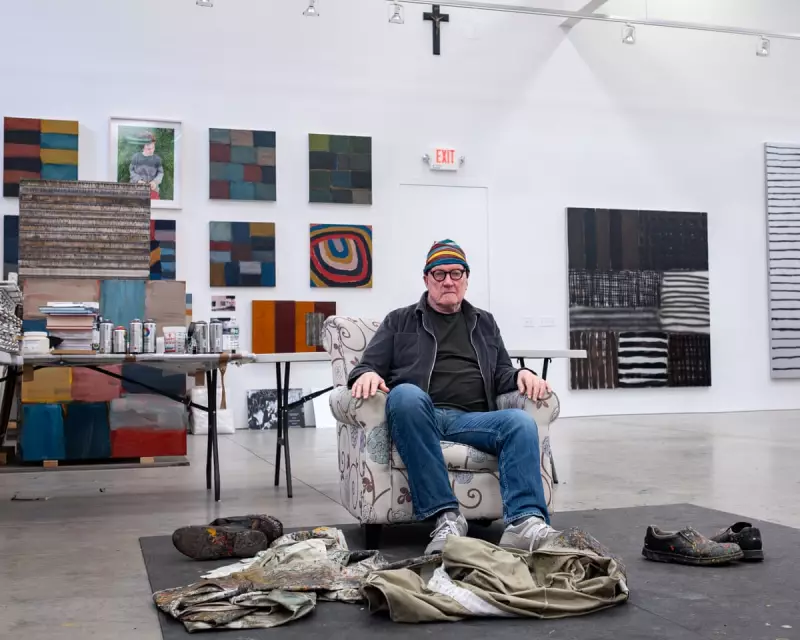
Sean Scully, widely regarded as the greatest living abstract painter, is channelling a lifetime of anguish into a powerful new series of works. Now 80, the artist's latest exhibition, 'Blue', at the Thaddaeus Ropac Gallery in Paris, transforms personal pain into a visual symphony of colour and form.
The Blues in Paint: A Lifelong Soundtrack
When asked to define the power of abstract art, Scully turns to music. He compares his work to the wordless intensity of jazz legends like Miles Davis and John Coltrane, rather than the lyrical pop of the Beatles. His paintings—composed of abutted rectangles, squares, and strips of colour—operate on a pre-verbal, emotional frequency. The new 'Blue' series resonates with the smoky, melancholic notes of a saxophone at midnight, mixing deep blues with blacks, reds, and browns in what he describes as a "slow, sad, beautiful music."
"I got interested in blue because I had the blues," Scully reveals, explaining the deep-seated sorrow that continues to drive his creativity. He confesses to a lingering terror of the dark, a vulnerability that contrasts with the boldness of his art. Beneath the orderly patterns of his compositions—reminiscent of ploughed fields or window panes—lies a storm of barely controlled feeling, a turbulence that foams more mightily than ever in his latest work.
A Shattered Foundation: The Roots of Anguish
Born in Dublin in 1945, Scully's life has been marked by rupture and conflict from the start. He moved to London as a small child, part of what he calls "a completely smashed-up family." Named after a grandfather who died by suicide in a British military prison in 1916, and with a father who also deserted from the army, Scully's early years were spent in a slum off the Old Kent Road.
His mother, described as a "hurricane" or a "monsoon," dominated his childhood. A profound scar was formed by a conflict between her and the "scary nuns" at his Catholic school. When she removed him from their influence at age seven, Scully suffered a nervous breakdown. "I lost my religion, and I’ve never been able to put it back together again," he says. "I’ve tried to put it back together with art."
This Anglo-Irish internal conflict—an "endlessly irresolvable dance between order and abandon"—remains the core engine of his work. Tragedy struck again in 1983 when his 18-year-old son, Paul, died in a car accident, grief that he says still feeds on itself.
Renewing Abstraction: From New York to Paris
Trained as a figurative painter in England, Scully moved to New York in 1975. He found the prevailing American abstract styles—from the last Abstract Expressionists to the Minimalists—to be emotionally empty. He is openly sceptical of Barnett Newman's grand spiritual claims and even found the revered Rothko Chapel in Houston "extraordinarily underwhelming."
Yet, Scully is undeniably their heir. He has spent decades infusing the minimalist grid with a romantic, vulnerable spirituality it often lacked. His new, intentionally small-scale 'Blue' paintings are not heroic statements but intimate, vulnerable objects. "I try to make abutments and unions and relationships that are difficult, strange, tender, poetic," he explains, reflecting on human connection and shared existence.
Despite his personal scepticism, he acknowledges the spiritual power of abstraction: "Abstract painting goes straight into your soul... It goes bang, straight inside." He draws a parallel to the opera aria 'Nessun Dorma', which can move listeners to tears without them understanding the words. "That’s what I’m trying to do. I’m trying to break people’s hearts," he states. "I want to make abstraction popular without lowering the bar."
Now dividing his time between New York, London, and Dublin, Scully finds joy in daily studio practice and family life with his teenage son, Oisin. Though he cannot reclaim his lost faith, he attends Catholic church for his son and surrounds himself with symbols—from a replica of Monet's bridge to statues of Buddha and an angel—in a continuing search for meaning.
The exhibition 'Sean Scully, Blue' is on view at Thaddaeus Ropac in Paris until 17 January, offering a profound glimpse into the heart of an artist for whom painting remains a vital, direct conduit for life's deepest pains and passions.