Wilhelm Sasnal's 'Family/History' Exhibition: A Disturbing Collision of Images
The Polish painter Wilhelm Sasnal has transformed the ground floor of Sadie Coles HQ's elegant London gallery into a provocative parade of broken images that challenge conventional visual narratives. His exhibition, titled Family/History, presents a startling juxtaposition of personal family moments with historical atrocities, creating what many viewers describe as an almost obscene visual experience.
The Fragmented Visual Landscape
Sasnal's collection features diverse subjects painted with unsettling proximity: the Oval Office interior rendered in acid greens and faecal browns stands beside a ghastly forest scene; a portrait of former US President Donald Trump with a cigarette-burn face shares space with the artist's tender depiction of his wife and daughter. These paintings, mostly untitled, function like broken online links—difficult to connect to their original sources yet impossible to ignore.
The exhibition's centerpiece reproduces at monumental scale the cover art of Throbbing Gristle's ironically titled album 20 Jazz Funk Greats. This cultural artifact, featuring the band posing in a bucolic landscape at Britain's most notorious suicide spot, Beachy Head, connects through Sasnal's artistic vision to his 2003 painting Shoah (A Forest), creating an uncomfortable association between avant-garde art and genocide.
Cinematic Montage Techniques in Painting
As both a film-maker and painter, Sasnal employs montage techniques familiar from cinema, asking viewers to bridge gaps between disparate images. This method becomes particularly challenging when attempting to connect his tender family portraits with the exhibition's themes of suicide, murder, and political corruption. The exhibition title itself—family/history—separates these concepts with nothing more substantial than a poetic line break, mirroring how social media platforms collapse boundaries between holiday snaps and global atrocities.
This visual approach reflects what Sasnal identifies as a contemporary crisis in visual perspective. Our attention has become scattered across multiple media platforms, unable to maintain the focused absorption characteristic of traditional portraiture.
Personal and Historical Intersections
Upstairs galleries feature more intimate works, including a portrait of Sasnal's son Kacper that reimagines Michelangelo's Creation of Adam with modern technology—the subject reaches from a book to a laptop, embodying our era's distracted attention. Nearby pastoral scenes showing solitary figures on riverbanks reference both Georges Seurat's Bathers at Asnières and William Tylee Ranney's The Lazy Fisherman, while carrying darker historical undertones.
Sasnal's grandmother once recounted how the river near his birthplace in Tarnów was thronged with bathers in the summer of 1939—a seemingly idyllic scene preceding historical catastrophe. This personal memory underscores the exhibition's central theme: nowhere, not even apparent utopias, remains safe from history's encroachment.
Diminishing Tension and Unresolved Unease
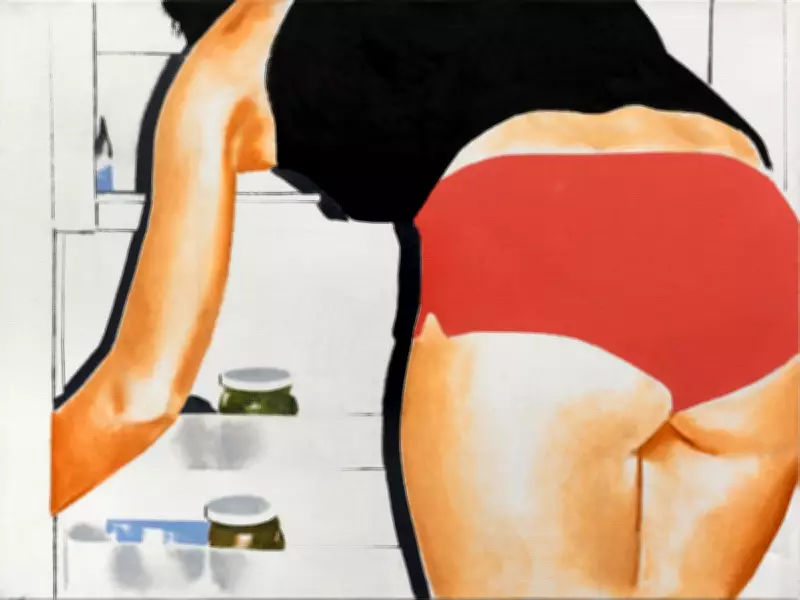
The exhibition's energy diminishes in the upper galleries, where family portraits and holiday scenes predominate without the dramatic historical collisions of the ground floor. Paintings of a band on stage and depictions of backsides in shorts feel banal by comparison, lacking the tension that makes the initial rooms so compelling.
This dissipation might be intentional, however. Unlike traditional montage that seeks to reveal higher truths through image juxtaposition, Sasnal's works resist easy interpretation. They generate profound unease by presenting the coexistence of good and evil without explanatory resolution. In the double portrait of his wife Rita and daughter Anka, the subjects face away from viewers toward a calm sea, seemingly shielded from the surrounding horrors yet unavoidably part of the same visual field.
The exhibition ultimately suggests that we cannot fully protect loved ones from history's reach, nor can we neatly explain away the disturbing proximity of beauty and atrocity in our visual culture. Sasnal's work serves as a powerful reflection of how digital media has flattened perspective, forcing personal and historical images to compete for attention in ways that feel both contemporary and deeply unsettling.
Wilhelm Sasnal: Family/History continues at Sadie Coles HQ, London, through 23 May.