Hamnet-Era Mourning Jewel Rediscovered After 400 Years in Historic Painting
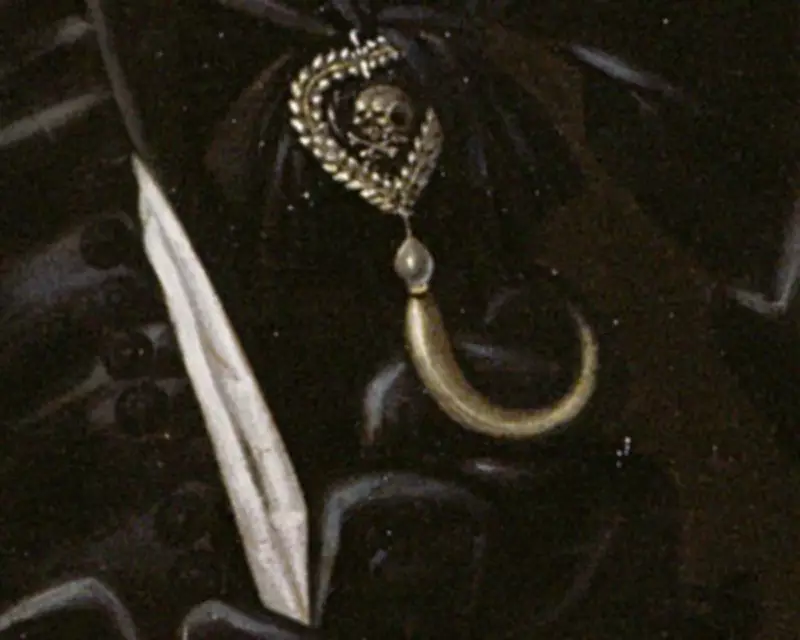
A remarkable Hamnet-era mourning jewel has been rediscovered four centuries after it was immortalised in one of Britain's most enigmatic and celebrated 17th-century family portraits. The heart-shaped pendant was depicted in Sir Thomas Aston at the Deathbed of His Wife, a 1635 life-size mourning masterpiece painted predominantly in black and white by the Cheshire artist John Souch, which hangs in the Manchester Art Gallery.
Poignant Family Tragedy Unveiled
Sir Thomas Aston's beloved wife, Magdalen, had died in childbirth months earlier and is depicted after death, lying beside the wicker cradle of their dead baby. Her bereaved husband, dressed in black, stands with their sole surviving child, three-year-old Thomas, who points to an inscription: "Grief is immeasurable." The family endured immense tragedy, as young Thomas died a year later, and their other children, Robert, Elizabeth, and Jane, also perished as youngsters.
In the painting, Aston wears the pendant made to commemorate the loss of Robert in 1634, aged just six. Its tassel was crafted from the child's blond hair. No one had imagined that this long-lost memento mori jewel had actually survived, making its rediscovery a significant historical event.
Detailed Artistry and Historical Significance
John Souch was an English portrait painter particularly admired for his rendering of details such as drapery and jewellery. Despite his precision in painting the pendant, it is only through the discovery of the actual object that its full meaning, details, and inscriptions can now be understood. Within a golden wreath, it is enamelled in black and white with a death's head skull and inscriptions in Latin on both sides, translated as: "Your Robert died 4 May 1634 ... In whom was our delight, through whom was our consolation, with whom the hope of his parents first perished." These inscriptions cannot be read from the painting alone.
The pendant had remained with the Aston family until its sale in 1862. The present owners acquired it 30 years ago, long after its poignant history had been forgotten. On a chance visit to an exhibition featuring Souch's painting, they spotted their depicted jewel and realised its significance, leading to this groundbreaking discovery.
Expert Insights and Emotional Resonance
Martyn Downer, an historian and specialist dealer in historical objects and works of art, was contacted about the find. He noted: "It's in wonderful condition, having spent most of the last 400 years unrecognised. The iconic painting has been studied by scholars over the years because it's full of symbols and metaphors. Recovering the jewel unlocks some of the questions about the painting." Downer drew parallels to Shakespeare's loss of his son Hamnet in 1586, a tragedy that inspired recent Oscar-winning films, highlighting the pendant's emotional depth: "At its heart is a man mourning the loss of his first son. We're all familiar now with the story of Hamnet. This is a few years later and it's very touching. Although it's quite a small object, it packs a lot of emotion into it."
The pendant has been valued at £650,000, reflecting its exceptional rarity, as jewellery from the 17th century is extremely scarce. Downer, a former head of jewellery at Sotheby's London, emphasised: "There's a great deal of interest in memento mori jewellery because it's loaded with feeling. This is not a jewel to display wealth or status. It's highly personal."
Tragic End and Future Prospects
Sir Thomas Aston himself came to a tragic end. He was a courtier, theologian, soldier, and poet who, having trained in law, entered parliament and served as high sheriff for Cheshire. Knighted by King Charles I, he fought for the royalist cause in the civil war before his capture by parliamentarian forces in Staffordshire. Aged just 44, he died from wounds received in attempting to escape.
Fiona Corridan of Manchester Art Gallery expressed excitement: "It's incredibly exciting to learn that the mourning pendant depicted in the painting exists and that it reflects the inscriptions in the painting. This intricate, beautiful piece is steeped in history, carrying a unique story of grief, love, and memory across centuries. It would be wonderful to find out more and perhaps re-unite the pendant with the painting."
Downer will unveil the pendant to the public at the Treasure House Fair at the Royal Hospital Chelsea, which runs from 24 to 30 June, offering a rare glimpse into this poignant piece of history.