The Vanishing Art Preserved in a Brussels Workshop
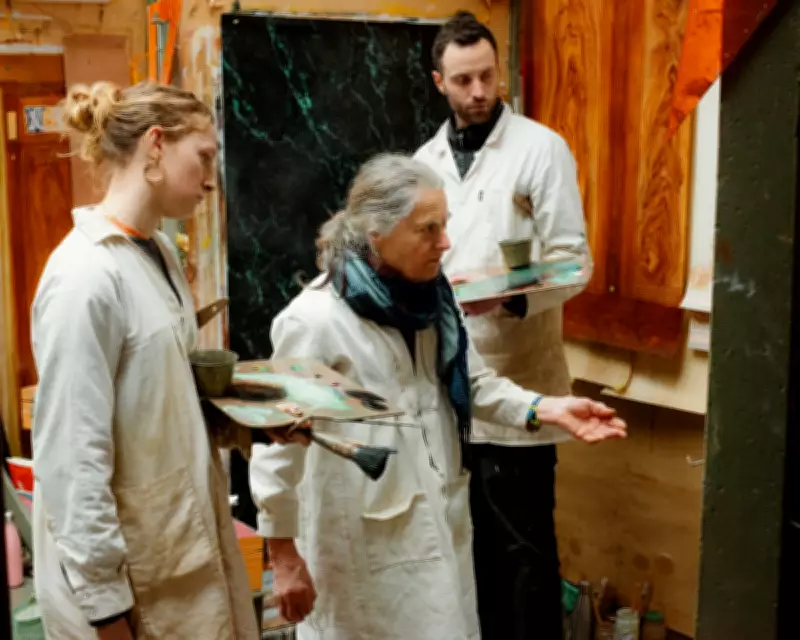
In a chilly, glass-roofed studio in Brussels, 28 students in white lab coats gather each winter morning to learn painting techniques that have remained virtually unchanged since 1892. The École Van der Kelen-Logelain, a family-run institution hidden behind a gothic brick townhouse, represents one of the world's last bastions of traditional trompe l'oeil painting education. Here, aspiring artists endure a rigorous six-month program that demands absolute dedication, silence, and tolerance for the cold emanating from a single wood-fired stove nicknamed "la mama."
A Discipline of Silence and Precision
The school's rules are uncompromising: students must arrive by 9am sharp or face exclusion until lunchtime; mobile phones and cameras remain strictly prohibited in the workspace; white lab coats must be worn at all times; and work proceeds in near-total silence. This austere environment serves as the backdrop for mastering specialized skills ranging from sign painting and gold leaf application to the manipulation of textural finishes. Yet the program's core focus remains trompe l'oeil—the art of creating three-dimensional illusions on flat surfaces.
"The first touch of the brush is generally the best," explains Sylvie Van der Kelen, who recently assumed leadership from her mother Denise. "It is preferable not to make revisions." During a demonstration last February, Sylvie painted a perfect, pink-tinged sky while students observed intently, knowing they would soon attempt to replicate her technique. Clouds, she reveals, should appear "elongated like the shape of the human body" rather than rounded.
The Brutal Rhythm of Panels and Operations
Students follow a schedule that has remained constant for over a century: workshops run from 9am to 6pm five days weekly, plus Saturday mornings. Each day begins with a new technique demonstration by a Van der Kelen family member, after which students produce exact copies on large sheets called "panels." These panels require multiple "operations"—distinct stages separated by drying periods for paints and varnishes—meaning students juggle numerous works simultaneously.
"It's brutal," confesses one British painter. "Every day you're learning something new, and just when you think you've mastered it, another panel arrives to cut you down." Homework often extends until midnight, and emotional breakdowns occur approximately weekly according to students. Yet despite these challenges, participants continue arriving from across the globe, drawn by the school's unique curriculum and the promise of acquiring vanishing artistic skills.
From Crisis to Revival Through Contemporary Art
The school faced existential threats in the mid-2000s as decorative painting fell out of fashion and enrollment dwindled to just 10-11 students—a stark contrast to the interwar peak of over 100. Competitors had closed, and the Van der Kelen seemed destined for the same fate until Scottish artist Lucy McKenzie discovered the institution in 2007. Already an established contemporary artist, McKenzie enrolled and subsequently used trompe l'oeil techniques to create acclaimed large-scale works exhibited at Tate Britain, the Stedelijk Museum, and the Art Institute of Chicago.
"Lucy McKenzie has a lot to answer for," remarks one current student cheerfully, acknowledging how her work sparked renewed interest in the school. McKenzie herself describes the institution as "a national treasure" that "should be Unesco protected," despite its conservative aspects. Her advocacy, combined with a growing resurgence of interest in decorative arts, has steadily increased enrollment in recent years.
Cycles of Fashion and Fundamental Preservation
Sylvie Van der Kelen observes that demand for trompe l'oeil follows approximately 40-year cycles, with peaks in the 1920s-30s and 1970s-80s followed by decline. By the mid-2000s, the school was considered "something a little bit dusty," yet recent exhibitions at major institutions like the Metropolitan Museum of Art and adoption by fashion houses including Loewe and Louis Vuitton have revived appreciation for the form.
The technique itself has experienced fluctuating prestige throughout history—celebrated by ancient Greeks and Renaissance masters yet dismissed as mere "trickery" by critics like John Ruskin. Often associated with periods of significant inequality, trompe l'oeil appeals to contemporary luxury brands seeking visual illusion in their collections.
A Family Legacy Facing the Future
Now in its fourth generation of family leadership, the school charges €13,750 for its comprehensive program including tools and materials. While some critics might dismiss it as a reactionary institution, Sylvie and her mother Denise emphasize their mission to preserve techniques taught nowhere else. "They all discover something in themselves, working here," Denise reflects, referring to students as "my kids."
Sylvie, who previously worked as an archaeologist studying ancient trompe l'oeil examples in Egypt and Pompeii, always knew she would return to the family business. As for the next generation, her 10-year-old son Hilaire occasionally expresses interest in continuing the legacy. "It is a really nice job that he is going to learn," declares Denise confidently. "I think he will be convinced."
For now, the workshop continues its seasonal rhythm, transforming aspiring painters into masters of illusion through discipline, tradition, and what Sylvie describes as everyone's search for "something special" in this unique Brussels institution where history remains vividly alive on every brushstroke.