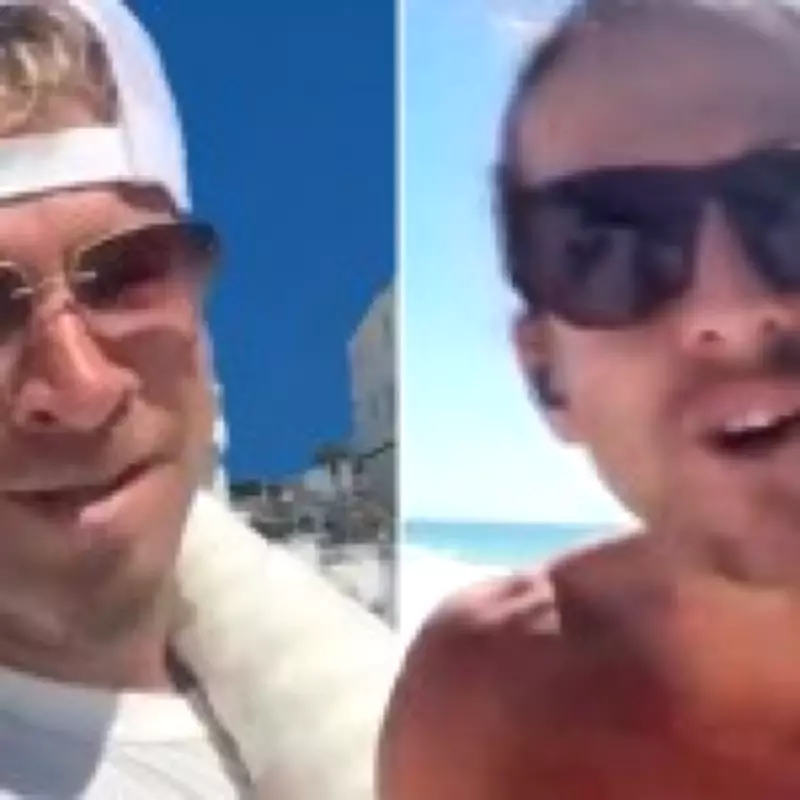
Backstreet Boys Singer Faces Backlash Over Beach Confrontation
Backstreet Boys star Brian Littrell has ignited significant controversy online following a heated exchange with a sunbather on a Florida beach. The 51-year-old singer, famous for hits like "Everybody" with bandmates Nick Carter, Howie Dorough, AJ McLean, and Kevin Richardson, confronted beachgoer Kyle Gallagher outside his multimillion-dollar mansion in Santa Rosa Beach, Florida.
The Confrontation Unfolds
Littrell approached Gallagher, who was relaxing on his towel by the water, and began filming him from behind. Gallagher, initially unaware due to wearing headphones and scrolling on his phone, jumped up startled when he realized he was being recorded. The situation quickly escalated into an intense argument.
"You cannot be putting s**t in my face, bro," Gallagher stated, reaching out to push the phone away. Littrell warned him, "Don't test me." As Gallagher stood up and told Littrell to "get out of my f***ing face," the singer became defensive, saying, "You can't grab my phone, dog." Gallagher then started filming in retaliation.
During the quarrel, Gallagher asserted he had "lived across the street for 20 years" and wouldn't be left alone. Littrell responded, "I will," to which Gallagher laughed and said, "No, you will not." The exchange grew more heated, with Gallagher shouting, "You came and shoved your phone in my face, bro. You're lucky I didn't knock you the f**k out."
Allegations and Denials
Social media users claimed Littrell used a homophobic slur during the argument, specifically when he asked Gallagher, "You wanna be gay?" and called him a "p***y." Littrell has firmly denied these allegations through his attorney, Peter Ticktin, who stated, "Despite claims of what people online heard, Littrell did not use a homophobic slur in the clip."
The footage has circulated widely online, drawing criticism from many viewers. User @FFAFamily wrote on X that Littrell "is the problem," adding, "He may own up by his house but definitely not by the water!" Others, like @shermjanae, called him a "whole Karen," while @AncientArgonaut commented, "So basically it's a public beach and Brian felt the need to come down and harass the beach goer."
Legal Battles and Property Rights
Following the incident, Littrell attempted to press criminal charges against Gallagher. Deputies visited Gallagher's home the next day, where he explained he felt threatened by the phone being shoved in his face and reacted reflexively. Walton County authorities dropped the matter, concluding the video evidence showed insufficient criminal intent.
This led Littrell to sue the county last month, alleging failure to protect him against trespassers. A judge dismissed this lawsuit, prompting Ticktin to say, "Littrell was assaulted by a hostile beach protester. A report was made to the feckless sheriff's office. The assault was awful enough, but the fact that the sheriff's office is not enforcing the law makes our whole community one of greater danger."
Littrell's legal team argues the beach is his "backyard," as he purchased the property in 2023 for $3.8 million. However, Visit South Walton reports that public access to privately owned beaches is allowed up to 20 feet landward from the wet/dry sand line, known as the Transitory Zone, where sunbathing is permitted from 9am to 4pm.
Family Impact and Ongoing Issues
The quest for privacy has been an ongoing struggle for Littrell and his family, including wife Leighanne, 56, and son Baylee, 23. They claim alleged trespassing has caused "emotional distress." Leighanne told Fox News, "It's scary to have to be in this small community with a lot of angry people, honestly, and then making us out to be these monsters that we're not. We love this town, but now we don't know where to eat because of who hates us."
Ticktin emphasized in a statement to The Independent, "Mr Littrell and his family purchased what they saw as their dream home, only to discover an ongoing pattern of trespassing and harassment targeting private property owners along their and their neighbours' stretch of beach. These actions are not about public access; public beaches exist on both sides of the neighbourhood and remain open and uncrowded. Instead, certain individuals appear intent on challenging the very concept of private property rights."
Despite the legal dismissals and public criticism, Littrell's attorney maintains that homeowners are entitled to safety and privacy on their property. The incident highlights broader tensions between private property rights and public beach access in coastal communities.