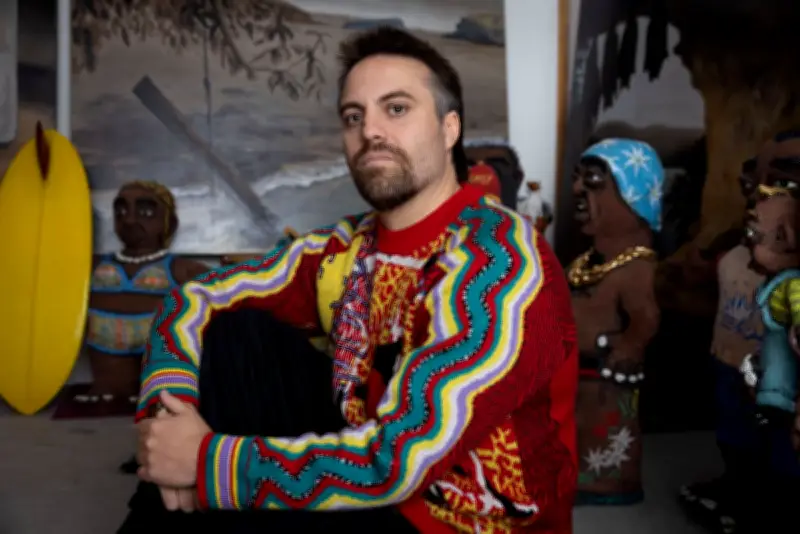
Dharug artist Billy Bain is reclaiming the Australian beach as an Indigenous space through his upcoming solo exhibition 'By the River' at the Art Gallery of New South Wales (AGNSW). The exhibition features 11 colourful clay sculptures of Indigenous family members dressed in bikinis, shorts, and budgie smugglers, challenging the dominant image of the bronzed Aussie beachgoer.
Personal experiences of exclusion
Growing up in Avalon on Sydney's northern beaches, Bain often felt like an outsider while surfing. 'I'd be told that I'm not from there, so I need to go in [to shore],' he recalls, interpreting these warnings as veiled threats of violence. 'Otherwise, you know, something's gonna happen to you.' Now 33, Bain sees his presence as an Aboriginal surfer as a form of reclaiming space. 'The beach was and still is an Aboriginal space, but in popular culture it has been represented as a very white space,' he says.
Exhibition details and symbolism
'By the River' runs from 4 July to 8 November at AGNSW. The show includes five landscape paintings of the Dyarubbin/Hawkesbury River, which connects Bain's upbringing on the northern beaches to his ancestral country. The river flows into an estuary at Pittwater, making surfing there a cultural return for Bain. He draws a parallel with the eel, which spawns at sea and returns to river systems: 'I see the story of the eel ... as an interesting metaphor for a return.'
The clay figures will hold a four-metre-long soft sculpture of a long-finned eel, a totem animal known in Dharug language as burra. The eel is made of cloth on a wire and steel frame, adorned with 200 textile elements handwoven by Bain's mother, Kathleen Bain. Kathleen, a Dharug woman, encouraged her children to create with various materials; Bain often made faces and figures from wax scraped off his surfboards.
Artistic process and family involvement
Bain's father, champion surfer Rob Bain, also contributed to the exhibition. They took a small boat up the Dyarubbin, bush bashing along cliffs and finding ancient Aboriginal handprints in caves, which informed Bain's landscape paintings. During one trip, they saw graffiti that read 'Do not deface Aboriginal rock art,' which Bain describes as 'an obnoxious warning, more overbearing than the tags people had done.'
Painting landscapes is new for Bain, who previously painted portraits. His oil work of western Aranda deaf artist Rona Panangka Rubuntja and her dog, Pig, was a finalist in the 2025 Archibald Prize. Bain is colour-blind, which has affected his confidence with painting. 'Being colour-blind has probably hindered me, in a way, as far as confidence with painting, because I felt maybe I'd be getting something wrong,' he says.
Art as healing and reconciliation
Bain describes his art practice as 'a healing thing' and 'a massive part of learning to express myself.' In 2023, he painted a self-portrait in pink tones, looking upset and angry, the night after the failed Indigenous voice to parliament vote. The portrait is now owned by a private collector. 'I find it funny, someone looking at my grumpy face on their wall,' he says, laughing.
Bain believes that fun and humour in art can convey serious ideas. 'I don't exactly know what reconciliation looks like,' he adds. 'But I am hopeful and I do have quite a positive look on the human spirit and people's ability to be good-natured and embrace other people. I think that's intrinsic in us as humans.'