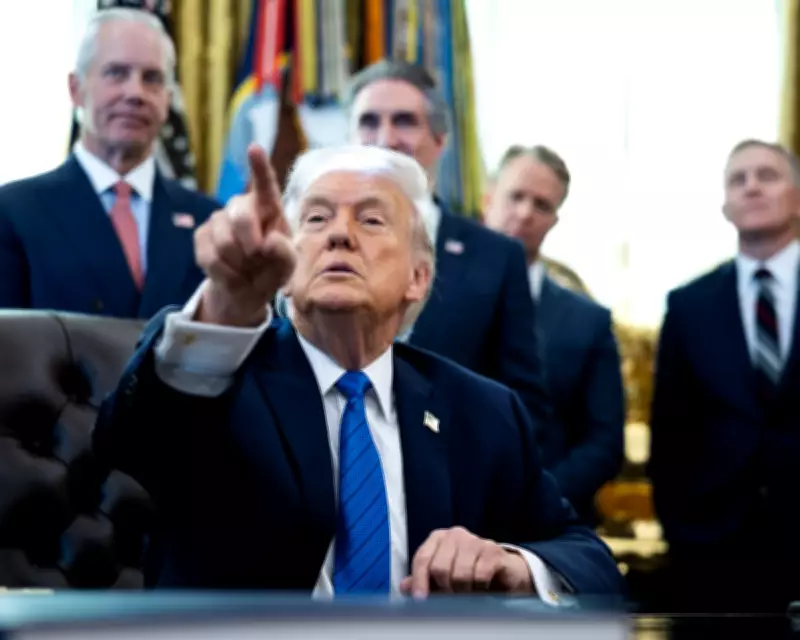
Donald Trump has signed executive orders in the Oval Office at the White House in Washington DC, setting the stage for a controversial new addition to the capital's skyline. According to reports, the US president is pushing forward with plans to construct a monumental arch that would significantly overshadow some of the city's most iconic landmarks.
A Monumental Vision for the Capital
The proposed structure, named the Independence Arch, is envisioned to reach a staggering height of 250 feet. This would make it substantially taller than the 100-foot-tall Lincoln Memorial and even surpasses the 164-foot Arc de Triomphe in Paris. However, it would remain less than half the height of the world's tallest arch, the Gateway Arch in St Louis, Missouri.
The Washington Post reported that Trump has identified a potential site for this ambitious project on a plot of land near Memorial Bridge over the Potomac River. This location falls under the jurisdiction of the US National Park Service and sits between the Lincoln Memorial and Arlington National Cemetery, raising significant concerns about its impact on the existing memorial landscape.
Architectural Concerns and Historical Context
The scale of Trump's proposed arch has already alarmed architectural experts and preservationists. Catesby Leigh, an art critic who originally conceived of a more modest arch in a 2024 essay, expressed serious reservations about the current plan. "I don't think an arch that large belongs there," Leigh told the Post, suggesting alternative locations such as Barney Circle in south-east Washington DC which overlooks the Anacostia River.
Leigh had initially proposed a temporary 60-foot arch to mark the 250th anniversary of the US Declaration of Independence. However, Trump has opted for a permanent design four times larger, reportedly to be funded with leftover donations from the $400 million White House ballroom project. The president is already constructing a new East Wing to the White House containing an 89,000 square foot ballroom that will be larger than the White House's current 55,000-square-foot footprint.
John Haigh, chairperson of Benedictine College's architecture program, emphasized the solemn nature of the proposed location, describing it as "a very somber corridor" that includes the sightline of Arlington National Cemetery, Memorial Bridge, and the Lincoln Memorial.
Design Evolution and Presidential Enthusiasm
Trump has reportedly considered more modest arch designs, including versions standing 165 feet and 123 feet high, which he shared at a dinner in 2025. However, the president has decided to pursue the 250-foot version, partly because the number mirrors the 250th anniversary of the US Declaration of Independence in July. People at the dinner quoted Trump as saying: "250 for 250 makes the most sense."
At a White House Christmas reception, Trump reportedly told guests: "The one that people know mostly is the Arc de Triomphe in Paris, France. And we're gonna top it by, I think, a lot." The president has appointed Atlanta philanthropist and developer Rodney Mims Cook Jr, president of the National Monuments Foundation, to the Commission of Fine Arts that would theoretically oversee the arch project.
Nicolas Leo Charbonneau, an architect recommended by Leigh, has reportedly been retained by the White House to work on the project. Charbonneau had previously posted enthusiastically on social media: "America needs a triumphal arch!" alongside a rendering of the proposed structure.
Potential Impacts and Ongoing Controversy
The proposed arch's location raises multiple concerns beyond its sheer scale. Architectural experts worry it could:
- Reshape the existing relationship between the Lincoln Memorial and Arlington National Cemetery
- Obstruct pedestrians' views in the memorial corridor
- Create thematic discord by placing a celebratory arch on Memorial Circle amid solemn memorials
- Alter the symbolic representation of peace between the Union and Confederacy that Memorial Bridge represents
The Post noted that Washington DC is unusual among major world cities for lacking a triumphal arch to commemorate national achievements. Trump told Politico in December that he hoped to begin construction of the arch within two months, and earlier in January he posted images to his Truth Social platform of three potential designs, including one with gold gilding.
As plans progress, the Independence Arch proposal continues to generate debate about architectural scale, historical appropriateness, and the future of Washington DC's memorial landscape, with preservation groups already having sued over Trump's White House ballroom project.