Each morning at seven o'clock, groups of women assemble outside clothing factories in Maseru, the capital of Lesotho, clutching the faint hope of securing a day's work. This daily vigil has grown increasingly desperate since April 2025, when former US President Donald Trump imposed sweeping global tariffs, drastically reducing opportunities in this southern African nation.
The Human Cost of Trade Policy
For 48-year-old Moleboheng Matsepe, the economic chill is a harsh reality. She lost her full-time position sewing sports leggings for the American brand Fabletics in 2023. After managing on short-term contracts, she has found no work since September. "The pressure is too much … We can’t even sleep at night," she confesses. Now supporting five family members, she scrapes by on roughly 50 maloti (£2.23) a week from occasional laundry jobs.
Her story is echoed by Mapuseletso Makhake, also 48, who struggles to afford sanitary towels and school fees for her daughter. Having not worked since a brief packing contract in late 2024, she tearfully describes the burden of providing for her son and elderly father alone. "My heart breaks every time, because I don’t like the life I am living," she says.

A Pillar of the Economy Under Threat
Lesotho's garment sector, a cornerstone of its economy, once employed 50,000 people at its 2004 peak. This growth was fuelled by the African Growth and Opportunity Act (Agoa), a US trade initiative launched in 2000 that granted tariff-free access for thousands of African products. The act expired at the end of September amid a US government shutdown and awaits Congressional renewal.
Today, the trade ministry reports approximately 36,000 textile workers, predominantly women, remain in the country. A third produce clothing for the US market, including jeans for Levi’s and Gap. While monthly wages can be as low as 2,582 maloti (£115), these jobs are vital in a nation where official 2024 unemployment stood at 30%.
The Impact of 'Reciprocal' Tariffs
The crisis deepened in April 2025 with Trump's announcement of "reciprocal" tariffs, calculated on trade imbalances. Based on 2024 figures where Lesotho exported $237m of goods to the US but imported only $2.8m, the initial formula suggested a staggering 50% tariff. Although later reduced to 15%, the impact has been severe.
Lesotho's Trade Minister, Mokhethi Shelile, argued his country was treated like a "pariah state" by an administration that claimed it was a nation "no one had ever heard of." The economic consequences are quantifiable: in June, the central bank revised its 2025 and 2026 growth forecasts down by 1 percentage point each, to 1.1% and 0.9% respectively.
A government survey in August revealed the sector's distress. Of 15 US-exporting companies, 12 responded reporting 400 lay-offs. Five were operating at just 5-30% capacity, and three had ceased operations entirely.
Factory Floors Feeling the Pinch
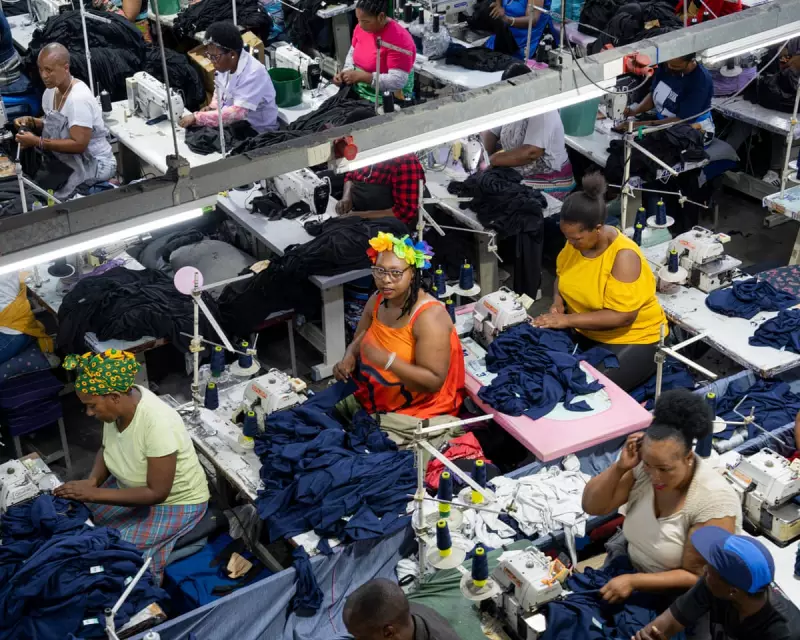
The scene at Ever Successful Textiles illustrates the strain. Hundreds of machines produce black Reebok tops for America and children's leggings for South Africa. However, HR manager Malefetsane Phahla confirms only 80% of the 470 machines are running, with staffing down from 650 in 2024 to 550 now.
The shift in markets brings a stark financial difference. Order forms show the factory receives $5 (£3.71) per piece for US orders, compared to a mere 5 rand (£0.23) for South African ones. While Minister Shelile confirms a strategic pivot towards the South African market, he emphasises the continued need for US dollars to import essential goods and maintain the loti currency's peg to the rand.
A Fragile Path Forward
A glimmer of hope emerged on 10 December when the US House Ways and Means Committee voted for a three-year Agoa extension, though the Trump administration supports only a one-year renewal. Shelile hopes a three-year deal will pass Congress by January's end, preventing even higher future tariffs. However, the existing 15% levy would remain. He argues it must be cut to 10%—the rate applied to Eswatini, Ethiopia, and Kenya—for Lesotho to stay competitive.

As these high-stakes negotiations continue, the women of Maseru keep their daily vigil at the factory gates, their livelihoods hanging in the balance of international trade policy.