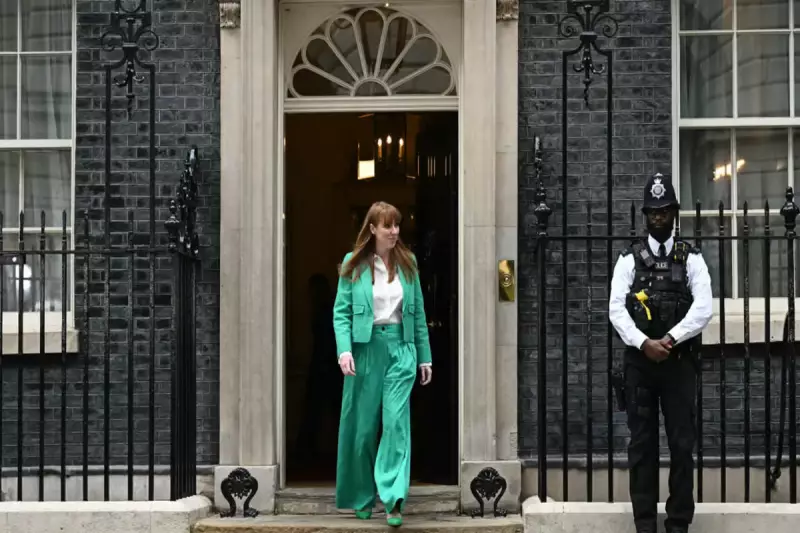
Senior financial analysts have identified a potential premiership for Angela Rayner as one of the most significant threats facing the UK banking sector in 2026. The warning comes as Sir Keir Starmer battles to maintain his leadership amid poor polling figures, with his former deputy frequently tipped as a successor.
Market Jitters Over a Potential Rayner Premiership
The concern stems from fears that a government led by the figurehead of Labour's left wing would pursue a markedly less bank-friendly agenda than the current status quo. Under Chancellor Rachel Reeves, the sector has enjoyed a close relationship with the Treasury, escaping a predicted tax raid in both of her Budgets. This rapport contributed to a bumper stock surge for banks in 2025, which far outperformed the wider City index.
Equity analysts Jonathan Pierce and Priya Rathod cautioned that "potential for change at the top of Government may hang over the sector." Their concerns were echoed by John Cronin of Seapoint Insights, who noted that while executives are pleased with Reeves's stance, it is unclear if a new Chancellor would push regulatory loosening with the same vigour.
The Leaked Memo and Tax Hike Fears
The root of the banking industry's anxiety can be traced to a leaked memo from May 2025, penned by Angela Rayner to Rachel Reeves. In it, Rayner lobbied for a significant increase in the bank surcharge, raising it from two per cent to five per cent. This move would effectively lift the sector's total corporation tax rate to 30 per cent.
Although this specific proposal was not enacted in the November Budget, the overall tax rate on UK banks still rose by 0.6 per cent to 46.4 per cent, widening the competitive gap with other global financial hubs. Analysts at Jefferies pointed to a scenario of Rayner as Prime Minister with Torsten Bell as Chancellor as likely to "lift bank taxes, as proposed in the former’s leaked memo."
The City's Preferred Alternative
In contrast, the financial markets would view some other potential leadership combinations more favourably. Prediction markets currently estimate a 25 per cent chance of a harder-left Prime Minister by the end of 2026. More reassuringly for investors, the most likely replacement for Rachel Reeves is seen as the current Work and Pensions Secretary, Pat McFadden.
Pierce and Rathod stated that a government led by Wes Streeting and Pat McFadden is considered somewhat more probable than one led by Angela Rayner and Torsten Bell, and "this could be viewed positively by the market." McFadden has built a reputation for fiscal discipline, recently insisting that welfare reform "must happen."
However, analysts issued a clear warning: any shift towards a less market-friendly leadership would 'clearly' subvert investor risk appetite and keep bank stock prices under pressure. While the 'status quo' remains the most probable outcome, the mere possibility of change is casting a shadow over one of the City's best-performing sectors.