
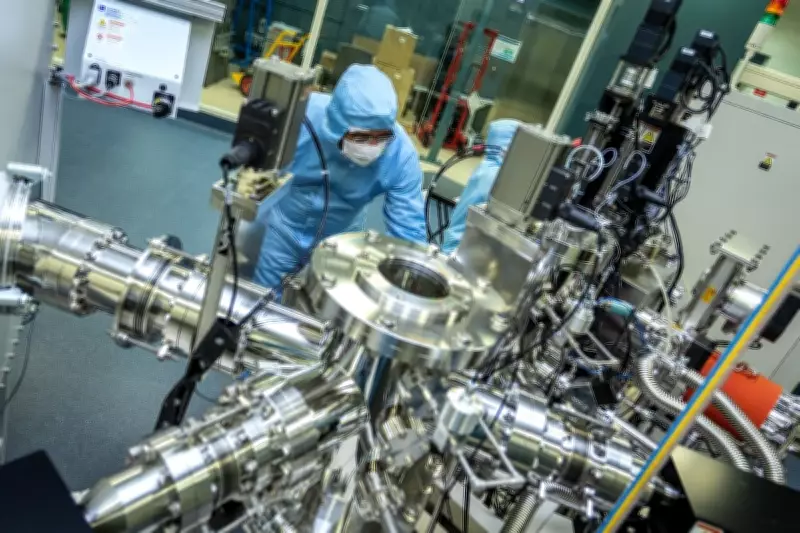
Australian Scientists Unveil World's First Quantum Battery Prototype
Australian scientists have announced the creation of what they claim is the world's first proof-of-concept quantum battery, a groundbreaking development in energy storage technology. This prototype, which operates on the principles of quantum mechanics, represents a significant leap toward fully functional batteries capable of charging almost instantaneously.
How Quantum Batteries Work
Quantum batteries, first theorized in 2013, utilize quantum mechanics to store energy, potentially offering greater efficiency than traditional batteries. The new prototype, developed by researchers at Australia's national science agency, CSIRO, is charged wirelessly using a laser. According to lead researcher Dr. James Quach, this marks the first time a battery has completed a full cycle: charging, storing energy, and discharging in a quantum system.
In conventional batteries, charging time increases with size, explaining why devices like mobile phones take around 30 minutes to charge and electric vehicles require overnight charging. In contrast, quantum batteries exhibit a unique property where larger sizes result in faster charging times, thanks to "collective effects" that accelerate charging as more quantum cells are involved.
Breakthrough in Charging and Storage
The prototype, detailed in the journal Light: Science & Applications, charges in femtoseconds—quadrillionths of a second—and stores energy for nanoseconds, which is approximately six orders of magnitude longer than the charging time. Dr. Quach illustrated this by noting that if a battery took one minute to charge, six orders of magnitude would equate to a storage duration of "a couple of years."
However, the current model has a limited capacity of only a few billion electron volts, insufficient for powering practical devices. Dr. Quach emphasized that the next critical step is to extend the storage time beyond nanoseconds to make it viable for everyday applications, such as mobile phone usage.
Potential Applications and Future Prospects
Fully developed quantum batteries could revolutionize various fields by providing rapid, wireless charging. Potential uses include powering quantum computers, small electronic devices, and enabling remote charging for drones or electric vehicles on the move. Dr. Quach envisioned scenarios where drones could be charged mid-flight or cars could recharge without stopping at stations.
Professor Andrew White, who leads the quantum technology laboratory at the University of Queensland and was not involved in the study, praised the research as "a really nice piece of work" that demonstrates quantum batteries are more than just theoretical. He predicted that while these batteries won't appear in electric vehicles soon, they could first impact quantum computers by delivering energy coherently with minimal energy loss.
This advancement underscores Australia's role in pushing the boundaries of quantum technology, with ongoing efforts focused on scaling up storage capabilities and exploring real-world implementations.




