The Phantom AI Supercomputer: UK's Tech Ambitions Meet Reality
In the world of artificial intelligence, timelines are often as ambitious as the technology itself. It generally takes 18 to 36 months to construct a hyperscale AI site – the kind required for one of the world's most powerful supercomputers. Yet, in Loughton, Essex, a project heralded as a cornerstone of the UK's AI revolution remains far from this benchmark.
From Press Release to Scrap Metal Site
Government announcements in 2025 painted a picture of a gleaming supercomputer facility on the outskirts of north London, complete with glass and concrete architecture rising from tree-lined streets. Artist's impressions showed a futuristic hub, accompanied by images of glowing blue robot faces, symbolizing a technological leap forward. By the end of this year, that vision was supposed to materialize.
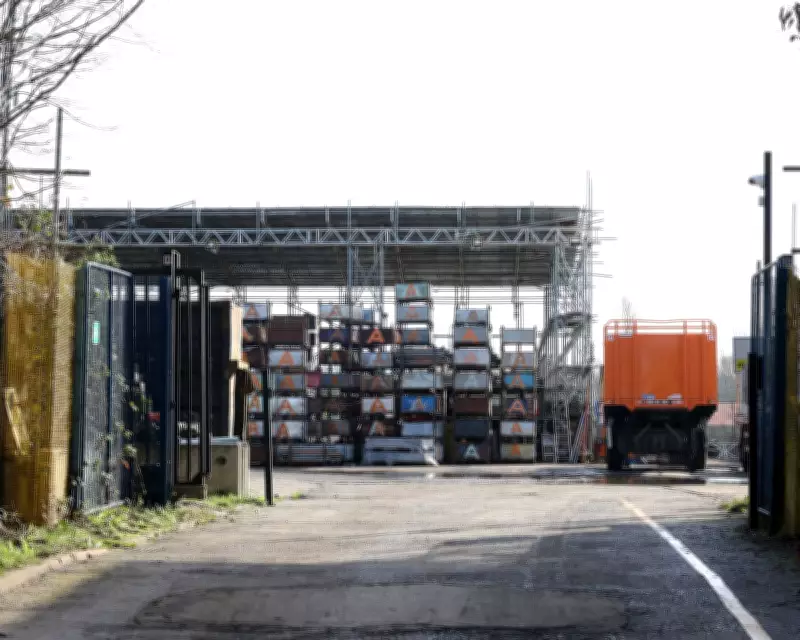
However, a recent visit by journalists revealed a starkly different scene. The four-acre plot in Loughton is currently a depot stacked with pylons and scrap metal under a corrugated roof, with flatbed lorries transporting poles in and out. Nine months before the project's scheduled completion, it functions solely as a working scaffolding yard.
The Global AI Investment Frenzy
The Loughton supercomputer story offers a window into the dizzying ambitions for AI as an economic powerhouse, both in the UK and globally. Billions of dollars, along with the fortunes of governments, banks, and pension funds, are staked on the promises of a few massive companies to rapidly build AI infrastructure and reshape the global economy.
Nvidia's CEO, Jensen Huang, expressed confidence in the UK as a hub for AI investment during visits in June and September 2025. At London Tech Week, he shared the stage with Prime Minister Keir Starmer, praising the UK's tech ecosystem as "the envy of the world." Later, he urged investors to back the UK "if they want to get rich" and predicted the nation would become an "AI superpower."
Questionable Commitments and Phantom Investments
Despite these bold proclamations, key investments scrutinized by investigators are not as they appear. Massive financial commitments often lack substance as tangible contributions to the UK's economy. Many "new" datacentre projects turn out to be old buildings retrofitted with new chips.
This issue is not confined to the UK. A recent report indicates that half of the world's datacentre projects slated for completion this year may face delays. In the US, OpenAI's $500 billion Stargate project has been significantly postponed due to stakeholder disputes.
Cecilia Rikap, a professor of economics at University College London, notes, "There has been a lot of narrative crafted by tech companies that links AI to economic growth. Companies claim that they are doing this big investment. But it is a narrative that doesn't hold water."
The Loughton Supercomputer: A Case Study
The Loughton supercomputer, announced by the government in 2025 as part of a plan to "turbocharge" the economy, was reported to be three times as powerful as the fastest supercomputer in the US. The developer, Nscale, is a small London startup with no prior experience in building datacentres.
Nscale bills itself as an "AI hyperscaler" and lists 11 datacentres on its website, including sites in Portugal and Loughton. However, all these locations appear to be either under construction or premises acquired from other entities.
The government's announcement stated that Nscale had "signed a contract" to build the supercomputer by 2026, investing $2.5 billion in the UK's economy and creating 750 jobs. A subsequent announcement in September revealed Microsoft as a partner, contributing to what was framed as part of Microsoft's $30 billion investment in the UK, with $15 billion allegedly earmarked for the Loughton project.
Unraveling the Financial Reality
Investigations reveal that Nscale's "contract" and the combined $17.5 billion "investment" from Nscale and Microsoft are not formal commitments to the UK government or economy. The contract referenced by the government is actually between Microsoft and Nscale, according to an Nscale spokesperson. The government admitted it has no mechanism to audit the $2.5 billion investment, which "may well include equipment and capital funding" and is "not a formal contract, rather an intention to commit capital."
Nscale, like CoreWeave – another key player in the UK's AI plans – originated as a bitcoin mining company, spinning off from Australian crypto firm Arkon Energy in 2024. A spokesperson for Nscale clarified that the investment would primarily involve Nvidia chips.
Microsoft, for its part, explained to investigators that it is not building the supercomputer but has agreed to become Nscale's customer once the datacentre is operational. Thus, the $17.5 billion investment essentially represents a plan for a UK company to purchase chips made in Taiwan by a US company, install them in a Loughton building, and lease them to another US tech giant.
Delays and Uncertainties
When questioned about the promised 750 jobs, an Nscale spokesperson could not provide details on how this figure was calculated. Land records suggest that Nscale has not yet been registered as the owner of the site, over a year after the claimed purchase. The company stated it either owns the land or the sale is pending but could not specify a transaction date.
Nscale filed planning permission for the supercomputer in late February, following inquiries from journalists. A spokesperson claimed construction would begin "very soon," within the next couple of months. However, given that hyperscale AI sites typically require 18 to 36 months to build, completion by year's end seems highly improbable.
Broader Implications and Shareholder Windfalls
An essential aspect of the global AI economy is that regardless of whether datacentres are actually built, companies like Nscale and their shareholders often stand to gain significantly. CoreWeave, another central figure in the government's AI strategy with a planned £1.5 billion investment in Lanarkshire, faces a lawsuit from US shareholders alleging it concealed information about construction delays, misrepresenting its ability to deploy AI "at massive scale."
Nscale raised $1.1 billion in funding in September 2025, shortly after the government announcement, with Nvidia acquiring a significant stake through a £500 million investment. In October, the company allotted over 2.9 million shares at 1 pence each. By Monday, after announcing a $2 billion funding round that boosted its valuation to $14.6 billion, those shares appeared to be worth hundreds of thousands of times their original price.
Alvin Nguyen, an analyst at Forrester, commented, "It's kind of a 350,000% return on investment. There's very few things that will give you that, right?"
Conclusion: Navigating the AI Hype
The Loughton supercomputer saga underscores the gap between ambitious AI narratives and on-the-ground realities. As the UK strives to position itself as an AI superpower, critical scrutiny of investments and timelines becomes paramount. The scaffolding yard in Essex serves as a tangible reminder that in the race for technological dominance, promises must be matched by progress.