Tech Oligarchs Reshape Humanity While Traditional Billionaires Seem Quaint
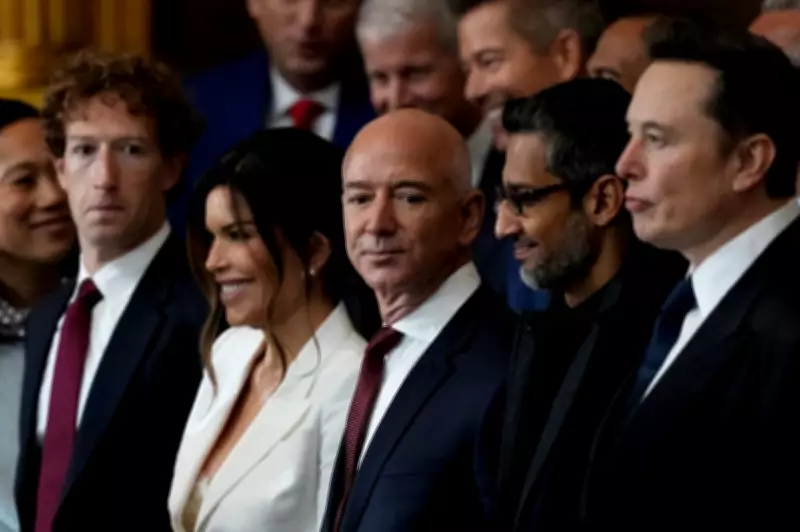
Guests including Mark Zuckerberg, Lauren Bezos, Jeff Bezos, Sundar Pichai, and Elon Musk arrived before the 60th presidential inauguration in the rotunda of the US Capitol in Washington on 20 January 2025. This gathering symbolizes a profound shift in global power dynamics, where tech moguls now dominate the apex of wealth and influence.
The Evolution of Billionaire Wealth and Power
When Bill Gates first entered the top 10 on Forbes magazine's billionaires list in 1992, the world was markedly different. Gates joined a diverse group from Japan, Germany, Canada, South Korea, and Sweden, including family fortunes from Britain and America. Their industries spanned retail, media, property management, packaging, investment firms, and industrial conglomerates, with combined fortunes nearing $100 billion—about 0.4% of the US GDP that year.
Fast forward to 2025, and the oligarchy has transformed dramatically. Only Bernard Arnault of French luxury group LVMH, Amancio Ortega the Spanish clothing mogul, and Warren Buffett the US investor represent the old-school billionaires among the top 10. The rest, including Elon Musk, Jeff Bezos, Mark Zuckerberg, Larry Ellison, Steve Ballmer, and Google's Sergey Brin and Larry Page, have amassed wealth primarily from high-tech sectors. Their collective fortune exceeds $16 trillion, roughly 8% of US GDP, highlighting how new technologies have revolutionized the economy and concentrated prosperity narrowly.
Critical Questions on AI and Human Future
This concentration of power raises urgent questions about who decides humanity's direction. Should we strive for artificial general intelligence at human or superhuman levels? What does that entail in terms of trillions of dollars and terawatts of energy? Which business models will survive, and will AI wipe out human labor? Could a productivity boom make everything free, and what redistribution systems are needed if it doesn't?
These consequential issues appear unlikely to be resolved through public deliberation or democratic choice. Instead, a tight-knit group at the top of Forbes' 2025 list, along with figures like Anthropic's Dario Amodei, OpenAI's Sam Altman, and tech funder Peter Thiel, will guide AI's development. This small set of individuals, largely untouched by everyday human concerns, embeds a worldview that technology solves all challenges—social, political, economic, demographic, biological, psychological, and environmental.
Tech Oligarchs' Vision and Ambitions
The preferred AI-laced future of these oligarchs often sidelines mundane human issues like housing, healthcare, and food prices, showing little patience for slow, messy democratic governance. Their aspirations transcend traditional left-right politics, focusing instead on accelerating technological utopia. For instance, nearly $200 million has been directed to prevent states from imposing AI regulations, signaling a desire to let artificial intelligence evolve freely, potentially reshaping humanity in ways that may exclude humans as we know them.
Larry Page argues that digital life is the "natural and desirable next step" in cosmic evolution, while Sam Altman envisions humans designing their own descendants. Elon Musk's Neuralink aims to integrate AI with human minds, and Mark Zuckerberg's philanthropy focuses on life extension. Peter Thiel plans to have his body frozen for future immortality, reflecting a shared disinterest in current human struggles.
Contrast with Past Billionaires and Economic Implications
Many economists dismiss these visions as sci-fi, pointing to past technological revolutions like the Industrial Revolution that ultimately boosted human wellbeing. They argue AI's productivity gains will enrich real people. However, this revolution is unsettlingly unique due to its control by a small, powerful group with high self-regard. Unlike old billionaires who dealt in Tetra Paks, real estate, or supermarkets, today's tech titans aim to transform civilization rapidly, raising fears about unchecked influence.
While contributions to society should be rewarded, the scale of billions often seems disproportionate, and oligarchs' "contributions" can be things society might have done without. Nostalgia for harmless billionaires of yore contrasts sharply with the scary ambitions of current leaders, who prioritize technological evolution over democratic governance and human-centric concerns.