A Molten, Mushy State: Scientists May Have Found a New Type of Liquid Planet
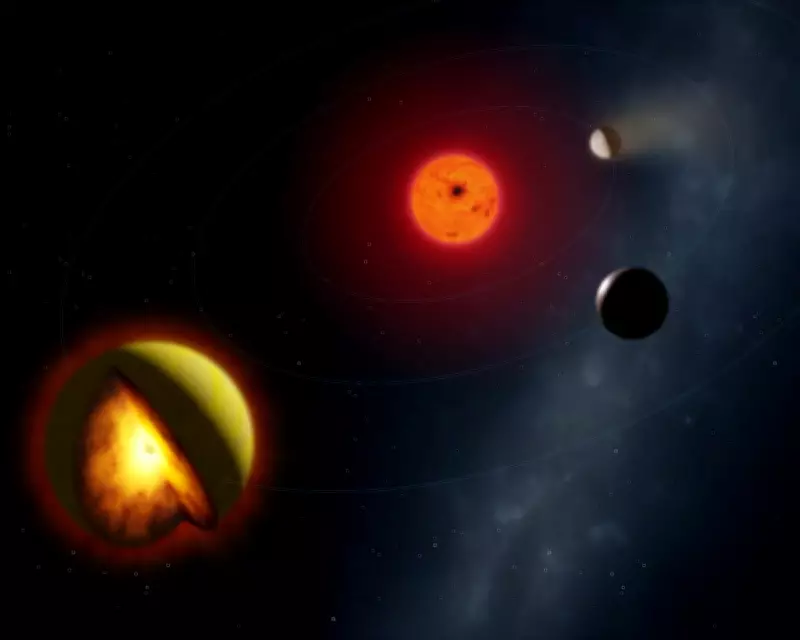
Astronomers have made a groundbreaking discovery that could redefine our understanding of planetary formation. They have identified a distant world, known as L98-59d, which appears to be composed entirely of molten lava, suggesting the existence of an entirely new category of liquid planet. This finding challenges previous assumptions about exoplanets and opens up new avenues for space exploration.
Unveiling the Lava Planet
L98-59d is located approximately 35 light years from Earth and orbits a small red star. Initially, scientists speculated that this planet might harbor a deep ocean of liquid water, but the latest analysis reveals a far more extreme environment. With a size about 1.6 times that of Earth, L98-59d is now believed to be in a perpetual state of molten chaos.
Dr. Harrison Nicholls, an astrophysicist at the University of Oxford, described the planet's condition as "a mushy, molten state", comparing it to molasses. He noted that the core is likely molten as well, contributing to the planet's unique composition. Surface temperatures on L98-59d soar to a blistering 1,900°C (3,500°F), creating a landscape dominated by a global magma ocean that extends thousands of kilometers beneath the surface.
Hostile Conditions and Atmospheric Mysteries
The environment on L98-59d is anything but hospitable. Large waves are thought to roll over the magma ocean, driven by tidal forces from neighboring planets. Additionally, the atmosphere is rich in hydrogen sulphide, emitting a pervasive stench of rotten eggs. These conditions make it highly unlikely that the planet could support life, as Nicholls emphasized: "If there are aliens out there that could live in lava that would be amazing, but I don't think it's likely that it's habitable."
Previously, observations from the James Webb Space Telescope indicated a sulphur-rich atmosphere, which conflicted with the idea of L98-59d being either a rocky or water world. Advanced computer simulations have now reconstructed the planet's history, suggesting that a deep magma ocean has efficiently stored gases for nearly 5 billion years, protecting them from processes that would otherwise remove them.
Implications for Exoplanet Research
This discovery implies that molten planets may be more common than previously thought, prompting astronomers to reconsider how they designate exoplanets as potentially habitable. Nicholls warned: "Some planets in the so-called habitable zone might not be very habitable at all, they might be these molten planets." This highlights the incredible diversity of worlds beyond our solar system and raises questions about what other types of planets await discovery.
Dr. Jo Barstow, a planetary scientist at the Open University involved in the observations, noted that the findings provide a plausible explanation for L98-59d's extreme nature. She compared it to Jupiter's moon Io, known for its volcanic activity, but suggested this planet could be even more extreme.
The research, published in the journal Nature Astronomy, underscores the importance of continued exploration and the use of advanced technology like the James Webb telescope to uncover the secrets of distant worlds. As we push the boundaries of space science, each discovery brings us closer to understanding the vast and varied universe we inhabit.