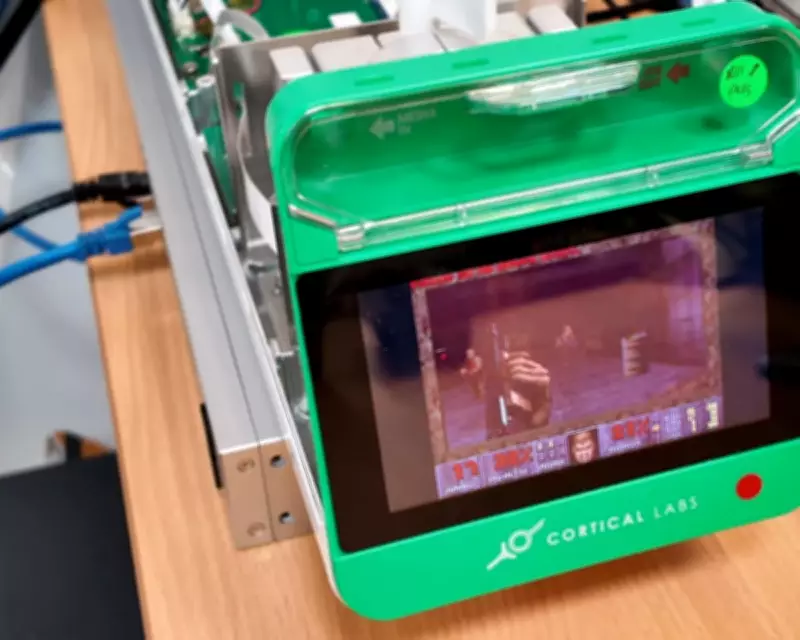
Human Brain Cells Master Doom in Groundbreaking Lab Experiment
In a development that seems ripped from a science fiction script, a petri dish containing 200,000 human brain cells is now playing the classic 1990s video game Doom. This remarkable feat, achieved by Australian startup Cortical Labs, represents a significant leap in biological computing, where living neurons interface with technology to perform tasks traditionally reserved for silicon-based systems.
From Pong to Doom: The Evolution of Biological Gaming
Cortical Labs first made headlines in 2022 by teaching lab-grown neurons to play Pong. Building on that success, the company has now created what it calls "the world's first code-deployable biological computer", utilizing human tissue instead of conventional chips. "As soon as we managed to get Pong to work, the first thing people said was: 'When are you going to do Doom?'" explains Hon Weng Chong, CEO of Cortical Labs, highlighting the tech community's fascination with running the iconic shooter on unconventional platforms.
How Brain Cells Are Harvested and Programmed
The process begins with a simple blood sample—in this case, Chong's own—yielding about 100 white blood cells. These are reprogrammed into induced pluripotent stem cells (iPSCs), which can be multiplied exponentially and transformed into neurons. "Essentially we reverse the biological clock back to an embryonic state, induce them into neurons, and put them on a glass chip roughly the size of a 50p piece", Chong details. The neurons are then connected to a computer system via electrical signals, enabling them to interact with the game.
To facilitate gameplay, 24-year-old AI graduate Sean Cole developed code that encodes game data—such as player health and enemy positions—into signals the neurons can process. The neurons respond by firing outputs that translate into in-game actions like moving or shooting. "It's really no different from how humans operate", Chong notes, comparing it to visual input processed by the brain.
Sentience and Learning: Ethical Implications Arise
While the neurons demonstrate learning capabilities, such as improving their gameplay over time, experts caution against attributing consciousness. "I definitely don't think it's conscious", Cole asserts, though he acknowledges the system's ability to adapt. This raises profound ethical questions, including concerns about memory manipulation or enhanced learning through brain-computer interfaces, akin to technologies like Neuralink.
The learning mechanism remains partially mysterious, with theories pointing to principles like Hebbian learning or free energy minimization. "If we find a way to safely connect this technology to humans, that is kind of what the implications might be", Cole suggests, hinting at potential future applications in accelerated skill acquisition.
Parallel Breakthrough: Fruit Fly Brain Uploaded to Simulation
Meanwhile, in San Francisco, biotechnology firm Eon Systems has achieved another milestone by scanning and uploading a fruit fly's brain into a computer simulation. The virtual insect, comprising around 140,000 neurons, exhibits innate behaviors like walking and feeding without prior training. "Our goal is to make the emulation and computed brain and body feel indistinguishable from the natural biochemical body and brain", says CEO Michael Andregg, though he admits the simulation lacks high-fidelity sensory details.
This challenges prevailing AI assumptions by suggesting that some intelligence may be hardwired, rather than learned. Andregg envisions brain emulation as a tool for humanity to thrive alongside superintelligent systems, though practical applications remain distant due to technical hurdles like scanning entire bodies.
Future Applications: Beyond Gaming to Medicine and Robotics
The real promise of these technologies lies beyond entertainment. Chong emphasizes biomedical research, such as modeling diseases like epilepsy to test and personalize drugs. Additionally, biological systems could overcome limitations in robotics, where tasks like motor control and decision-making in unpredictable environments have proven difficult for traditional computers. "Robots may be very good at solving maths problems, but we're still trying to build robots that can walk properly", he observes, citing Moravec's paradox.
For now, these experiments serve as a proof of concept, blending cutting-edge science with playful curiosity. As humanity edges closer to sci-fi realities, they prompt crucial discussions about ethics, consciousness, and the future of human-machine integration.