
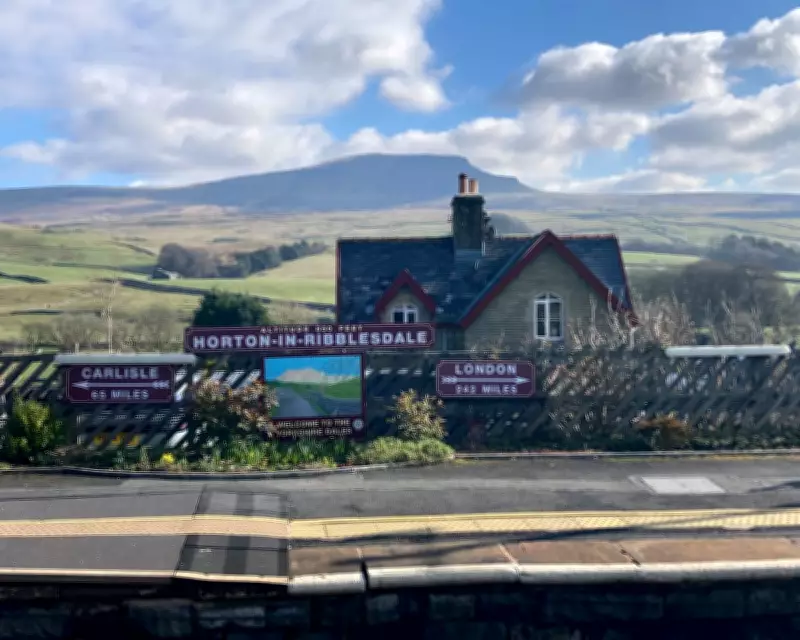
The Yorkshire Three Peaks rise majestically around Horton-in-Ribblesdale station, making it an ideal starting point for walkers. The landscape is raw and wild, a stark contrast to the typical image of the Yorkshire Dales with its pretty villages and walled sheep fields. Limestone stretches on all sides like an inland ocean, its origins in ancient coral and sea creatures. Walking across the clints and avoiding the grykes, the terrain is broad and flat, then suddenly drops into a huge fault, evoking the natural realm celebrated by WH Auden.
A Little-Known Train Route
The Yorkshire Dales Explorer is a direct train connecting Rochdale and Manchester with the national park and the Three Peaks. While the famous Leeds-Settle-Carlisle service runs 20 times a day, the Explorer is less frequent, operating on Saturdays only with one morning and one late afternoon service each way. This under-promoted service offers a unique way to access the heart of the walking country.
Starting the Hike at Horton-in-Ribblesdale
Alighting at Horton-in-Ribblesdale, the penultimate station before Ribblehead, walkers are immediately immersed in the Three Peaks. Pen-y-ghent lies behind, Ingleborough ahead, and Whernside to the north. All three summits are around 700 metres high. For the super fit, completing them in one day is possible, with the men's running record at 2 hours 46 minutes and the women's at 3 hours 9 minutes. The full circuit is over 23 miles and can take 8-10 hours for trained walkers.
Our mission was less daunting: a plateau walk between the peaks down to Settle for a pub lunch. The route is adventurous, with few marked footpaths, but open access land allows for self-navigation using cairns. From the station at 250 metres, we climbed to the Moughton trig point at 427 metres, enjoying sweeping views of the peaks and Bowland Fells. Skylarks and ravens filled the air, while shake holes in the limestone required alertness. The descent at Long Scar offered dramatic views of the Norber Erratics, boulders transported by glaciers.
The Limestone Edge and Beyond
The edge of the limestone pavement is enthralling, resembling an underwater cliff from ancient times. We passed a massive quarry where greywacke, a tough gritstone, is extracted. The rest of the walk turned green and agricultural, with wild garlic, newborn lambs, and daffodils. At Feizor, a teashop once for walkers now attracts car tourists. We continued over small rises to the banks of the Ribble, which begins its journey near our starting point.
Settle was bustling with bikers and shoppers, but we enjoyed pints and late lunches in the pubs. Options for return included the late train or the number 11 minibus to Clitheroe. For those from farther afield, later trains to Leeds or Lancaster are available.
Tips for Walking the Three Peaks
This walk is ideal for getting back into exercise after winter. To attempt the Three Peaks by train, splitting the hikes over a weekend is recommended. Horton to Pen-y-ghent and on to Ribblehead is a 10-mile day. Whernside and Ingleborough can be done the next day, covering a similar distance back to Horton. Campsites and the Station Inn at Ribblehead offer accommodation.
The three hills have distinct characters: Pen-y-ghent is a steep lump requiring a scramble; Ingleborough is haughty and mesa-like; Whernside is a long whale-back ridge. The peaks create their own microclimate, often colder and snowier than surrounding areas. Bear this in mind when planning your outing.




