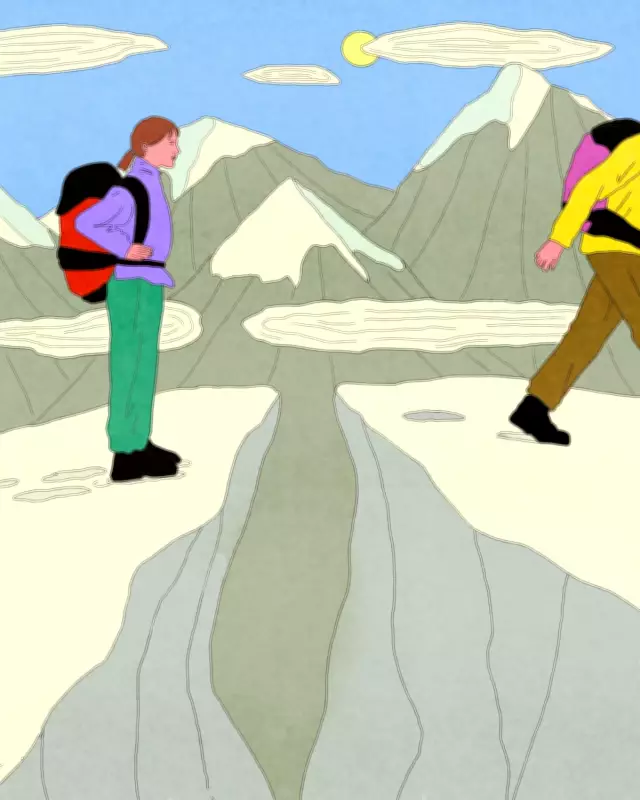
The Rise of 'Alpine Divorce': When Hiking Dates Turn Into Abandonment
A disturbing trend is emerging on hiking trails and mountain peaks across the United States and beyond. Women are reporting being abandoned by their male partners during outdoor adventures, a phenomenon now widely known as 'alpine divorce.' This term describes situations where a man leaves his date or partner behind on a hike, climb, or other wilderness excursion, often leading to immediate breakups and, in extreme cases, serious danger.
Personal Stories of Trailside Abandonment
MJ, a 38-year-old PR professional from Los Angeles, experienced what she calls 'small T trauma' during a trip to Zion National Park five years ago. While hiking Angel's Landing with a new partner, he grew impatient with her pace. 'I could tell it was getting on his nerves that I was slow,' she recalled. 'I was like, 'Fuck it, just go ahead of me.'' He did so without hesitation. At the summit, they took a photo together, but then he descended with another woman he had met on the trail, leaving MJ to finish alone. Their relationship ended shortly after.
On social media platforms like TikTok, similar stories have gone viral. One video with over 4.2 million likes shows a woman sobbing as she navigates down a rock formation alone. 'He left me by myself, I should have never come with him,' she cries. The comments section flooded with accounts from other women: one described a 12-hour solo journey out of the Grand Canyon after being ditched; another told of getting lost in the woods after being left behind.
Many women describe feeling vulnerable in these situations, often lacking proper supplies, adequate water, or familiarity with the terrain. 'It's such a common thing,' said Julie Ellison, former editor-in-chief of Climbing magazine. 'There's that male ego element to it that's not necessarily evil or ill-intentioned, but it usually has a negative effect on the partner being left behind.'
The Role of Masculinity and Outdoor Culture
Experts suggest that traditional notions of masculinity and outdoor culture's romanticization of endurance contribute significantly to alpine divorce incidents. 'Masculinity seems to play a role in how alpine divorce manifests in real life,' said Doriel Jacov, a New York-based therapist specializing in relationship patterns. 'There's this emphasis on strength, independence and stoicism that is really embedded in the way males are taught to prioritize character traits.'
Outdoor culture has long celebrated rugged individualism, with folk heroes like Timothy Treadwell (who lived among grizzly bears) and Christopher McCandless (who died alone in the wilderness) embodying this ideal. This environment can encourage men to prioritize personal achievement over partnership safety.
Jacov emphasizes that leaving someone in an unsafe wilderness position often constitutes an abusive dynamic. 'I can't see how leaving someone in a highly unsafe position wouldn't qualify as an abusive dynamic, especially if the man is aware to some degree that that's what they're doing,' she stated.
Real Dangers and Legal Consequences
The dangers extend beyond emotional distress. Last month, an amateur Austrian mountaineer was found guilty of gross negligence manslaughter for leaving his exhausted girlfriend behind on the country's highest peak while he went for help. The woman died, and the man claimed he was 'endlessly sorry,' calling it a tragic accident. However, he couldn't explain why he failed to wrap his freezing girlfriend in her emergency blanket before descending without her.
A former girlfriend testified that this same man had left her behind on a trail during a 2023 hike, ending their relationship. This pattern highlights how alpine divorce behaviors can repeat across different partnerships.
Communication Failures and Different Expectations
Many alpine divorces occur not from malicious intent but from poor communication and mismatched expectations. David Webb, editor-in-chief of Canada's Explore magazine, notes that when you invite someone on a hike, 'you're basically acting as their de facto guide.' He emphasizes that proper guides always move at the pace of the slowest member.
Webb recalls a personal experience where he and his wife had radically different expectations for a hike. 'My goal was to go on a mission, and she just wanted to spend the day outside,' he said. 'I was a little bit guilty of dragging her on a mission that I had not really communicated about.'
Daniel Duane, a 59-year-old writer and marriage therapist in San Francisco, acknowledges that personal ambitions can sometimes override partnership considerations in outdoor settings. 'It's just so awesome to share an outdoor adventure with good company, and yet, we often have these personal hungers and ambitions when we go into the mountains,' he said. 'Sometimes that more selfish part of ourselves takes over.'
Questioning Gender Stereotypes
Some women in the outdoor industry challenge the gender assumptions embedded in alpine divorce discussions. 'Believe it or not, we can do things that have nothing to do with men,' said Julie Ellison. 'I really struggle with saying 'men do this,' and 'women do that,' and those generalizations.'
Blair Braverman, an adventurer and dogsled musher who has competed in the Iditarod, offers a different perspective. 'Personally, if I were with a man and he wandered away from me on a mountain, I'd be more worried for him than me,' she said. 'I think it's interesting that the term assumes that the woman is the one with less capability.'
Finding Strength and Community After Abandonment
Despite the trauma, many women find empowerment and community after experiencing alpine divorce. When MJ was abandoned in Zion, she hiked down with a friendly female stranger and her young son. Naomi, a 46-year-old educator, once helped a woman with vertigo in Arches National Park after the woman's date left her behind to retrieve a dropped camera.
Social media comments reveal similar patterns of women supporting each other. One user wrote: 'It happened to me many years ago. I met 2 girls on the mountain and told them what happened, and we walked down together. They wouldn't let me go alone.'
MJ stopped hiking for a year after her experience, questioning her fitness and ability. It took two solo trips to Montana's wilderness for her to rediscover her love for the outdoors. 'The reason why I love hiking is because it doesn't matter if you're fast or not,' she said. 'Hiking is something you don't have to be good or bad at. It's just there.'
Now in a committed relationship with someone who isn't particularly outdoorsy, MJ sometimes hears him joke: 'Aren't you glad I don't like hiking?' After her Zion experience, she values having a personal relationship with nature unencumbered by partnership dynamics.
The alpine divorce phenomenon reveals complex intersections between gender, outdoor culture, communication, and safety. As hiking and outdoor recreation continue growing in popularity, these incidents serve as cautionary tales about the importance of partnership, preparation, and mutual respect in wilderness settings.