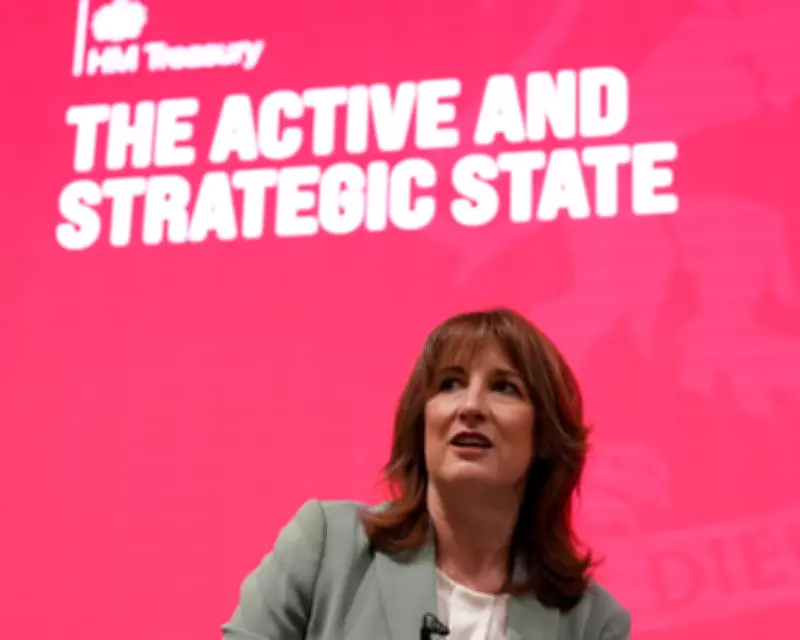
Chancellor's Energy Strategy Faces Business Backlash Over High Costs
Chancellor Rachel Reeves delivered a major economic resetting speech this week, outlining ambitions for closer EU trade relations, rapid AI adoption, regional tax revenue redistribution, and growth corridor development. However, a glaring omission overshadowed these plans: the persistent crisis of sky-high energy costs for UK industry, which business leaders argue threatens the nation's economic foundation.
The Elephant in the Room: Uncompetitive Energy Prices
While Reeves correctly identified high business energy bills as an inherited problem, industrial groups contend her response remains dangerously timid. The UK currently suffers some of the highest industrial energy prices in the developed world—a critical concern for a chancellor who attributes sluggish post-financial crisis productivity to "anaemic levels of investment."
Global AI firms considering power-hungry datacentre locations will inevitably scrutinize electricity costs, making this issue central to future economic competitiveness. Despite acknowledging the problem, Reeves offered little beyond existing schemes that business leaders consider inadequate stopgap measures.

Business Leaders Sound Alarm on Deindustrialization Threat
Manufacturing body Make UK's chief executive Stephen Phipson praised the EU and regional themes but emphasized: "The overwhelming priority for business is the need to get energy prices down and ensure security of supply. This is the single biggest factor impacting industry's competitiveness and nothing should be off the table. So long as energy prices remain at current levels we will continue to face the threat of deindustrialization and the loss of key industries."
Chemical Industries Association's Steve Elliott highlighted the immediate crisis: "It is important that governments have long-term ambition but there is also the here and now. How do we stop our critical foundation industries disappearing because of government policy? America pays one quarter of what we pay for its industrial energy."
The chemicals sector—considered a favored industry in government policy—has seen output plummet 60% between 2021 and 2025 with 25 site closures, demonstrating the urgency of comprehensive action beyond occasional last-minute plant rescues.
Existing Schemes Fall Short of Comprehensive Solution
Reeves referenced the "supercharger" scheme offering enhanced energy bill discounts from next month, but this covers only 500 heavy users. The "British industrial competitiveness scheme" (BICS) targeting 7,000 firms from April 2025 lacks crucial details regarding funding mechanisms and what "up to" 25% discounts actually entail.
Critically absent was any broader initiative to reset energy costs across UK industry or remove levies contributing to price inflation. Oxford professor Sir Dieter Helm argues such selective interventions represent mere "sticking-plaster solutions" rather than the permanent competitive framework needed.
Radical Alternatives Proposed for Structural Reform
Professor Helm advocates for industry receiving preferential pricing based on long-run marginal system costs rather than bearing full network expenses—a system that operated routinely in pre-privatization eras. While this would shift costs to other consumers, his argument emphasizes preserving industrial capacity to contribute to overall system sustainability.
Additional proposals include flexible carbon prices that stabilize with oil markets and take-or-pay contracts for North Sea production. Though potentially expensive or politically challenging amid household energy bill concerns, these structural approaches address what Helm calls the need for "a permanent solution to put British industry on a competitive basis with our rivals overseas."
Long-Term Challenges Demand Immediate Attention
Even as temporary factors like $100-a-barrel oil and geopolitical gas price spikes eventually moderate, the fundamental crisis of uncompetitive industrial energy costs persists. Renewable and nuclear expansion won't substantially reduce costs before the 2040s given massive network infrastructure requirements.

If Reeves truly seeks "a foundation of economic security" as her speech concluded, industrial energy affordability must become a far higher priority. Growing future industries requires confronting present challenges, and ensuring existing industries survive to utilize future greener infrastructure remains essential for national economic resilience.