
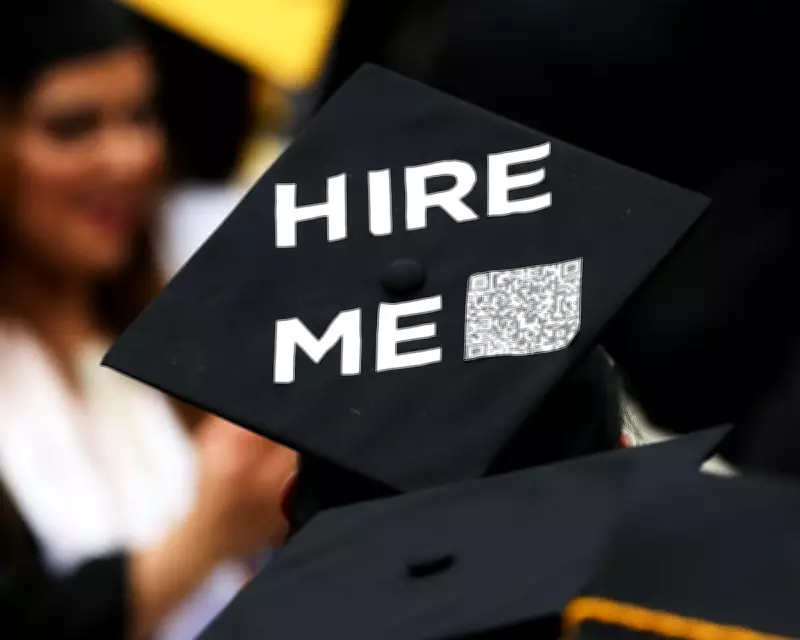
Young Graduates Confront Bleak Job Market Amid AI Rise and Shrinking Opportunities
American college graduates are navigating the most challenging entry-level job landscape since the pandemic, with the underemployment rate soaring to 42.5% – its highest level since 2020. This troubling statistic underscores a market shaped by tightening opportunities, the rapid integration of artificial intelligence, and shifting employer expectations that leave many young professionals feeling helpless.
A Grueling Search Process
Gillian Frost, a 22-year-old Smith College student majoring in quantitative economics, has been searching for work since last September. She described dedicating over two hours every weekend to applications, having submitted more than 90 so far. "I've been ghosted by nearly 25% of them and rejected automatically from around 55%," Frost revealed. Despite securing about 10 interviews, the lack of communication from employers has been particularly disheartening.
"I feel helpless. No one seems to know how best to prepare due to the unique conflux of events occurring," she said. "How do you prepare for a tight labor market coinciding with the emergence of AI and direct US involvement in war? Most generations have dealt with maybe one of these but our generation is the first to deal with all three."
Changing Expectations and Structural Barriers
For Jeff Kubat, a 31-year-old in St Cloud, Minnesota pursuing a master's in accounting after eight years in construction finance, the challenge manifests differently but remains severe. He noted that even companies in small-town Minnesota show "a dearth of willingness to train people who have relatable backgrounds into what they need." As his search continues, Kubat finds himself lowering salary expectations, observing that "the only roles that are opening are due to people falling out of roles rather than genuine growth in the area."
The difficulty extends beyond availability to increasingly demanding requirements. A 25-year-old New York University graduate in media, culture and communications pointed out that "decent-paying jobs that are listed as entry-level will often ask for candidates with three to five years of experience – an amount of time that simply cannot be achieved if one is fresh out of college." This disconnect leads many qualified candidates to avoid applying altogether.
The AI Hiring Challenge
Automated hiring systems present another significant hurdle. The NYU graduate described the necessity of tailoring resumes with specific keywords to pass through AI screening: "It's aggravating and exhausting, but sadly a necessity in this market and point in technological development." They expressed frustration that "I have to worry about passing a machine's arbitrary and unknowable tests before anyone considers my human capability and what I could bring to a given position as an individual."
Hidden Opportunities and Networking Gaps
Anna Waldron, a 22-year-old Loyola University Chicago student double-majoring in political science and journalism, highlighted structural barriers in hiring practices. She typically applies through platforms like Handshake, LinkedIn, and FlexJobs, but noted that "a lot of jobs don't get posted on these sites because they hire internally or keep it 'in the circle of the company', which makes it hard for entry people like me who don't have as many connections."
Despite three internships including work for the US Senate, Waldron continues to struggle: "I have skills both in writing for news publications and doing policy work... but despite me applying to all kinds of jobs related to both of these fields, I am still struggling to find something."
A Generation Facing Multiple Challenges
The convergence of economic tightening, technological disruption, and geopolitical instability creates unprecedented challenges for this generation of graduates. As Frost articulated, previous generations typically faced one major crisis at a time, while today's graduates must navigate all three simultaneously. The result is a job market where even highly qualified candidates with relevant experience find themselves competing for fewer positions against automated systems and unrealistic expectations.
This environment has pushed the underemployment rate to concerning levels, suggesting that even those who find work may be settling for positions below their qualifications. The stories of these graduates reflect broader trends in the American economy, where the transition from education to employment has become increasingly fraught with obstacles that extend far beyond traditional job search challenges.




