
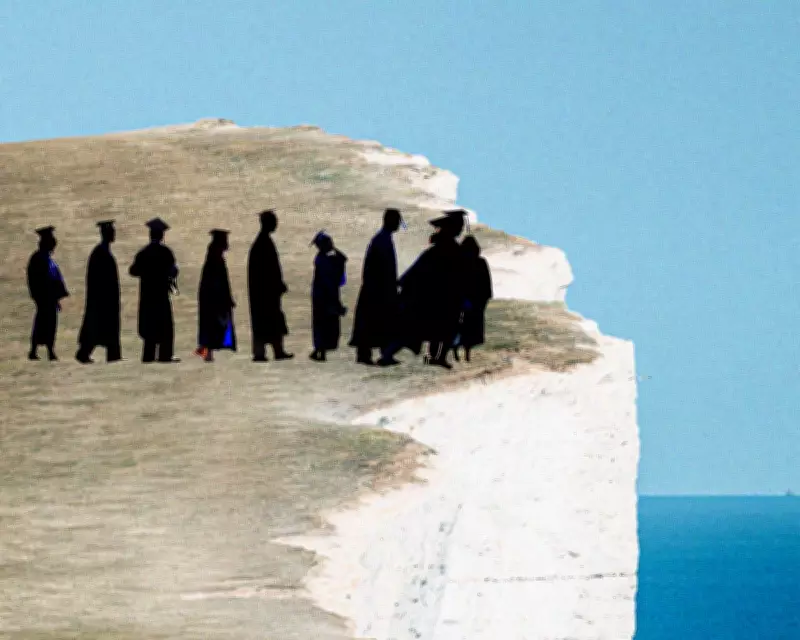
Despite a growing economy and low unemployment rates, young college graduates are faced with dismal hiring prospects. A college degree once ensured prosperity, but Generation Z is finding 'just not much out there.' Survey after survey shows Gen Z experiencing deep economic instability, along with eroding trust in U.S. leadership and weakened social connections.
The Struggles of Recent Graduates
Jes Vesconte graduated from one of California's most prestigious art schools, completed a Fulbright in Germany, and earned a master's degree from Columbia University. Yet at 29, Vesconte is struggling to afford everyday life. Balancing freelancing and service-industry jobs, they are now in the midst of another job search to supplement their income before student loan repayments begin next month. 'I can barely find a way to make more than $3,000 a month,' Vesconte said.
Vesconte is not alone. According to a report from the Economic Policy Institute, the college degree is 'losing its edge.' Despite a growing economy and low unemployment rates, young college graduates face bleak hiring prospects. Surveys indicate that Gen Z is experiencing deep economic instability, alongside eroding trust in leadership and weakened social connections.
Economic and Social Challenges
Many young people feel stuck, with the life and freedom they envisioned for adulthood seeming out of reach. 'They have low expectations for how they're doing now, they have low expectations of how things are going to look in the future,' said Janelle Jones, former chief economist at the Department of Labor and a senior fellow at the Groundwork Collaborative. 'That is in part the labor market, but people aren't just workers. They're living in a time where we're facing multiple existential crises right now.'
While some may dismiss this angst as a rite of passage, data shows this generation faces unique challenges. Since the pandemic, the unemployment rate for recent college graduates has been higher than that of the overall American workforce, according to the Federal Reserve Bank of New York. Although the overall unemployment rate among college graduates remains lower than that of all workers, the gap has narrowed significantly compared to previous decades.
The Cost of Education
Even as the value of a college degree has declined, the cost remains high. The graduating class of 2024 left with an average of $29,560 in loans, according to LendingTree. Total student loan debt in the country has reached upwards of $1.8 trillion, with over 44 million Americans owing federal loan debt.
For those with jobs, the current economy can make it difficult to switch careers or pursue meaningful work. Sophia Xu, a 28-year-old designer at a major tech company, has struggled to find a new job internally or externally. 'I've worked in this industry long enough where I have a better sense of what I am looking for in my next job and what would make me happy,' she said. 'There's just not much out there.'
Declining Confidence and Wellbeing
Young people's confidence in the economy and their personal finances is also down. Since the 1970s, the University of Michigan's consumer sentiment index among people aged 18-34 had been mostly stronger than that of older counterparts. However, the index took a nosedive last year and has since remained lower than that of Americans over 55.
Research from David G. Blanchflower, a professor of economics at Dartmouth College, shows that the wellbeing of American workers is deteriorating most quickly among young employees, for reasons extending beyond the job market. For example, fewer young Americans have driver's licenses, want to go on dates, or are having sex. 'We've seen this huge decline in all sorts of things,' Blanchflower said. 'There are long trends in this stuff going on, and then it was exacerbated by smartphones. So I think we're in a deeply complex puzzle.'
Unfulfilled Expectations
The experience of early adulthood has fallen short of the idealized lives portrayed in TV shows like Sex and the City or Friends. 'The idealized life of the Carrie Bradshaw, or the cast of Friends, that we see in these TV shows might have been possible when those shows existed, but now, capitalism has fractured things so much that even having a social life in New York City is really an effort,' Vesconte said. 'Most of my friends, who I met at school, moved out of New York after they graduated, because it's so hard to live here and hard to have a social life.'
Ragini Subramanian, 23, majored in journalism and media studies at Rutgers University, hoping to avoid public relations. But after graduating last May, they landed an hourly contract at a small PR firm in East Brunswick, working long hours at a windowless desk. After nearly a year earning roughly $1,600 a month and spending just under half on an apartment shared with four roommates, Subramanian quit and moved back home to the Bay Area.
This solution is common among Gen Z. Although the percentage of Americans aged 25 to 34 living with their parents has dropped slightly since the pandemic, a fifth of young adults still live with their parents. 'Financially, it wasn't giving me enough for me to be able to live here [in New Jersey] and pay rent,' Subramanian said, noting they saved very little. Living with parents has allowed them to focus on freelance work and search for a long-term job.
While Subramanian considers themselves lucky to have the option to move back home, they said it can be socially isolating, especially as a queer person. 'That's what's kind of stunting me right now, especially someone who's trying to work in the creative field. So I'm trying to find ways around that, and to get myself outside in spaces where I feel more understood, of course, and just be myself,' they said.
Despite plunging into unemployment and applying for jobs in the precarious media industry, Subramanian feels anything but stuck. 'I know I have a lot to do and offer to this world, whether that is being paid by a company or whether that is my own work that will lead me elsewhere,' they said. 'I have no doubt in my mind, right now, that I'll be OK.'




