
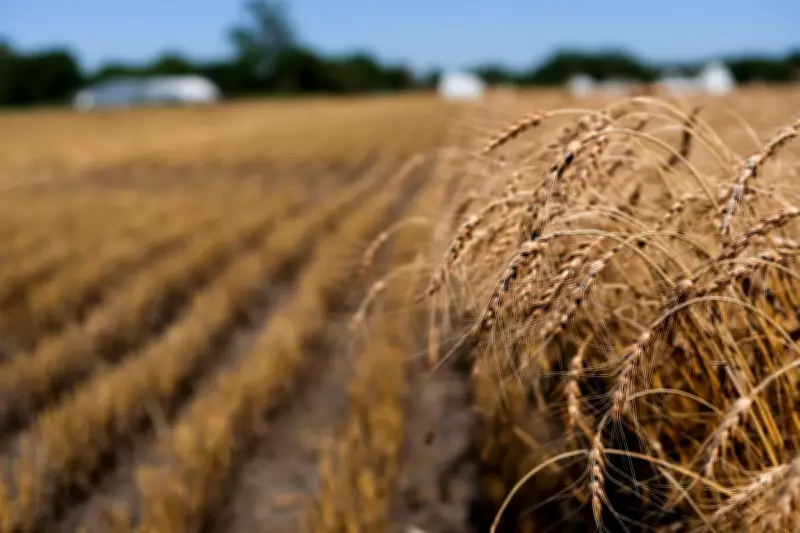
Merrill Nielsen's wheat crop initially appeared healthy after he planted it last fall on his 2,500-acre farm in north-central Kansas, about 50 miles west of Salina. The plants benefited from higher-than-normal November rainfall. However, an abnormally warm and dry winter, followed by extreme temperature variability, stressed the developing wheat. During the winter-to-spring transition, temperatures fluctuated from 70 to 80 degrees Fahrenheit on some days, while dropping to the teens or low 20s on others.
Nielsen jokes that the wheat “wasn’t sure whether or not to have its Bermuda shorts and sunglasses on and bake in the sun … or to have its winter coat on.” But the volatile weather destroyed his crop. This week, a crop insurance adjuster told Nielsen that, at best, his fields would yield two bushels per acre, compared with the normal upper-40s to mid-50s bushels per acre. “Crop will be terminated,” he texted a reporter, deciding not to harvest what little wheat grew.
Widespread Impact Across the Plains
Nielsen has farmed for about 50 years, growing wheat, grain sorghum, soybeans, and alfalfa on the farm his great-grandfather established in 1871. He says this year’s season was one of his worst in years. He is not alone. Farmers in the central and southern Great Plains grow much of the country’s bread-type wheat, hard red winter. It is sown in the fall to establish roots ahead of winter so it can start growing before the summer heat sets in. Kansas is the largest US producer, with Oklahoma, Texas, Colorado, and Nebraska also major growers.
Numbers bear out Nielsen’s observations, as Kansas and Oklahoma had their second-warmest year from March 2025 to March 2026. In March, temperatures were 10 to 11 degrees Fahrenheit above normal, says Shel Winkley, a Texas-based meteorologist at Climate Central, a non-profit research organization. It was the third-warmest March on record for Kansas, with record warmth for Oklahoma, allowing drought conditions to set in further.
Poor Crop Conditions
This year’s winter wheat crop condition in the Plains is one of the poorest in recent history, rivaling 2023, another drought year. The weekly crop condition report issued by an arm of the US Department of Agriculture rates 44% of Kansas’s and 49% of Oklahoma’s wheat in very poor to poor condition, with similar ratings elsewhere. The extreme March heat bears the fingerprints of the climate crisis, Winkley says, because of the drought and prolonged heat the area was already experiencing.
“It wasn’t just a weird, wonky March. We understand there’s something bigger here,” he says. “Especially at the peak of the heat in March, we know that those temperatures would be rare or almost virtually impossible at that time of the year in the central Plains, without an influence of climate change.”
Farmers Face Difficult Decisions
Farmers in north-central and northwest Kansas were hit hard this season. Romulo Lollato, the wheat and forages production professor at Kansas State University, expects affected producers in this area may follow Nielsen’s decision not to harvest. Other Kansas farmers are doing slightly better but will also see some yield loss. Ben Palen, a fifth-generation farmer in northeast Kansas, near Lawrence, farms 15,000 acres of corn, sunflowers, millet, grain sorghum, and organic wheat. He may only yield 30% of his normal crop. He is waiting on an estimate of how much he might be able to harvest this year.
Vance Ehmke, who farms 11,000 acres in Lane County, in southwest Kansas, saw 90-degree temperatures in early January, with freezing weather after. In late April, rainfall of less than an inch fell on his parched crops, which perked up the plants. “That helped a whole bunch, but we’re so far behind that it’s not even funny now,” says Ehmke, who has farmed for more than 50 years.
There is still some time for crops to benefit from moisture before harvest starts in early June, but longer-range forecasts between May and July call for below-average rainfall in Kansas and Nebraska, Winkley says.
Outlook for US Wheat Production
Wheat is a resilient crop and can improve even with modest amounts of rain, so estimating yields and crop size before final harvest is tricky. But wheat experts say with a combination of reduced planted acres and potential abandonment, US total wheat production will fall. Earlier this year, the USDA estimated that US wheat acreage will be the lowest since 1919. US wheat seedings have trended lower in recent years because planting corn and soybeans was more lucrative, at least until recently. Now, no crops are profitable as costs outweigh current grain prices. That will factor into wheat farmers’ decisions whether to salvage some production.
Given the current reality, Lollato estimates this year’s Kansas wheat production may be closer to 200 million to 220 million bushels, far below the 10-year average of 317 million bushels, according to Kansas Wheat, an advocacy group. In 2023’s drought year, Kansas harvested 201 million bushels, and 29% of planted acres went unharvested, the most since 1951. Using crop condition ratings, potential harvested acres, and yield estimates, Gregg Ibendahl, associate professor at Kansas State University, suggests that total US wheat production will be down 15% from last year, writing in his Substack newsletter.
As bad as this year’s wheat harvest may be, the US is not running out of wheat, cushioned by last year’s bumper crop, leaving the US with plenty of supply for now.
Climate Change Concerns
The Plains is known for its volatile weather, including temperature and rainfall extremes. This year, some farmers, such as Palen, who has farmed for 40 years, suspected their wheat never went completely dormant. That added to crop stress and caused it to tap available subsoil moisture early. He has also noticed rainfall patterns are less consistent, making it difficult for farmers to manage around these changes. Erratic rainfall, warm temperatures, and the crop developing earlier left it susceptible to late winter freezes this year, he says.
“Climate change is an increasing concern … because you try to plan as best you can with your management decisions, but it was a wild card, when you got that cold for two nights in a row at just exactly the worst time for the wheat,” Palen says.




