
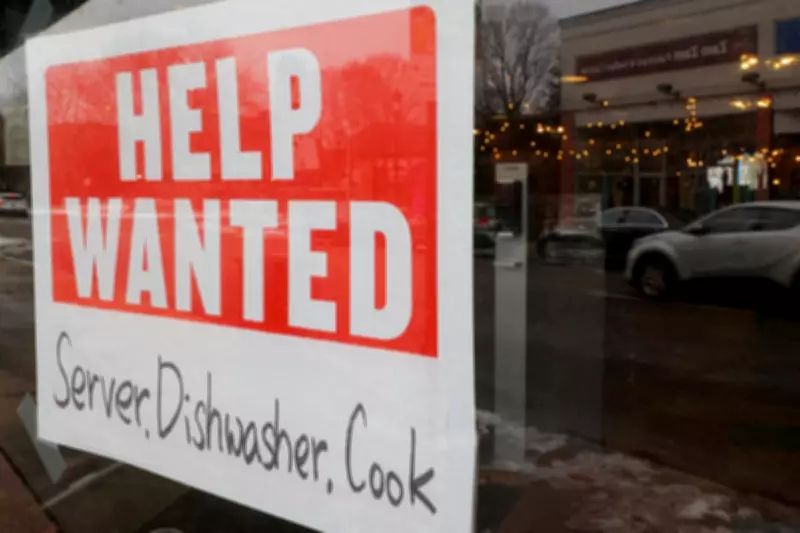
The US labor market showed surprising resilience in April, with employers adding 115,000 jobs and the unemployment rate remaining steady at 4.3%, even as the US-Israel war with Iran continues to fuel economic uncertainty.
Job Growth Exceeds Expectations
Economists had projected only about 55,000 new jobs for the month, making the actual figure more than double the forecast. The unemployment rate held at 4.3%, consistent with predictions. However, a day earlier, the Labor Department reported that 200,000 people filed for weekly unemployment benefits, a slight increase from the prior week.
Key Industries Driving Gains
Job gains were concentrated in four sectors: healthcare, transportation and warehousing, retail, and social assistance. Together, these industries added 106,000 new positions. Healthcare continued to be a major driver, with steady demand for medical services.
Private employers added 109,000 jobs in April, the largest increase since January 2025, according to payroll firm ADP. The ADP report highlighted growth in small and large businesses, though medium-sized firms showed softer hiring. "Small and large employers are hiring, but we're seeing softness in the middle," said Dr. Nela Richardson, ADP's chief economist.
Job Losses in Federal Government and Information Sector
Federal government employment continued to decline, losing 348,000 jobs since November 2024. The information sector also saw losses, shedding 8,000 jobs in April. These declines reflect ongoing changes in immigration policies, government layoffs, and tariff impacts.
Revisions to Previous Data
The Bureau of Labor Statistics revised earlier figures. March's job gains were adjusted upward to 185,000, far exceeding initial expectations of about 70,000. Conversely, February's losses were revised to 156,000, a steeper decline than the originally reported 92,000—a major contraction just before the US-Israel conflict in Iran escalated.
White House Response
White House spokesperson Kush Desai hailed the April jobs report, writing on social media that it "smashed expectations" and was "another sign that the American economy remains on a solid trajectory under President Trump."
Federal Reserve Outlook
The US Federal Reserve cited slow job growth among factors for keeping interest rates steady last month, alongside elevated inflation and Middle East conflict. Outgoing Chair Jerome Powell announced he will remain on the Fed's board as a governor even after Kevin Warsh, Trump's nominee, is sworn in. Powell cited investigations into Fed headquarters renovations as a reason to stay, expressing concerns about the Fed being "pulled into politics."
Kevin Warsh faces pressure from the White House to lower interest rates, but he cannot set rates without support from the other 12 voting members of the Fed's board. The Fed's decisions on rates significantly influence unemployment and inflation as it pursues its dual mandate of maximum employment and price stability.
The series of major changes over the past year—tariffs, government layoffs, shifting immigration policies, and rising oil prices due to Middle East conflict—have destabilized the labor market and added to economic uncertainty.




