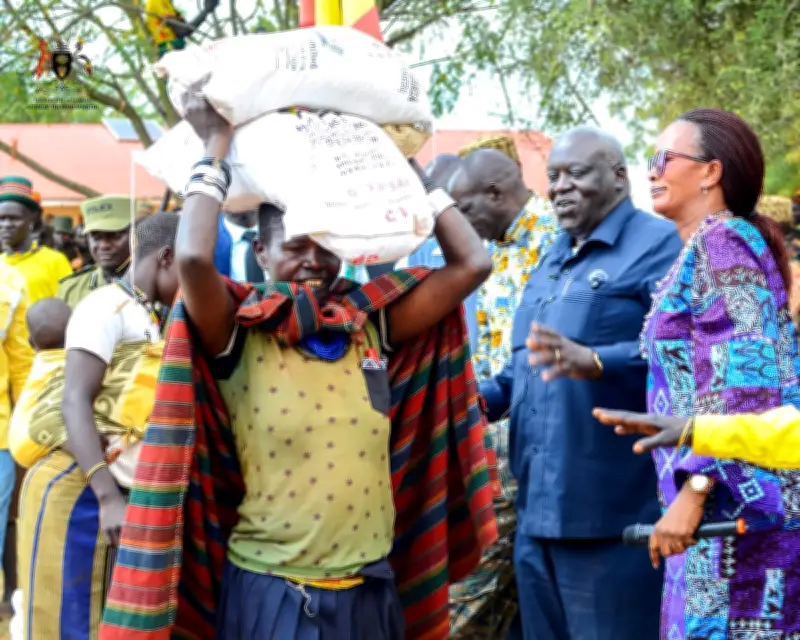
Uganda has initiated emergency food relief distribution following reports of at least 19 deaths from hunger in the eastern Karamoja region, which has been hit by prolonged drought and crop failures. The crisis has left 1.5 million people facing acute food shortages and rising malnutrition.
Government launches large-scale food distribution
The Famine Early Warning Systems Network (Fews Net) reported that the situation in Karamoja has deteriorated to a crisis level. In response, the Ugandan government announced plans to distribute 9,400 tonnes of relief food over the next two months, funded by a 45 billion shilling (£9 million) emergency allocation approved by parliament. This marks the first large-scale operation of its kind organized by the government after funding cuts to international aid.
Sam Engola, Uganda's minister for disaster preparedness and refugees, launched the aid distribution at a primary school in Lodiko sub-county, Kaabong district, on Wednesday. “The president does not want to hear of anyone in Karamoja dying of hunger. I am here to supervise the distribution of this food to the end. I will ensure that everyone receives food. No one will be left behind,” Engola said.
Severe drought devastates crops
Karamoja is experiencing its most severe dry spell in years. Farmers have lost crops since the last meaningful rainfall in April, the beginning of the planting season. Angelina Nakiru, a 21-year-old mother of two in Rupa, near Moroto town, said she struggles to feed her children after all her crops failed. She works at a small-scale grinding mill, crushing rock into powder to extract gold ore, earning just enough to buy a cup of maize and beans. “The work is dusty and exhausting, but it is the only way I can earn money to buy a cup of maize and beans to feed the children,” Nakiru said. “If I don't, the children will sleep hungry. Other days when I fail to get the meagre income from the mill, we go to bed on empty stomachs. The situation is terrible. People are starving and dying due to hunger. The government must come to the rescue of the people.”
Health facilities report treating hundreds of children for severe malnutrition. A nutrition report published in June found that nearly half the population in Karamoja's Kaabong and Kotido districts are in a crisis situation.
Root causes and long-term solutions
Experts attribute the region's recurring food insecurity to climate crisis shocks, environmental degradation such as deforestation and overgrazing, poverty, and low agricultural productivity. In 2022, a devastating hunger crisis claimed more than 2,200 lives, according to Uganda's human rights commission. While emergency food aid provides short-term relief, the government says it remains committed to long-term measures under the recently approved Karamoja regional development plan, aimed at strengthening resilience to drought. John Baptist Lokii, minister for Karamoja, said: “The government will provide drought-resistant, disease-resistant and early-maturing seeds ahead of the next planting season.”
Shift in humanitarian aid landscape
Agnes Kirabo, executive director of Uganda's Food Rights Alliance (FRA), said the government is taking the lead on distribution as both a necessity and a policy choice, as the humanitarian aid landscape has changed dramatically. Following significant funding cuts, most notably from USAID, agencies such as the World Food Programme (WFP) have scaled back aid. In Uganda, the WFP has phased out food assistance for 63% of the refugee population, cutting off more than 1 million people and reducing rations to 663,000 recipients.
“This transition should not be viewed solely as a reaction to aid cuts, but also as a positive shift towards nationally owned, sustainable development. Government leadership is a constructive move, provided it is part of a long-term strategy to establish durable national systems,” said Kirabo. “Emergency food distribution is a life-saving measure, not a permanent solution. To break this cycle, we must address the root causes of food insecurity through structural reforms.”
The FRA wants access to food to be made a fundamental human right and the government to invest in water infrastructure and climate resilience. “Karamoja possesses adequate rainfall and water routes to achieve food self-sufficiency, but requires the political will to strategically invest in water infrastructure for production,” Kirabo said. “Ultimately, the Karamoja hunger crisis is a governance crisis. The government's leadership in this emergency is welcome, but it must be matched by the political will to implement the systemic changes required to permanently protect the people of Karamoja and Uganda from predictable, preventable hunger.”