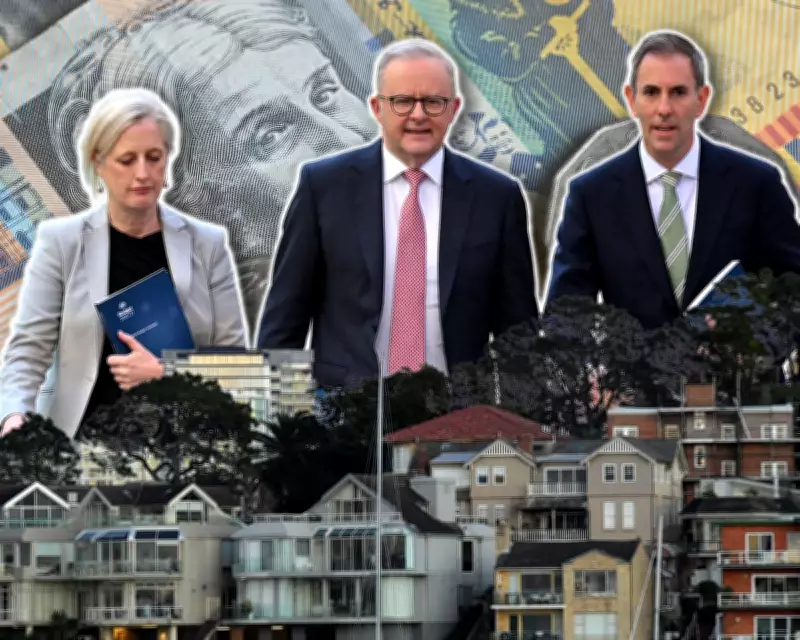
The finance minister, Katy Gallagher, the prime minister, Anthony Albanese, and the treasurer, Jim Chalmers, have unveiled the 2026 federal budget, which includes changes to the capital gains tax discount and negative gearing concessions. These measures are designed to help owner-occupiers gain a foothold in the housing market.
How Labor’s Budget Hit the Brakes on Australia’s Housing Market
Economists believe home values are set for their first national slump since 2022, though Australia’s persistent housing shortage means any fall would be short term. Mortgage broker Steph Thomas rarely hears from homebuyers looking to pull out mid-purchase, but four rang up after the government curbed investor tax breaks in last week’s budget. Two were investors weighing the impacts, but two were owner-occupiers entirely unaffected yet worried by the reforms. Thomas noted that the average buyer “doesn’t necessarily understand” terms like capital gains tax or negative gearing, and “people are a bit scared.” Fear is expected to weigh on property prices, with sentiment already down due to rising interest rates and economic pessimism.
Market Reaction and Forecasts
More than half of homes listed for auction in Sydney during budget week did not sell, the weakest result since pandemic lockdowns began in April 2020, according to preliminary Cotality data. Ray White reported open home attendance fell by a sixth nationwide. Auctions have recorded a national clearance rate below 60% for much of the past two months, putting the market in price fall territory. Thomas said, “There’s a lot of people in media talking about the potential of rental prices increasing and property prices dropping dramatically. When they heard it in the media and it came out strong, I think people just get frightened because they don’t understand what it actually means.”
The ‘Scare Campaign’
Labor’s changes target those making future property investments, who will no longer enjoy negative gearing on most purchases and will be taxed at a new inflation-adjusted rate for capital gains. The country’s 2.3 million investors will retain all tax advantages on their existing 3.3 million properties. Treasury forecasts just a fraction will exit, pushing rents up less than $2 a week on average and allowing about 75,000 people (1% of renters) to enter the market. Investors can still negatively gear newly built homes, and some economists believe reforms may leave some better off. Despite this, parts of the property industry and commentators have raised alarms. Tom Panos, top real estate agent and auctioneer for TV show The Block, predicted an investor exodus. Jack Henderson, a real estate agent and social media influencer, predicted a 15% boom in rents. Sam Gordon, another influencer, said investors may stop buying and selling. A post-budget Newspoll found more people expected to be worse off than better off across all groups, including young people and renters.
Treasurer Jim Chalmers blamed the result partly on “an unhinged scare campaign from people with partisan or commercial interests,” stating the government aims to fix the under-taxation of property investment. “It’s driven this situation where house prices have grown more than twice the rate of incomes,” he said. “What we’re doing is introducing a fairer, more neutral treatment … taking out that distortion which has locked too many young Australians out of housing in the first place.”
A Short-Term Slump?
Economists believe the strength of homebuyers’ and investors’ reaction could drag the housing market from weak growth to a short-term slump. Investor activity had contributed to home prices rising nearly 10% in the year to February in capital cities, according to Cotality, but that pace has slowed to just 3% annualised in May. Trent Saunders, a Commonwealth Bank economist, said fundamentals mean house prices should end 2026 growing at 3%, but slumping sentiment would undermine the weak market. Home lending has recorded its sharpest start-of-year slowdown since 2019, weighed down by three consecutive interest rate rises and rising living costs. The number of new loans fell 6.2% in the first three months of 2026 compared with the prior three months, as reported by the Australian Bureau of Statistics. Investor lending fell 5.3% after rising to record highs in 2025.
Labor’s tax changes are designed to rebalance the ratio in favour of owner-occupiers, not achieve a specific price growth pace. Chalmers expects house prices to continue rising at a slower rate in the long term. However, in the short term, economists from NAB, Macquarie, Barrenjoey, HSBC, and UBS expect house prices to fall. Cotality data suggests the median price in capital cities has already started falling.
House Prices Could Fall, Then Resume Rise
Matt Bowes, housing expert at the Grattan Institute, said the reforms’ small drag on house prices would help affordability in the short term. “If we’re going to see houses become more affordable over time, we need to slow the pace of house price growth,” Bowes said. “Having house prices grow more slowly than living standards for a number of years would be a positive outcome.” Shane Oliver, chief economist at AMP, expects the price hit to arrive quickly as investors step back. “This will no doubt be chalked up as a win for the policy change. The property market had already slowed down and then the tax changes add to that.” The expected slump would be the first sustained fall since 2022, when prices fell about 7.5% in eight months, only to recover losses eight months later.
Chalmers has said housing supply is “the main game” for improving affordability, but the government’s housing council expects Australia will fall 220,000 homes short of its goal to build 1.2 million new homes by 2029. Oliver believes the undersupply will push prices back up once interest rates ease and the tax shock passes.