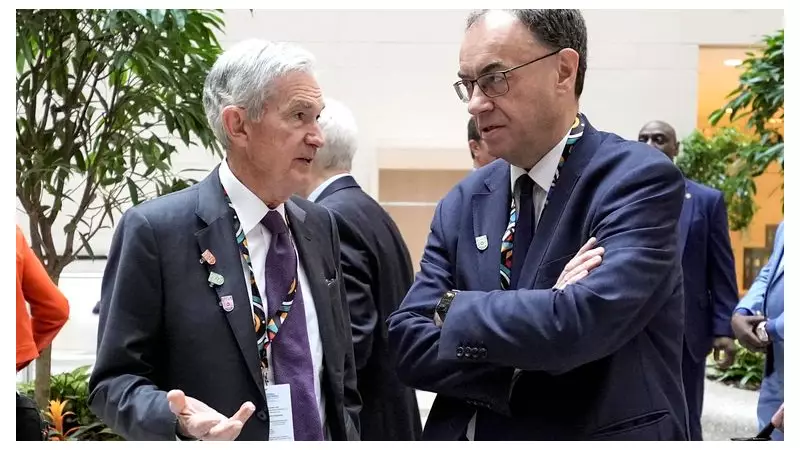
In a powerful show of international unity, the Governor of the Bank of England has joined fellow central bankers worldwide to publicly defend the embattled head of the US Federal Reserve.
Global Solidarity for Powell as Legal Pressure Mounts
Andrew Bailey added his name to a joint statement on Tuesday 13 January 2026, declaring "full solidarity" with Federal Reserve Chair Jerome Powell. This move comes just days after Mr Powell revealed he and the Fed are facing a potential criminal investigation by the US Department of Justice (DoJ). The preliminary inquiry focuses on spiralling renovation costs for the central bank's buildings, which have exceeded original estimates.
The statement, also signed by European Central Bank President Christine Lagarde and other global counterparts, forcefully argued that central bank autonomy is a non-negotiable pillar of economic stability. "The independence of central banks is a cornerstone of price, financial and economic stability in the interest of the citizens that we serve," it read. The bankers emphasised the need to preserve this independence "with full respect for the rule of law and democratic accountability."
A "Pretext" for Political Influence?
Mr Powell, who had largely avoided public comment on a long-running tussle with the Trump administration over control of the Fed's rate-setting committee, broke his silence on Sunday. He characterised the DoJ's actions as a "pretext" designed to exert greater political influence over American monetary policy. His claim has garnered cross-party condemnation in the US.
This is not the first time Mr Bailey has spoken out in defence of the Fed's independence. He has previously voiced concerns following financial market instability linked to White House efforts to pressure the Fed into faster interest rate cuts.
Uncertain Future for Fed Leadership
The legal row casts a significant shadow over the leadership transition at the world's most influential central bank. Jerome Powell is due to step down in May after serving two terms, but there is now considerable doubt over whether the US Congress will approve any successor nominated by the White House amid the escalating controversy.
Further complicating the political landscape, the Trump administration is concurrently seeking to fire a member of the Fed's rate-setting committee, Lisa Cook—an appointee of the previous Biden presidency. A Supreme Court hearing on that matter is scheduled before the end of January.
While former President Donald Trump, who has previously criticised Mr Powell, has distanced himself from the Washington US Attorney's information requests, the subpoenas related to Fed building costs remain active. The global financial community now watches closely, as the principle of central bank independence faces one of its most direct challenges in recent memory.