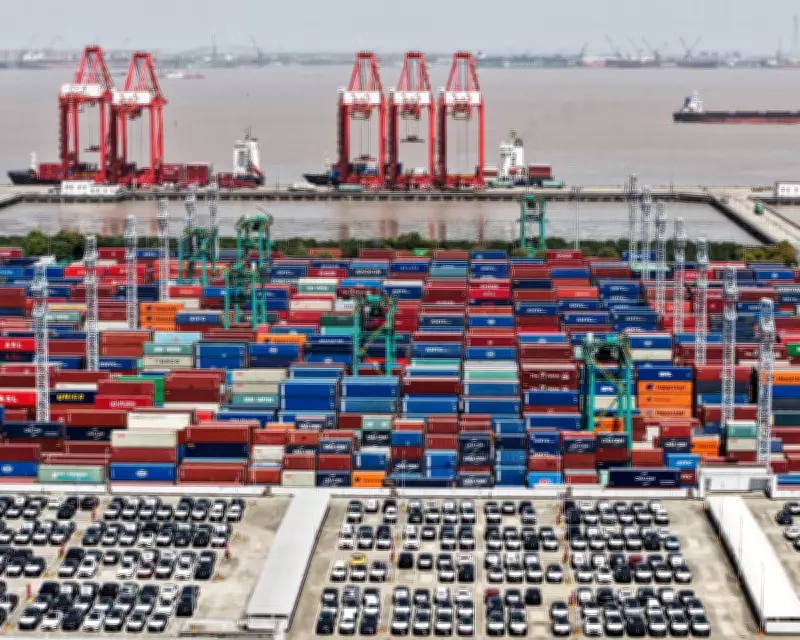
Europe is confronting a new China shock that risks cannibalizing local factories, causing job losses, and leading to a de facto colonization of industry by Beijing, according to trade analysts and representatives. They warn that the plunging exchange rate and support for Chinese 'zombie firms' echo the crisis in the US 25 years ago when the term 'China shock' was first used, referring to the impact of China joining the World Trade Organization and displacing local industries, resulting in up to 2.5 million job losses.
Growing Dependence on Chinese Components
Jens Eskelund, president of the European Chamber of Commerce in Beijing, noted that while many think of finished goods like electric vehicles, the real problem lies in the sheer volume of components imported from China. 'If anything, Europe is getting more dependent on China,' he said. As Chinese components become deeply embedded in the EU's industrial bloodstream, the bloc faces stark choices. According to a Financial Times report, the EU is considering forcing European companies to buy critical components from at least three different suppliers.
Urgent Talks and Measures
European commissioners will meet on May 29 for urgent talks on possible measures. Oliver Richtberg, head of foreign trade at VDMA, commended Brussels for its engagement, unlike Berlin. He highlighted that state subsidies unfeasible in Europe make Chinese products cheaper, but the bigger worry is exchange rate changes. Jürgen Matthes, a German economist, suggested the yuan could be 40% undervalued against the euro, leaving procurement bosses with little choice.
Richtberg explained that if a Chinese supplier offers 95% quality at 30-50% lower cost, it is a rational choice. 'This is what is hurting us. We cannot accept this any more because it is just unfair,' he said. He warned that Europe is losing market share and industry is under significant pressure, with Germany alone losing 22,000 jobs in the machinery industry last year.
Cannibalization of Industries
Soapbox, a China trade watch website, reported that data confirms the prospect of industry cannibalization, which is 'more worrying than expected.' For example, the EU imports 52% of amino acids by value from China, but 88% by volume. For polyhydric alcohols, used in plastics and cosmetics, 96% of EU imports by volume come from China. The anonymous author warned that low-priced supply could make EU production uneconomic, leaving the union dependent on the source that displaced it.
Trade Imbalance and Job Losses
Trade figures show China's surplus with the EU ballooning. Andrew Small of the European Council on Foreign Relations noted that China shock dynamics persist, and EU tools are not commensurate with import levels. China is now Germany's top trading partner, with its surplus doubling from $12 billion to $25 billion between 2024 and 2025. Imports from China hit $118 billion while exports dipped to $93 billion. An estimated 250,000 industrial jobs have been lost in Germany since 2019, with 51,000 lost in car manufacturing between 2024 and 2025.
Eskelund called the growing reliance on China an existential worry, noting that 26% of chamber members are increasing their onshore presence in China. 'There is already deindustrialisation as we speak – Germany losing something like 10,000 to 15,000 jobs a month. At some point this could become a security issue,' he said. Small added that China is still massively underweight in debates about European industry.
EU Legislative Proposals
The EU has proposed the Industrial Accelerator Act, or 'made in EU' law, and an update of the Cyber Security Act of 2019 to allow companies to stop buying Chinese on security grounds. However, these will not be in force until 2027, leaving Brussels under pressure to provide immediate lifelines. Small questioned where member states stand, noting tariffs are a nonstarter. 'A huge amount of political energy went into getting tariffs. They were always going to fall short,' he said.
While the EU calibrates its decisions against China's inevitable hostile reaction, Beijing is seen as in the driving seat. Small concluded, 'China doesn't need to stop all the new countermeasures the EU has at its disposal, it just needs to snarl up the process with the aim of keeping their exports flowing.'