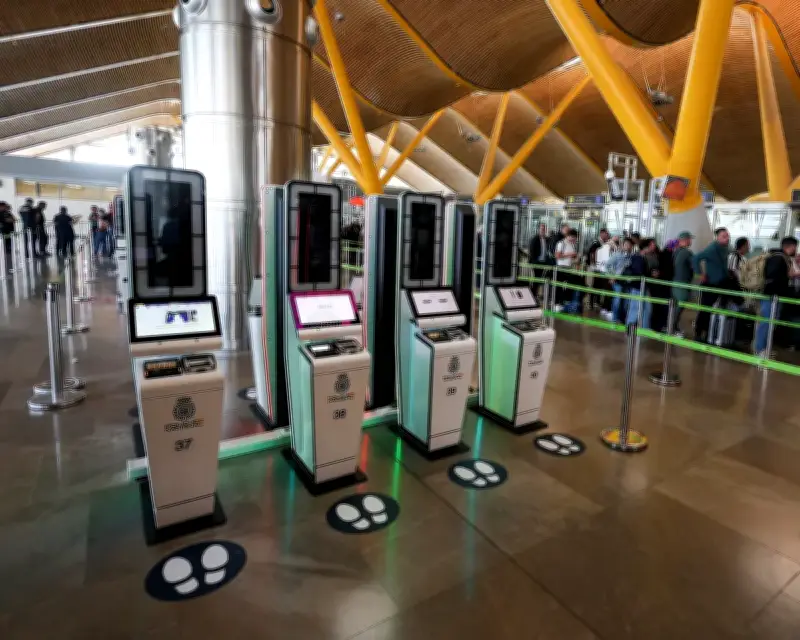
The EU's new digital Entry/Exit System (EES) has caused significant disruption for UK travellers, with reports of three-hour delays, missed connections, and biometric registration failures, according to travellers who shared their experiences with the Guardian. Despite these issues, Brussels has rejected calls from airports and airlines to suspend the scheme over the peak summer period, though border police can relax requirements under an opt-out that expires next month.
System failures and overstayer fears
The EES, which requires non-EU citizens to register, be photographed, and fingerprinted on arrival and departure from the Schengen zone, has been technically in full force since April after launching last autumn. One of its main purposes is to track whether non-EU citizens exceed their permitted 90 days in the bloc within a rolling 180-day period.
Martin Farrall, a retired university professor from Warwickshire, reported that his EES record failed to record his exit from the Schengen zone. In May, the 67-year-old and his wife arrived by ferry at Hoek van Holland, where Dutch border police enrolled them into EES, but no entry stamp was made on their passports. After returning to the UK on 30 June via the Dunkerque-Dover ferry, Martin found his residency tally was rapidly diminishing instead of showing 35 days left.

“It appeared that EES had not been updated to show I’d left the Schengen area,” said Martin, who feared being registered as an “overstayer” at risk of refusal of entry in future. He reported the error to the Directorate General for Foreign Nationals in France on 13 July but received no response. When he checked on 7 August, the EES website showed zero days left, but by 17 August it had updated to show 34 days left. His wife’s passport showed 90 days left despite identical travel history.
Fingerprint failures and confusion at airports
Nadia, a solicitor from Greater Manchester, described the system as “pretty shambolic” after experiencing contrasting trips this summer. A June trip to Tenerife was “quite straightforward,” but at Frankfurt airport in July, she faced a “ridiculously long” queue with limited information. She noted that border police did not take fingerprints due to the queue length, and she questioned the system’s efficiency and data security.
Kevin, 75, from Merseyside, and his wife Christine, 73, struggled with fingerprint machines at Lanzarote airport in June. “Some were not working. I noticed people getting angry when their fingerprints would not enter,” he said, adding that people resorted to hitting the glass harder. The couple eventually registered, but they are bracing for issues on their next cruise trip to Palma.
Martin, 68, a retired IT worker from Stockport, said the fingerprinting system failed for him and his wife at Schiphol airport in April. “Older people with drier fingers have trouble with touch screens,” he said. He was sent to manual entry, where his passport was not stamped, causing questions from German border police at Dusseldorf. He described the interface as “poorly laid out” and not properly tested for older people.
Visa mix-ups and accessibility concerns
Evie, 23, a student from Manchester studying in Munich, said her student visa caused confusion at Munich airport, where EES screens describe the system as registering “visitors.” She was often directed to the EES queue despite holding an extended-stay visa, and had to explain her situation “virtually every time” she flew in and out of Germany. She called for better signposting, especially given unreliable airport wifi.
Ed Griffiths, 67, a retired IT specialist from Buckinghamshire, said his visually impaired wife could not use the machines at Prague airport last September, leading to a 75-minute delay and a nearly missed taxi. In Milan in March, the system ignored his previous registration, and he waited an hour for manual assistance. In Vienna in May, an officer supervised the booths, and the couple got through in five minutes, but Ed noted, “Twice we have been registered already, and it made no discernible difference.”

These accounts highlight the system's teething problems, which have led to frustration and anxiety among travellers. The EU has allowed border police to relax requirements if queues become unmanageable, but this opt-out expires next month, leaving travellers uncertain about future disruptions.