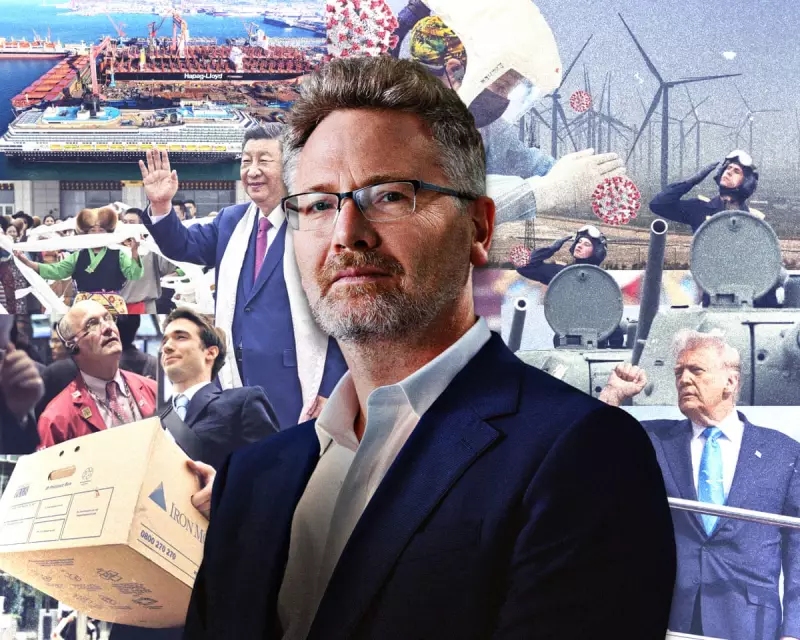
In a world reeling from financial shocks, climate emergencies, and a fragmenting international order, one historian has emerged as a pre-eminent interpreter of our turbulent times. Adam Tooze, a London-born academic based at Columbia University in New York, has transitioned from a specialist in European economic history to what his Financial Times editor calls "a sort of platonic ideal of the universal intellectual."
A Bruising Encounter in Brussels
The stark contours of this new era were laid bare in late January 2025, just ten days after Donald Trump's second inauguration. At an economic conference in Brussels, former Biden administration officials, including Trade Representative Katherine Tai, put on a brave face, touting their late-term achievements. The mood shifted dramatically when Adam Tooze joined the panel remotely.
Tooze delivered a blunt assessment: the Biden team had "failed in its absolutely central mission, which was to prevent a second Trump administration." He argued that the veterans on stage had, in fact, hastened the dismantling of the liberal world order they lamented, pursuing a China-containment policy that mirrored Trump's aggressive stance.
Tai's retort invoked a parable from actor Martin Sheen, asking Tooze, "Where are your scars, Adam? I can show you mine." Reflecting months later, Tooze was flabbergasted by what he saw as the self-satisfied sentimentality of American liberal elites, clinging to a vision of politics from TV shows like The West Wing while refusing to confront the scale of their failure.
From Academic Historian to Global Guide
Tooze's journey to this position of influence began with his 2018 book, Crashed, a contemporary history of the 2008 financial crisis. The book established him as a leading economic commentator, popular among Democrats critical of Obama's cautious fiscal response. His analysis, focusing on the global financial system as an interconnected matrix rather than separate national economies, provided a crucial framework for understanding the crisis.
His reach is now vast. He writes for the Financial Times and London Review of Books, hosts podcasts, and runs the wildly influential Substack newsletter Chartbook, sent daily to over 160,000 subscribers, including Nobel laureate Paul Krugman. A Chinese-language version garnered an estimated 30 million impressions last year.
This platform has given him unique access to power. In 2019, Senate Democratic leader Chuck Schumer invited him to Washington, where Tooze advocated for a massive investment surge, advice Schumer seemingly took to heart during the crafting of Biden's climate legislation. Tooze was even summoned to White House consultations in 2022, an experience he found deeply disillusioning, criticising the "narcissism" of Biden's team and the compromised nature of the final Inflation Reduction Act.
Confronting the "Radicalism of the Present"
At the core of Tooze's work is a commitment to confronting what he terms the "radicalism of the present." He biases his interpretation of modern history toward the thought that it might be unprecedented. This lens leads him to argue that Western policymakers, obsessed with the past, often fail to see the world as it is—particularly the epochal rise of China.
For Tooze, the climate crisis exemplifies this. He points to a graph of global coal production since 1700, where China's line, after 1950, becomes a near-vertical ascent, dwarfing the historical output of Britain, Germany, and the US. China, he argues, is both the climate crisis and its solution, now manufacturing more solar panel capacity in a single year than the US's total installed capacity.
This presents the West with a "popular front" question akin to the WWII alliance with the Soviet Union: to tackle climate change, must it find an accommodation with a economically dominant China led by "proper Stalinists"? Tooze's conviction is that the West must accept the end of its era of global domination and embrace a deep realism. "Ours is a bit part and not the starring role," he told a lecture audience. "This song is not about us."
Navigating Criticism and Personal History
Tooze's broad appeal has not shielded him from fierce criticism. In 2019, Marxist historian Perry Anderson published a scathing 16,000-word critique, accusing Tooze of failing to reckon with deep structural forces and essentially "running with the hare and hunting with the hounds"—trying to please both leftist academics and the Davos elite.
The attack devastated Tooze, a long-time reader of Anderson's work. He rejects the charge of hypocrisy, insisting on honestly acknowledging his privileged background as "the product of five generations of university-educated women" and a senior professor at an elite institution. His complex family history—including a grandfather who was a Soviet spy and a father known for his "toxic masculinity"—steered him away from the "toxic culture" of economics and towards history.
Now an American citizen, Tooze remains in the US despite Trump's return, partly due to family and partly because he disagreed with colleagues fleeing to Canada. He is vocal on issues like Palestinian rights but reluctant to label Trump's government "fascist," wary of easy historical analogies that obscure the novel perils of the present.
Ultimately, Adam Tooze sees his role as that of a teacher: to help people pin their eyes open, without flinching, on the unprecedented reality we inhabit. From the silent disco of electric cars in Chengdu to the graphs of Chinese coal production, he urges a clear-eyed confrontation with a world where the centre of gravity has decisively shifted, demanding new maps from an intrepid cartographer of crisis.