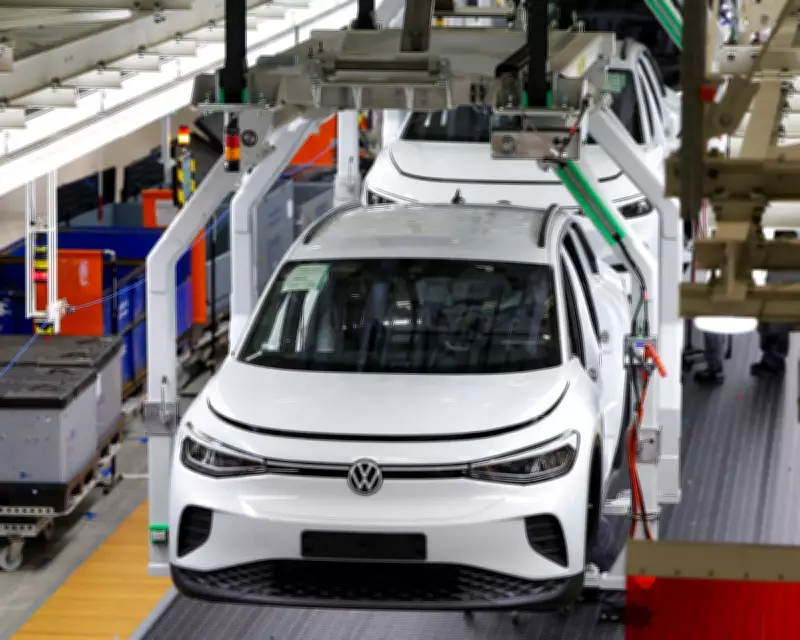
Volkswagen Announces Major Restructuring with 50,000 Job Cuts
Europe's largest automaker, Volkswagen Group, has unveiled plans to eliminate 50,000 jobs by the end of the decade. This drastic measure comes as the company grapples with a 54% plunge in pre-tax profits, falling sales in key markets, and the ongoing impact of punitive US tariffs imposed by the Trump administration.
Profit Plunge and Geopolitical Pressures
The 10-brand automotive giant reported that its pre-tax profits dropped to €8.9 billion (£6.6 billion), a decline largely attributed to "US tariffs" and a costly strategic shift at its luxury subsidiary Porsche. The company warned that global turbulence, including the US-Israeli military action against Iran, could negatively affect its outlook by increasing market uncertainty and driving up energy prices.
Volkswagen stated: "Challenges are expected in particular from the macroeconomic environment, uncertainties regarding restrictions in international trade and geopolitical tensions." This volatility is expected to intensify competition and create instability in commodity, energy, and foreign exchange markets.
Luxury Brands Under Pressure
The job cuts will affect the entire group in Germany, including premium marques Audi and Porsche, which are facing particular pressure. Porsche's operating profit nearly vanished in 2025, falling by 98% to just €90 million, as the brand postponed its transition to electric vehicles due to slack demand.
Volkswagen Group CEO Oliver Blume noted that while the Iran conflict isn't directly impacting the company's supply chain, it could affect demand for Audi and Porsche vehicles in the region, where volumes are modest but margins high. "We are simply seeing how volatile and fragile our world is, with new issues arising every month," Blume said.
Strategic Challenges Across Markets
The automaker faces multiple challenges simultaneously:
- Chinese Market Decline: Domestic competition has eroded Volkswagen's share in China, the world's largest car market, prompting Blume to announce "the largest product campaign in our history" to win back customers.
- European Stagnation: Even before Trump's tariffs, Volkswagen struggled with flat demand in Europe and the costs of investing in electric vehicles despite disappointing demand and insufficient infrastructure.
- Electric Vehicle Retreat: The group has been scaling back its electric vehicle production targets in recent months, including at its Italian supercar manufacturer Lamborghini.
Restructuring and Future Outlook
The 50,000 job cuts represent an expansion of previous restructuring plans. Volkswagen had already struck a deal with German trade unions at the end of 2024 to eliminate 35,000 jobs by 2030, partly through natural attrition via retirement and other staff departures.
Blume acknowledged the difficult environment while pointing to progress: "After three intensive years of realignment within the Volkswagen Group, we are seeing tangible progress. At the same time, we are operating in a fundamentally different environment."
The automotive giant's announcement underscores the profound challenges facing traditional car manufacturers as they navigate trade wars, shifting consumer preferences, and geopolitical instability while attempting costly transitions to electric mobility.