
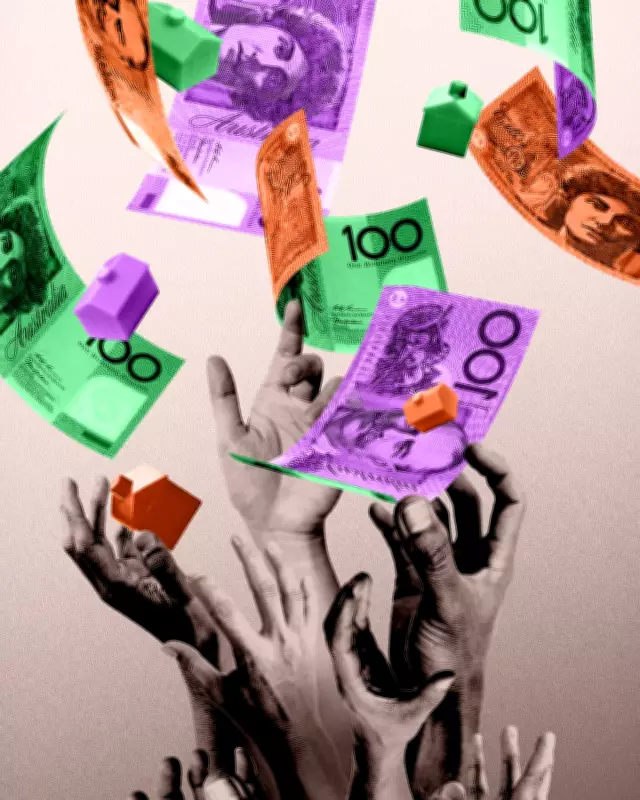
The $5.4 Trillion Wealth Shift Transforming Australia's Future
Australia stands on the brink of one of the most significant economic transformations in its history. Over the next two decades, an estimated $5.4 trillion in assets will transfer from baby boomers to younger generations through inheritances and gifts. This massive intergenerational wealth transfer represents one of the greatest challenges facing the nation, threatening to reshape social mobility, economic equality, and Australia's cherished fair go principle.
From Satirical Plotline to Economic Reality
Two decades ago, the television series Kath and Kim used inheritance as a satirical plotline, portraying Kim's desperate anticipation of her wealthy mother-in-law's estate as comical greed. Today, that same anticipation has become an economic reality for millions of Australians. The explosion of property prices since the show aired in 2004 has transformed inheritance from a comedic device into a potential lifeline for younger generations struggling to secure their financial futures.
Guy Debelle, former deputy governor of the Reserve Bank of Australia, has identified this wealth transfer as one of the country's most pressing near-future challenges. With Australia now boasting the world's second-highest median wealth and nearly 2 million millionaires in US dollar terms, the distribution of this wealth matters profoundly. More than half of personal wealth remains tied up in property, creating stark divisions between those with property-owning parents and those without.
The Growing Inequality Within Generations
University of Melbourne economist Dr. Melek Cigdem-Bayram reveals concerning trends in intergenerational wealth transfers. Between 2002 and 2022, the percentage of Australians receiving "inter vivo gifts" from living parents or grandparents increased from 5% to 7%, with average values rising from $6,500 to $10,300. These transfers have become increasingly unequal, with the top quarter of cash gifts averaging over $40,000 - potentially life-altering amounts when invested early.
"That's when I think we will start to see the full-blown implications on wealth and equality," Cigdem-Bayram warns. Inheritances significantly increase home ownership likelihood, even when received at ages 50 or 60, creating what she describes as a "vehicle to build wealth" that may exacerbate existing inequalities.
Research from the University of New South Wales and the Australian Council of Social Service reveals particularly pronounced wealth concentration among younger Australians. The top 10% of under-35-year-old households hold almost half the wealth of their entire age cohort - a greater concentration than in any other age bracket. Associate Professor Bruce Bradbury notes that while popular debate often focuses on generational conflict, "the growing gap within younger generations is an issue people need to pay more attention to."
The Erosion of Social Mobility
Dr. Ken Henry, former head of the federal Treasury, grew up believing education guaranteed social mobility and home ownership. "We just took it for granted," he recalls. Today, he acknowledges that a young person in similar circumstances would face "much, much, much different" prospects.
While Australia maintains relatively high income mobility compared to other nations, wealth persistence between generations presents growing concerns. Productivity Commission chair Danielle Wood notes that "direct wealth transfers through gifts, 'bank of mum and dad' support for property purchases and inheritances feed into wealth persistence." With trillions expected to transfer between generations by mid-century, she warns that "wealth persistence in the future will look more pronounced."
Cigdem-Bayram observes a hollowing out of the middle class, traditionally Australia's most productive segment and bastion of home ownership. "This dream that I think Australians had had for many years - what was achievable - was that everybody was capable of being a homeowner," she says. "All you needed was to work hard, and that was doable for everyone. And we're seeing that that's not the case any more."
Threats to Social Cohesion and Democracy
University of Technology Sydney economist Professor Peter Siminski links growing inequality to declining social cohesion and trust. "The larger inheritances are, the more compromised equality of opportunity becomes," he warns.
Henry expresses particular concern about the wealth transfer's impact on Australia's social compact. "Those who are not beneficiaries of the intergenerational wealth transfer stand to be somewhat disaffected by the fact that it's getting harder - or it seems to be getting harder - to accumulate wealth from your own effort." This disaffection, he suggests, could erode confidence in democratic institutions and potentially lead to political instability.
The economic implications extend beyond individual fortunes. Economies rely on large middle classes building wealth to generate social income. As Cigdem-Bayram notes, inequality "doesn't just end at housing or acquiring wealth or building wealth in this generation but it can carry over to future generations. It limits social mobility for those who are starting off with low levels of wealth."
A Crossroads for Australian Society
The scale of Australia's coming wealth transfer presents both challenges and opportunities. The house featured in Kath and Kim, which sold for $190,000 in 1997 and nearly $1.5 million in 2016, symbolizes how dramatically housing affordability has shifted. What was once an accessible Australian dream home now lies beyond reach for many highly educated, full-time professionals without family assistance.
Henry calls for renewed focus on Australia's egalitarian ideals: "I would like to see us focusing with much greater energy on that question of what it means to provide a fair go to all. Are we really a community that seeks to ensure that everybody has the ability to access a good life, a life that we would all agree they have reason to value?"
As Australia approaches this unprecedented wealth transfer, the nation faces fundamental questions about equality, opportunity, and what kind of society it wishes to become. The decisions made in response to this $5.4 trillion shift will shape Australia's social and economic landscape for generations to come.




