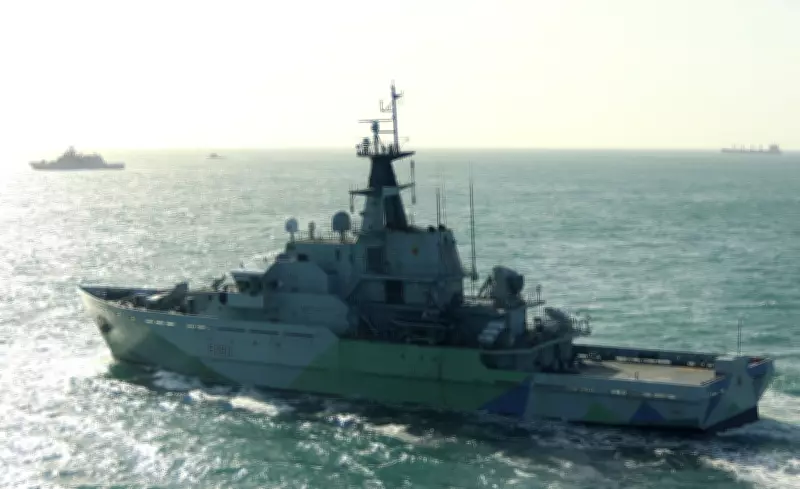
The Royal Navy tracked and followed a Russian frigate every day last month as it sailed from the Atlantic to the North Sea, amid heightened maritime tensions between London and Moscow. The Russian navy's Admiral Grigorovich escorted six Russia-linked vessels during April, including at least three under economic sanction passing east through the Dover Strait, while being continuously monitored by four UK ships and helicopters.
Russian Frigate Maintains Presence Near Britain
The frigate, which naval spotters believe remains in the North Sea, was able to sustain its presence near Britain by taking on supplies near the Galloper windfarm off the Suffolk coast. A second frigate, Admiral Kasatonov, passed through the Channel towards the end of April, escorting two merchant ships believed to be heading to Tartus in Syria. One of these, the Sparta, is associated with arms transport. That convoy was monitored by a British auxiliary ship, the RFA Tideforce, part of a wider commitment of the UK's stretched naval resources.
Defence Secretary Comments on Russian Submarine Activity
John Healey, the defence secretary, stated a month ago that the British navy had followed three Russian submarines on a month-long mission sailing over pipelines and cables near UK waters, likely spying on the infrastructure below. Elisabeth Braw, a security expert with the Atlantic Council thinktank, described the situation as "completely disproportionate," noting that navies normally only escort vessels when there is a clear military threat, such as from the Houthis in the Red Sea.

Russia's Shadow Fleet and Economic Sanctions
Russia relies on a "shadow fleet" of often old, poorly maintained tankers sailing under third-country flags of convenience for roughly half its seaborne oil exports. Braw added that Russia has decided this is an indispensable source of income that could be disrupted, and if the Russians thought these vessels would not encounter problems, they would not allocate a frigate. Prime Minister Keir Starmer announced on 25 March that the military could seize ships subject to existing economic sanctions transiting through UK waters. This reaffirmed existing powers but also confirmed a cross-government process for evaluating potential seizures. Starmer stated the UK would go after Vladimir Putin's "shadow fleet even harder" to safeguard the UK and starve "Putin's war machine of the dirty profits that fund his barbaric campaign in Ukraine."
Deterrence and International Actions
Since then, the UK has not led the seizure of any shadow fleet tankers, likely deterred by the presence of Russian warships in close proximity. Braw said the Russian government has shown it is willing to use its naval power to protect vessels that break maritime rules, making it much more difficult for coastal states to intervene. Other European countries have seized shadow fleet vessels this year, though it is not clear if any were escorted. Sweden has detained five tankers, the last of which, the Jin Hui, was boarded on Sunday on suspicion of flying under a false flag. France has seized two Russia-linked tankers with UK assistance this year, though each was released after the owners paid a fine. Belgian special forces seized an oil tanker bound for Russia with French help at the end of February; prosecutors said it was falsely flying the flag of Guinea. The US seized the Bella 1 or Marinera tanker in early January, which was reportedly escorted by a Russian submarine. It had been sailing towards Venezuela in defiance of a US blockade before turning around to evade seizure. In the days that followed, its crew painted a Russian flag on the side, but it was eventually run down and captured in the North Atlantic by the US with help from the UK.