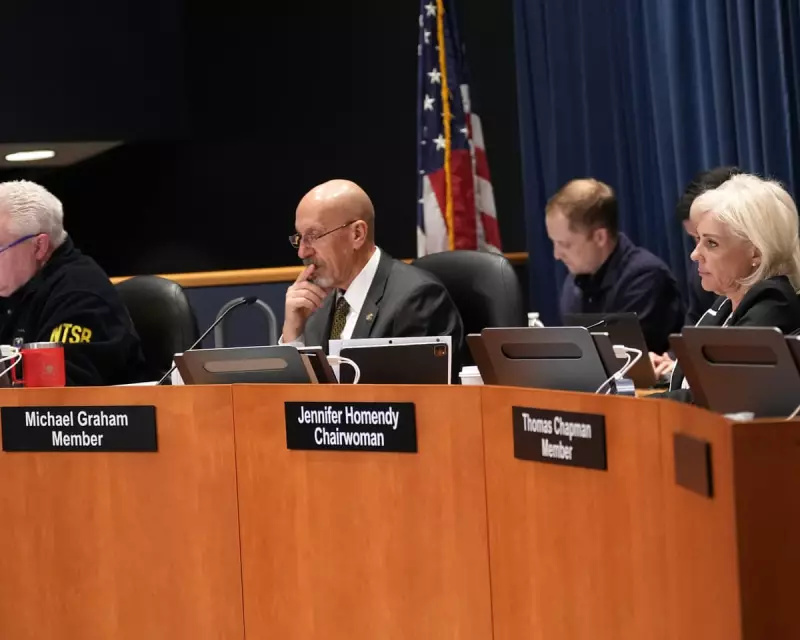
NTSB Chair Declares Fatal Washington DC Midair Collision '100% Preventable'
National Transportation Safety Board (NTSB) members expressed profound concern during a daylong hearing on Tuesday, examining a catastrophic midair collision near Washington DC that claimed 67 lives. The board highlighted years of unheeded warnings about helicopter traffic dangers and other critical safety issues that preceded the tragedy.
Systemic Failures and Missed Opportunities
Investigators detailed a troubling history of missed opportunities to address known risks. Key factors included the placement of a helicopter route within the approach path of Reagan National Airport's secondary runway, creating inherently dangerous airspace. Compounding this was a lack of regular safety risk reviews and air traffic controllers' excessive reliance on visual separation protocols.
The Federal Aviation Administration (FAA) had denied a 2023 request from a regional supervisor to reduce air traffic at Reagan National. Furthermore, authorities failed to relocate the problematic helicopter route or enhance pilot warnings despite an eerily similar near-miss incident occurring in 2013.
Emotional Testimony and Family Anguish
NTSB Chair Jennifer Homendy maintained a stern tone throughout proceedings, stating unequivocally: "We should be angry. This was 100% preventable. We've issued recommendations in the past that were applicable. We have talked about 'see and avoid' for well over five decades. It's shameful."
Family members of victims attended the hearing, some becoming visibly emotional as animations recreated the final moments of the collision. Kristen Miller-Zahn, who lost her brother, expressed frustration during a break: "The negligence of not fixing things that needed to be fixed killed my brother and 66 other people."
Technical Factors and Human Performance
Investigative animations demonstrated the extreme difficulty pilots faced in spotting each other amid Washington's night lights. Both aircraft windshields and the helicopter crew's night vision goggles further restricted visibility. Human performance analysis revealed that an air traffic controller felt overwhelmed as traffic increased to 12 aircraft shortly before impact, reducing situational awareness.
Katherine Wilson, an NTSB human performance investigator, noted that proper staffing protocols weren't followed: "If two controllers had divided responsibility for helicopters and planes, as required, the aircraft might have been warned sooner."
Organizational Shortcomings and Safety Culture
The hearing revealed significant communication failures between the FAA and Army, with safety data not being fully shared before the crash. Army helicopter pilots often remained unaware when involved in near-miss incidents around Reagan National.
Mary Schiavo, former US Department of Transportation inspector general, characterized the situation as "a shocking dereliction of duty by the FAA." She questioned whether current personnel could implement necessary fixes.
Recent Changes and Future Recommendations
Since the January 2023 collision between an American Airlines jet and an Army Black Hawk helicopter, the FAA has taken some corrective actions. These include permanently separating helicopter and plane airspace around Reagan National and reducing hourly arrivals from 36 to 30 aircraft.
The NTSB adopted numerous recommendations aimed at improving training, staffing, and safety standards. These measures seek to strengthen safety culture at both the FAA and Army while reducing collision risks. Chair Homendy endorsed proposed legislation requiring advanced aircraft locator systems, though she expressed concerns about potential conflicts of interest in FAA reorganization plans.
Broader Aviation Safety Context
While several high-profile incidents followed the Washington DC collision, NTSB statistics indicate 2023 saw the fewest total crashes since the COVID-19 pandemic began. The board continues pushing for systemic improvements to prevent similar tragedies, emphasizing that this disaster resulted from "systemic issues across multiple organizations" rather than individual error.