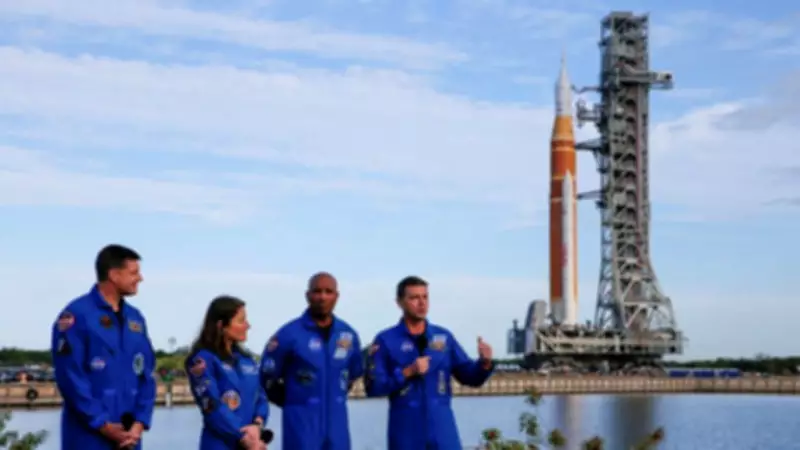
NASA has announced a potential delay to its highly anticipated Artemis II mission, which aims to send astronauts to the moon for the first time in over 50 years, following the discovery of a critical fault with the rocket. The agency had previously targeted 6 March 2026 for the launch from Florida's Kennedy Space Center, but a disruption in helium flow during preparation has raised concerns about the timeline.
Helium Flow Issue Threatens Launch Schedule
On Friday night, NASA identified that the flow of helium, essential for the rocket's launch, was interrupted during a key phase of the pre-launch process. A NASA spokesperson stated that this issue will almost assuredly impact the March launch window, casting doubt on the planned departure date. This setback comes after a successful second test on Thursday, where technicians replaced seals to address a prior hydrogen leak, which launch director Charlie Blackwell-Thompson described as a significant step toward mission readiness.
Crew and Mission Details
The Artemis II crew consists of four astronauts: three from the United States—Reid Wiseman, Victor Glover, and Christina Koch—and one from Canada, Jeremy Hansen. If the mission proceeds, they will become the first astronauts to travel to the moon since Apollo 17 in 1972, embarking on the farthest human flight into space ever recorded. The 10-day mission is designed to test life support, navigation, and communication systems in deep space, with the capsule entering Earth's high orbit for manual piloting before circling the moon for four days and returning to splash down in the Pacific Ocean.

Broader Implications for NASA's Plans
Artemis II serves as a precursor to NASA's Artemis III mission, scheduled for 2028, which aims to land astronauts on the lunar surface. These missions are integral to NASA's long-term strategy of establishing the Lunar Gateway, a space station for living and working, to prepare for future missions to Mars. The recent technical challenges highlight the complexities of space exploration and the rigorous safety protocols required for such ambitious endeavors.