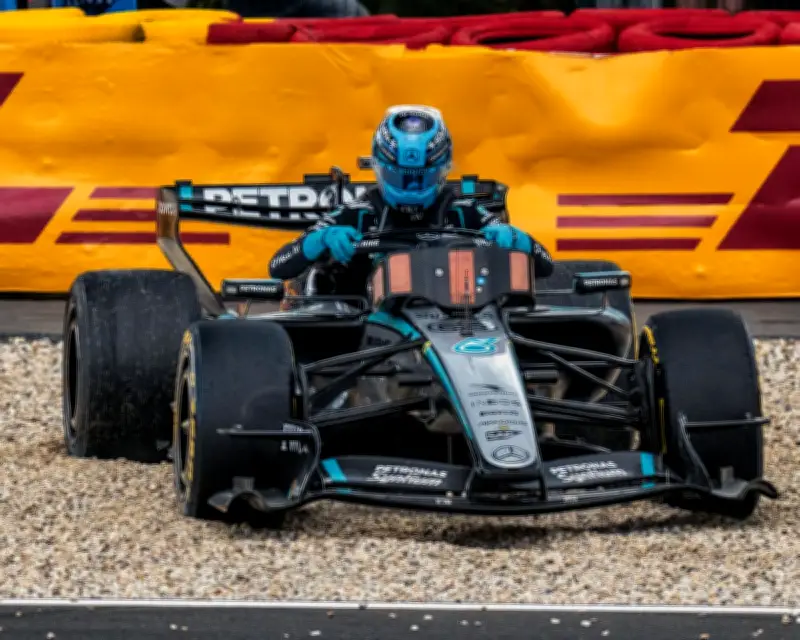
George Russell's championship hopes took a severe blow at the Belgian Grand Prix when his Mercedes suffered an inexplicable energy recovery failure through turn one, leaving him with no electrical power to deploy. He was swallowed up by Ferraris and then clipped by Lewis Hamilton through Les Combes, pitching him out of the race. Russell was furious, telling his team over the radio: "I had no fucking battery down the straight. Guys, unacceptable."
Energy Starvation Emasculates Classic Corners
The incident underscored a broader issue with F1's 2026 regulations: computer-controlled energy deployment now dictates races, reducing driver input and neutering iconic tracks. At Spa-Francorchamps, long straights left cars energy-starved, forcing the middle sector to rely solely on internal combustion engine power—half their potential output. Corners like Pouhon, once an exquisite test of risk and reward, became trivial. Lando Norris noted: "It's not a corner any more, it was easy flat."
Race-winner Kimi Antonelli's pole time was almost four seconds slower than last year's, yet F1 officials take comfort in entertaining racing. Drivers, however, bemoan the actual experience. Oscar Piastri, ordinarily even-handed, lost patience: "It sucks. I can't really say it any other way than that. When you've got qualifying grids decided by computers behaving or misbehaving, it's a pretty crap way of going racing."

Drivers United Against 'Skynet' Control
Max Verstappen gave a blunt assessment: "Welcome to F1 2026, sometimes it can be a jungle." Charles Leclerc, who finished second, added: "These power units are so complex that there are some days when you scratch your head trying to understand why you are losing so much on the straights. It's very difficult but also very frustrating for a driver because even when you are doing your best there are things in the background that change constantly."
Antonelli admitted: "Sometimes, especially on tracks like this that are very energy-demanding, if you start driving differently, then for the system it's a bit crazy." The unexpected changes in closing speed can be dangerous, as seen on the opening lap when cars converged on the Kemmel straight.
No Immediate Fix in Sight
The algorithms are now vital, determining when and how much energy to deploy, and drivers are at their mercy. The issue will persist throughout the season, with Monza looming as another high-speed circuit likely to amplify frustrations. The sport braces for more discontent as drivers demand a return to human-controlled racing.