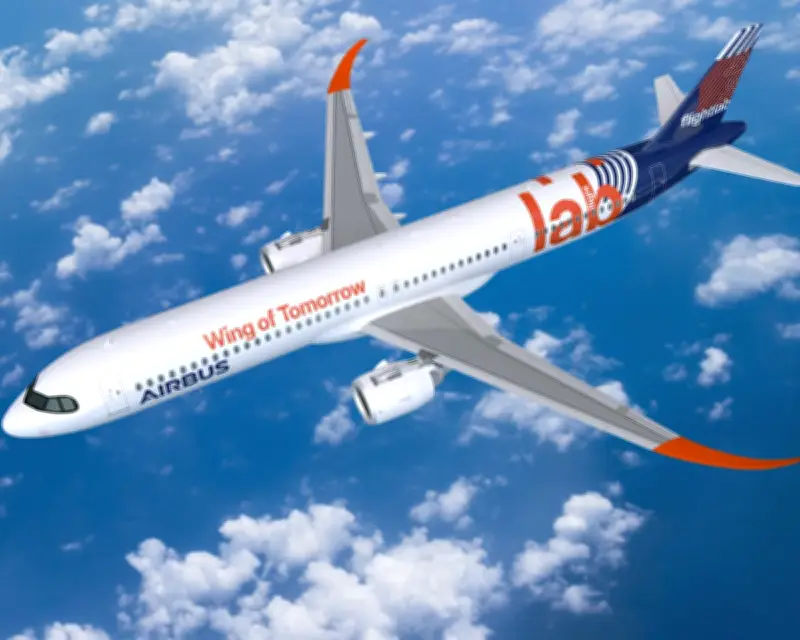
Airbus has announced plans to test folding wings for the next generation of its bestselling aircraft, as the world's largest planemaker races to define the shape of future commercial planes by the end of the decade. Longer, thinner wings made from lightweight but strong composite materials promise significant energy savings but pose a challenge because they may not fit at airports worldwide, many of which are already operating at or near full capacity.
Value of folding wings
"The value of being able to fold the wings is huge," said Sue Partridge, head of Airbus's wing of tomorrow programme, speaking at the Farnborough airshow near London. Folding wingtips offer a solution. Boeing has already installed them on its larger 777X, which has two aisles, but the technology has not been used on any single-aisle planes. Boeing is also exploring new technologies, including using a truss to brace longer wings.
Airbus said it will fit extensions of about four to five metres to the wings of one of its A321neo planes to test how different shapes perform in real-world conditions during the second half of next year. The A321neo is part of the A320 family, the bestselling aircraft model of all time.

Race for next-generation aircraft
The European manufacturer and its US rival Boeing are preparing to develop the next generation of planes after decades of selling their respective A320 and 737 models. Both companies are evaluating technologies to significantly cut energy usage, including new engines, hybrid electric systems, and longer wings.
Airbus is about to begin assembly of the wing extension at its factory in Broughton, north Wales. However, the initial phase of tests will only include the bolts to fix it in place, not yet the hinges that will allow it to fold. The company has said it will decide on the shape of its new aircraft by 2030. Partridge noted that Airbus already knows the next generation will use relatively heavy engines with a large diameter and that the wings will be bent like a gull's for extra aerodynamic benefit.
Engine choices and Rolls-Royce's ambitions
Airbus and Boeing will also need to select new engines. Airbus is considering covered engines that encase the fan blades or an "open fan" option with exposed blades. British manufacturer Rolls-Royce hopes to enter the market for higher-selling single-aisle planes, also known as narrowbodies, when the next generation is developed. Rolls-Royce CEO Tufan Erginbilgiç told reporters at Farnborough on Tuesday that the company has only two years to persuade the planemakers to choose its engines.
Erginbilgiç urged the UK government under new Prime Minister Andy Burnham to support the company's investments in its UltraFan engine programme. He noted that new Chancellor John Healey, previously defence secretary, "understands Rolls-Royce and our agenda." However, the plea for subsidy from the highly profitable manufacturer will have to be weighed against other spending priorities such as social care and ending rough sleeping.
Opportunity for UK manufacturing
Rolls-Royce is developing two variants of its UltraFan engine: one for larger widebody jets and another narrowbody version. Erginbilgiç said supporting the programme was worthwhile because it represented "the single biggest opportunity for the next 50 years" for UK economic growth and would "transform advanced manufacturing" in the country. "We would like to do it in the UK because it is our origin," he said. "But we have other options."
Kevin Craven, CEO of ADS Group, a lobby group for the British aerospace and defence industry, said the UK government should "focus on the champions for UK aerospace" in trying to win "probably the most consequential decision in our industry."