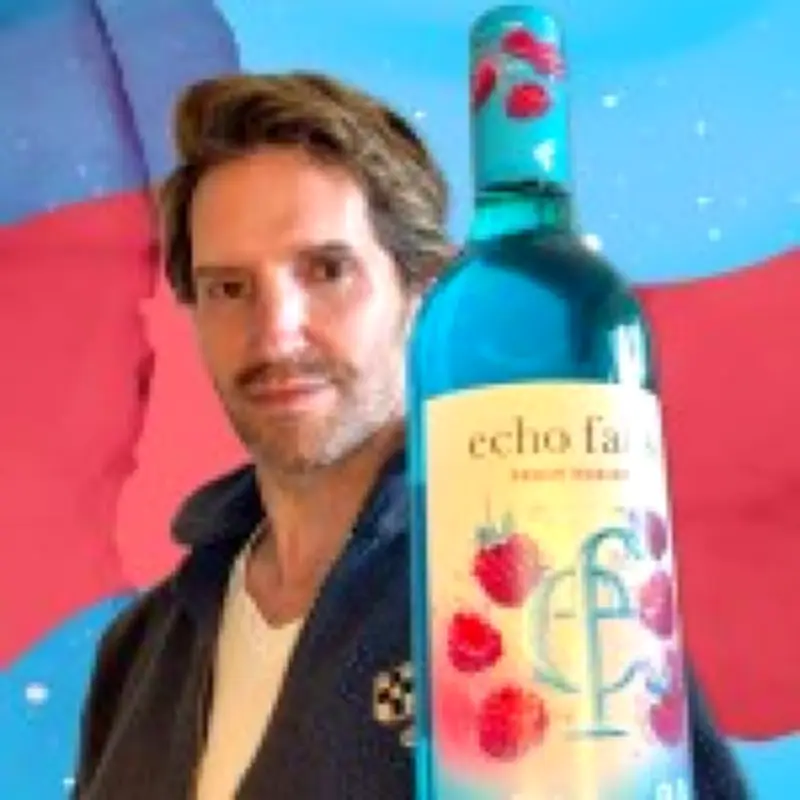
So, blue 'wine' is now a thing. Yes, it exists in the world. I've seen it with my own eyes and have even put it in my gob. You will likely have seen it too, as it's been all over social media. Echo Falls Fruit Fusion Blue Raspberry has officially gone viral, so much so that Morrisons has just brought out its own version, called Silver Bay Point. Both bottles retail for £6.
Echo Falls has been bringing easy-drinking Californian wine to our shelves since 2002, and the brand is pretty popular, but I have to admit, I don't have high hopes for this one.
What is it?
It's billed as a 'fruit-fusion', and it's been getting mixed reviews over social media. Some people are loving it, calling it 'dangerously good' and 'nostalgic', while others are less impressed, comparing its colour to 'mouthwash' and 'windscreen washer fluid'. Essentially, Echo Falls is selling us nostalgia. Unlike other flavours like lemon or strawberry, there's no authentic blue raspberry fruit this drink was inspired by. It's blue, and it tastes vaguely of raspberry.
But for anyone who grew up in Britain in the 1990s and 2000s, blue raspberry flavour carries a bizarre emotional significance. Slush puppies, Mr Frosty, penny sweets and fizzy drinks that stained your tongue electric blue after the boredom of last period maths class on a Tuesday afternoon. Ah, to be ten years old again.
Psychologists have found that nostalgic memories are often recalled through a warm and positive filter, rose-tinted glasses, if you will. Hence, old logos tend to reappear, and retro packaging often makes a comeback to great fanfare. And blue raspberry is a great example of that. Plus, modern food marketing has transformed a colour not associated with anything edible into something fun, innovative and novel. A blue-coloured drink is essentially clickbait in swallowable form. It's overtly artificial and is bound to taste sweet, and we're either here for it or running a mile in the opposite direction. I'm the latter.
Blue drinks are nothing new...
Blue drinks first came on the scene in 1850s Victorian England, with the invention of coal-tar dyes. Early 20th-century Europe was captivated by blue drinks; just look at Dutch-made Blue Curacao (Crème de Ciel), which uses blue food dye. It tastes confected and artificial against other triple secs like Cointreau, but was a roaring success in the 1950s in the Blue Hawaii cocktail.
Why I'm suspicious
Certain flavours don't belong in nature; blue raspberry is one of them. No one has stumbled across a blue raspberry bush in the wild; it's been dreamed up in a lab for confectionery. And now, somehow, it has made its way into the wine aisle, producing what I lovingly call 'Franken-wine's monster'. As a wine expert, blue 'wine' fills me with dread. What in the name of white, rosé, and red is going on with the world?
But then, I can't judge too hard. WKD Blue isn't too dissimilar and was a formative part of my tweenaged years. If you were anything like me and my Gen X and cusp-Millennial friends, you were doing a WKD Blue 'strawpedo' before heading out to Yates's or Brannigan's. Only to be turned away for having a crap fake I.D. and wearing the wrong shoes. Ring a bell? Either that, or we were 'blending' it with port, a la Charlotte Church. If you know, you know. Because alcopops aren't sweet enough on their own, you need to add in a sweet, fortified wine for good measure.
My grown-up, snobby side wants to pretend Echo Falls Blue Raspberry doesn't exist. That it's a fictional horror villain, like Freddy Krueger. Inexplicably, though, another side of me is compelled to taste it.
What did I think of it?
I tasted Echo Falls and Silver Bay Point, so you don't have to. Here are my thoughts.
Echo Falls tasted instantly sweet and artificial, like a raspberry-flavoured boiled sweet, or a Mr Frostie. It has a low-alcohol content of 9%, but it is still dangerous, as the sweetness prevents you from tasting any alcohol at all, and it comes off as a soft drink. Cloying on the lips and lacking in any complexity, I would not buy another bottle.
Silver Bay Point started the same way as Echo Falls, with an overly-sweet raspberry hit on the palate. Then something happened, some zestiness kicked in. This acidity was an essential ingredient which Echo Falls was lacking – vital for offsetting the sweetness and making it slightly more balanced. Although I wouldn't buy this bottle again either, as it's just not the drink for me, my overall verdict is that the one from Morrisons was far more palatable than Echo Falls.