Five decades after the punk bible Sniffin' Glue, DIY music fanzines are experiencing a radical resurgence in the UK, with creators citing resistance to algorithm fatigue and the hyper-capitalist music industry as driving forces. 'The most important part of the word 'fanzine' is 'fan',' says London-based zine-maker Jon Marsh. Existing outside mainstream media, free from release cycles and search engine optimisation, music fanzines are obsessions turned into tangible objects, self-published primarily for the maker's own enjoyment but with the potential of forging connections with like-minded people.
The punk legacy and today's revival
In the 1970s, punk zines such as Sniffin' Glue, Alternative Ulster, and Ripped & Torn allowed fans to share news and enthusiasm quickly and cheaply. Half a century on, music fanzines are enjoying a resurgence. 'Digital attention span is at an all-time low,' says hip-hop musician ExP, creator of the West Yorkshire Hip-Hop zine. 'You're almost definitely going to spend more time looking at a zine than anything you see scrolling. It's more interesting and more real.' In the words of Stephen McRobbie from indie-pop icons the Pastels: 'It's the long way round compared to other media, but the scenery is always better.'
Diverse genres and hyper-local scenes
Today's music fanzines reflect both individual passions and the eclectic tastes of collectives. They appear as punk one-sheets (Another Subculture) and Smash Hits-inspired puzzles (Hard Boiled Babe); documenting hyper-local scenes in Glasgow (Winch), Belfast (Poseur), south-east London (SelOut), and Teesside (Point Blank). 'I like to think that TQ serves as a living history of music in the north-east,' says experimental music zine TQ's editor Andy TarQuin Wood. This sentiment is shared by Nova, who co-edits Glasgow zine Teen Warfare with their friend Courtney. 'It acts as a permanent snapshot of a time in the scene,' they say. 'Even if some of the bands aren't around any more, this record is still there, which makes it special.'
Punk still features heavily, but just about every genre has a fanzine charting it, from ska (Do the Dog) to metal (Shrieks from the Abyss) and folk (Anarchic Folk). Newcastle-based Afropulse is a monthly zine celebrating Black British music. Jon Marsh started Wired Up eight years ago to express his love of glam rock. ExP created West Yorkshire Hip-Hop to build 'crucial infrastructure' locally. 'Hip-hop has always been about making something from nothing: rapping over beatboxing, graffiti with left-over paint, dancing in the street,' he says. 'Zines are a perfect way to connect a DIY community like ours.'
DIY aesthetics and techniques
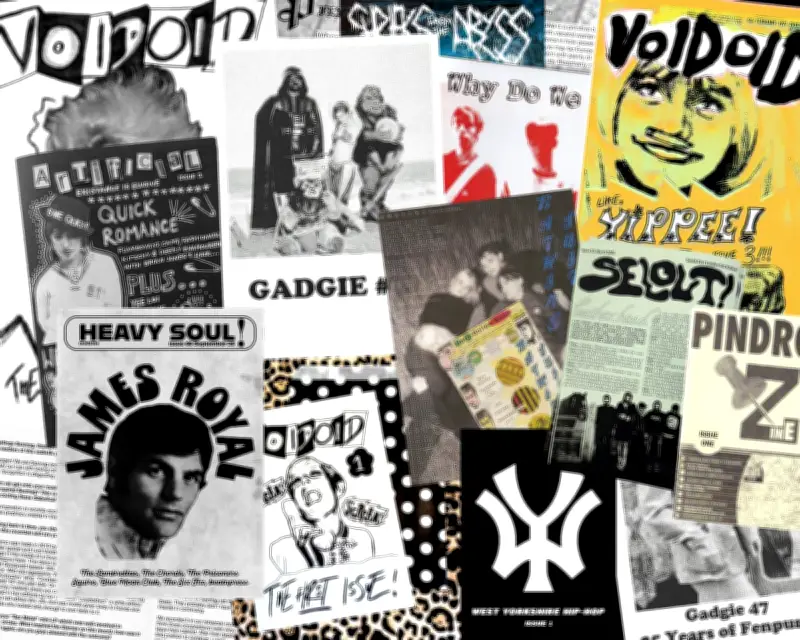
In defiance of AI slop, many young makers are adopting the cut-and-paste look of classic fanzines. Pindrop shares thoughts on the London underground scene via scrappy photocopied sheets. Voidoid features collaged essays on Lou Reed. Teenage friends Evan Moakes and Will White's dense, thoughtful Why Do We Care? (WDWC) was catalysed by a shared love of Manic Street Preachers. Encouraged by Moakes's father Gordon Moakes – a former bassist with Bloc Party who also edited the 90s zine Conform or Die – the duo created WDWC as 'equally a source of intellectual discussion and theory as of passion and spontaneity'.
Hamish Ironside's zine Saudade, originally from 1990-1994, returned in 2023 and is still printed on a Gestetner duplicator. 'The whole ethos of zines is DIY, and by owning my own printer I am totally self-sufficient,' Ironside says. Phil McMullen uses letterpress for his 'labour of love' Terrascopaedia, taking around seven hours to typeset a single page. 'I am drawn to featuring artists who share my sense of craft,' McMullen says, among them folk artist Sally Anne Morgan, who is also a letterpress printer.
Political and community impact
Zines have always been outlets for radical outsiders, such as bilingual Welsh zine Gwarth ar y Teulu, made by 'the misfits, the queers, the working class', according to Cardiff-based musician and editor Efa Supertramp. The latest edition of Texture features essays linking noise and resistance, including a piece on radio broadcasts in solidarity with Palestine. After the outbreak of war in Ukraine, TQ released a Ukrainian special featuring electronic musician Kateryna Zavoloka, who 'was very open about the effect of the Russian invasion on her music and her family', says editor Wood. Teen Warfare leveraged their zine's community for a protest outside a Disturbed concert over singer David Draiman's support of the IDF. 'Making it into a protest gig definitely encouraged more people to get involved,' says co-editor Nova.
Inter-generational appeal and future
The members of Scottish indie-pop band Bis have observed inter-generational appeal. 'Our continued appeal to fanzine creators comes from our genesis as fanzine creators ourselves,' reckons singer Sci-fi Steven, who edited Paper Bullets during the band's mid-90s breakout. 'Our era was the last pre-internet organic network, and I'd imagine there's a romance in that for [younger] generations.' Manda Rin credits their status as outsiders: 'The youth of today are not only attracted to us because of our political, shouty lyrics, but also the acceptance of being comfortably different to those around you.'
Zine-makers are connecting at gigs, online, and at zine libraries and fairs. 'Making a zine feels like speaking a forgotten language,' says White of WDWC. 'Whenever somebody who understands it hears you speak of it, you instantly bond with one another.' Wood sees everyone involved in TQ as 'part of a kind of looping collaboration'. Thirty years after they were zine-makers themselves, Bis still feel part of this communal creativity. 'Last year I found a fanzine in the back of my guitar amp – Why Do We Care? with Bis on the cover,' says Sci-fi Steven. 'After reading through and feeling the energy flying off the pages, I sat down to write a song that I thought the writers would want to hear. That's the real power.'