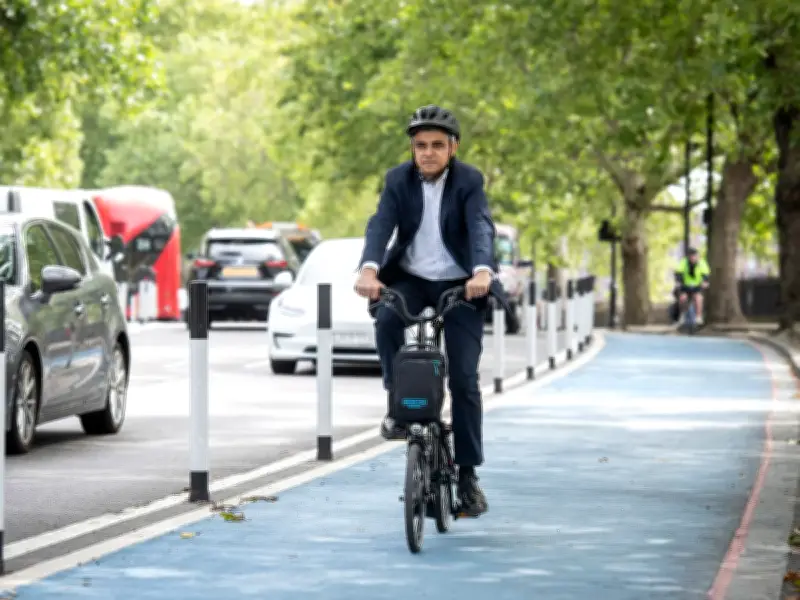
Transport for London (TfL) did not build any new protected cycle tracks on its own road network in the 12 months to March 2025, according to the annual Healthy Streets Scorecard released today by London’s Healthy Streets Scorecard Coalition (LHSSC). The Transport for London Road Network (TLRN) accounts for about five per cent of London’s roads by length but carries around 30 per cent of the capital's traffic.
Current cycle lane coverage
The TLRN currently has 137km of protected cycle tracks, representing 13.6 per cent of its 1,009km total length. This is a higher proportion than any London borough or the City of London. However, no additional protected cycle tracks were added on TfL-controlled roads in the past year, though TfL officials noted recent installations on Lambeth Bridge and ongoing work at Nine Elms Lane and A23 Streatham Hill.
Mixed progress on other measures
TfL did roll out more 20mph speed limits and added 19km of bus priority lanes, including a new 10km bus lane on Bromley Road in Lewisham. However, the scorecard also revealed a 2.4 per cent increase in serious and fatal road casualties (KSIs) on the TLRN. High streets and town centres such as Brixton, Clapham High Street, and Whitechapel Road were cited as particular danger zones.
Pedestrian crossing issues
The analysis found that 7.5 per cent of crossings on the TLRN lack any pedestrian phases, and nearly half have only partial coverage where at least one arm of the junction has no pedestrian signals. Simon Munk of the London Cycling Campaign, part of the LHSSC, said: “In the last year of data, despite TfL delivering more 20mph limits, collisions have risen, and traffic volumes and rollout of cycle tracks and bus priority measures have essentially flatlined while nearly 60 percent of TfL junctions have missing pedestrian signals.”
Calls for step change
Munk added: “The Mayor's made great strides in delivering the 'Healthy Streets' agenda in general, but there are weak points, particularly in TfL's delivery. TfL officers frequently talk about a 'step change' needed to ensure London gets truly healthy streets where kids play out, people walk and cycle - but there's little sign of that change and far too much 'business as usual'.” An LHSSC spokesperson said: “This is the first year we have published scores for the roads that TfL manages and we really hope it will encourage the Mayor to dramatically increase the pace of improvement on London’s arterial routes.”
Mayor's targets and political response
The Mayor of London, Sir Sadiq Khan, aims for 80 per cent of journeys to be made by walking, cycling, or public transport by 2041, and to eliminate deaths and serious injuries on roads. Green Party London Assembly Member Caroline Russell said: “The urgency to reduce the number of cars in London couldn't be clearer. We need to reduce the sense that people feel they need to own a car. TfL need to operate more buses, build more safe cycle routes and allow people safe crossings.”
TfL's response
Helen Cansick, TfL's Head of Healthy Streets Delivery, said: “We're determined to make roads safer, and have worked closely with London's boroughs over the past year to deliver new infrastructure across the capital – including new Cycleways, with a network that now spans more than 440km, up from 90km in 2016. More than £158m has been allocated for Healthy Streets this financial year, including £94.8m for boroughs to deliver the schemes set out in their approved Local Implementation Plans – an increase of more than £7m compared with 2025/26. We have recently completed construction of a cycleway on Lambeth Bridge and a safe cycle crossing on Marylebone Road at the junction with Harewood Avenue, and we are in construction on routes on the A23 at Streatham and Nine Elms Lane – all of which are TfL roads.”