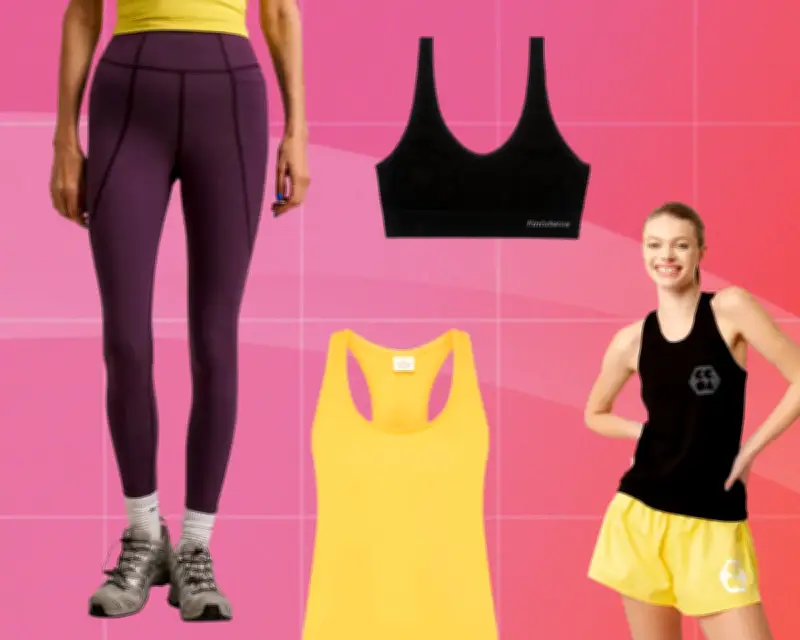
Most of us love to exercise in flattering, figure-hugging clothes, but they are often unsustainable. Workout gear with stretch tends to be made from fossil-fuel-derived synthetics, which dominate global fibre production. These fabrics shed microplastics during every wash, have huge carbon footprints—polyester is the biggest contributor to greenhouse gas emissions in fibre production—and can take hundreds of years to decompose in landfills, releasing harmful gases in the process. However, it can be difficult to find good workout clothes made from alternative, less-polluting fabrics.
So I set out to find the best workout gear made from materials that have a lower environmental impact but also do not compromise on performance. I put a range of pieces, from leggings to shorts, tank tops to base layers, to the test, wearing them for different types of exercise to find out how they felt, and if they retained their stretch. I looked at the environmental impact of each item, and I have noted any take-back and recycling schemes.
Most are more expensive than high-street alternatives. But having worn mainstream sportswear in the past—I still have some in my wardrobe—I can confirm the items I tested felt better against my skin, performed just as well, and did not need to be washed as often because of the greater amount of natural fibres, giving them a much better chance of lasting longer.
Why you should trust me
I am a journalist and author specialising in sustainability. In 2022, I published Three Things to Help Heal the Planet, a collection of essays offering climate-friendly solutions to everyday problems, as directed by experts. Earlier this year, I hosted a panel discussion for Performance without Toxicity, an exhibition exploring materials innovation in sportswear. I try to exercise several times a week, including running, swimming, tennis, yoga and weights at the gym—although never all five in the same week. I have swum between Greek islands, but still struggle to run my regular 5km route without looking like I have run a marathon.
How I tested
Each item of sportswear was put through its paces over three months of running, yoga and weight training. I wore these pieces several times over three months and for three activities: running, yoga and weight training. I washed every piece to test performance post-laundering, although no item needed washing after first use—or even second and third, in most cases. Despite getting pretty sweaty after my runs, pieces made from natural fibres stayed odour-free and just needed a bit of airing outside. It is important to check the care label: 30°C was the maximum temperature all round. Sizes can vary significantly between brands, so I would urge trying on sports clothes before buying. For online retailers, ask about sizing—they will want to help you find the right fit.
The best lower-impact activewear
The best lower-impact leggings and shorts
Bam Enduro ultra active leggings – £29.50 at Bam. These Bam leggings combine softness (24% organic cotton), smoothness (64% bamboo viscose) and stretch (12% elastane). The result is that you feel “pulled in” without restricting your movement. I wore them for the gym, yoga, tennis and outdoor runs—the handy side pocket can fit a phone while running or even a tennis ball for a second serve. They showed no signs of sagging, before or after laundering. Bam offers a preloved buying and selling platform to keep items in circulation for longer, plus a take-back scheme for products certified as recyclable by the Circular Textiles Foundation (check the label; this does not apply to this particular pair of leggings as the composition is blended).
Finisterre Ria seamless leggings – £57 at Finisterre. Soft and cosy, these leggings are made from 46% merino wool, a natural fibre that is brilliant at regulating temperature, with plenty of stretch (they contain 35% recycled polyester, with the remaining 19% a polyamide and elastane mix, so when you do wash them, they will still shed microplastics). Wool is odour-resistant, so I only needed to wash these leggings after several wears. I also tested the matching top, and both pieces are tight-fitting throughout, so the second time I wore the leggings, which have a high waist, I paired them with a different, looser top to balance out proportions. Sizing up in the leggings may have been a better fit at the waist for me, but the top was just right—I even kept it on after my run. I loved the olive colour, but wished there was a small pocket in the leggings to hold your keys.
Wellicious New Best yoga pants – £129 at Wellicious. Not everyone likes the tightness of leggings. These yoga pants have a slim silhouette with flattering thick cuffs and good movement, but without a skin-tight feel. Wellicious’ bottoms are the only ones I tested that are made using biodegradable elastane (under industrial composting conditions) and Global Organic Textile Standard-certified organic cotton, so I was intrigued to see how they would perform. These are 83% organic cotton and 17% elastane, and they feel soft against the skin while retaining plenty of stretch. I also wore them to the gym for weight training on cooler days. They washed well and felt just as soft afterwards. Wellicious offers a take-back scheme, and the brand is certified cradle to cradle, a global standard that assesses and certifies products intentionally designed to be reused or recycled at end-of-life.
Patagonia Endless run 7/8 tights – £100 at Patagonia. Patagonia’s leggings are made from 74% post-consumer recycled nylon (diverted from landfill and reprocessed into new material), with 26% elastane, and you can feel the difference when compared to natural fibres: it is smooth and sleek rather than soft and gentle. If you prefer a tighter fit, you may want to size down. They come with handy pockets on each leg to hold your phone and keys.
Wellicious Easy Perfect leggings (high waist) – £119 at Wellicious. I put these leggings to the test during a yoga session, and they offered plenty of stretch. They are soft and comfortable too, but lack the smooth, sleek texture of viscose or synthetics that some yogis might be accustomed to.
Tripulse Pro Tencel leggings – £149 at Tripulse. I loved the feel of these leggings: more second-skin than skin-tight. This is because they are made from 86% Tencel, a fibre made from wood pulp, which shares the qualities of viscose—smooth, strong and breathable—but is less carbon and water intensive to produce. They also contain 14% recycled elastane, which gives them their stretch, but it does mean that microplastics are shed during washing. I wore them for everything—yoga, the gym, running (outdoors and on the treadmill). They were comfortable, did not sag and retained their stretch and comfort after washing. The leggings are pared-back and flattering, with a hidden internal “pocket”—two openings inside the waistband. This can hold keys, and the brand suggests you can squeeze a phone in there too, but I found it too tight for that. At £149, they are the most expensive in this group, so treat them as an investment.
Pangaia Plant-Stretch compressive cycle shorts – £49 at Pangaia. I had not worn cycling shorts since childhood, thinking they would be too tight and I would feel self-conscious. Instead, I felt as if I could move freely in these and happily wore them to yoga. They are flattering too, with a wide waistband that comes to mid-stomach and a mid-thigh length. They have a pulled-together feeling without being restrictive. Pangaia’s shorts are bio-based, combining nylon made from castor beans and industrial corn and a 98% plant-based elastane, reducing reliance on fossil-fuel-derived synthetics. There is still a small percentage of synthetics for performance and durability.
Community Clothing Lightweight plastic-free running shorts – £30 at Community Clothing. Made from 100% organic cotton (with a blend of cotton and natural rubber for the waistband elastic), these shorts are cut into my ideal running silhouette: athletically loose and very short (they end on the upper thigh, so this might not be to everyone’s taste). Comfortable and lightweight, I liked the bright orange shade. A small internal pocket can just about hold your keys—you will need to carry or leave your phone at home.
The best lower-impact exercise tops
Finisterre Women’s Seeker merino long sleeve T-shirt – £80 at Finisterre. This Finisterre base layer is made from 100% merino wool with a relaxed fit, making it functional and versatile. Wool is great at regulating body temperature, and the fit means you can layer it over a vest or crop top, or wear it under a hoodie. I only washed it for the purposes of this article—it did not need laundering after several wears, but it washed well and stayed soft.
Pangaia 99% bio-based zipped long-sleeve top – £59 at Pangaia. This is a stylish, slim-fitting top that does not restrict movement. Handy thumbholes and a funnel-neck create a chic silhouette, although it feels a bit tight if zipped all the way up. I wore it in spring without an additional layer on a bright, sunny day (about 9°C) and it kept me at the right temperature for 90 minutes while I played tennis. I received quite a few compliments, too. Without washing it, I wore it again a couple of days later for a 4km run, and it still did not smell. This top is 99% plant-based, made from bio-based nylon and elastane, replacing fossil-fuel-derived inputs with alternatives that have a lower carbon footprint. But like the shorts above, there is still a relatively small amount of virgin fibres used.
Patagonia Capilene cool merino blend long-sleeved shirt – from £84.99 at SportsShoes, £85 at Patagonia. This top works on its own, or as a base layer under a hoodie for really cold days. I wore it running outdoors and to play tennis. I thought I would feel too hot, but the 65% wool composition worked its natural, temperature-regulating magic and felt soft against my skin for my two-hour match. The remainder (35%) is made from recycled polyester, which will still shed microplastics and be difficult to recycle at end-of-life.
Bam Enduro reversible crop top – £36 at Bam. This top earns extra brownie points for being reversible, giving you two different coloured pieces in one. I do not wear crop tops, so I was not convinced I would like this, but it has the lovely softness you get from natural fibres, and the wide underband was supportive enough for yoga and weight training (though I would not run in it; I would need a sports bra). I wore a medium—based on the size guide—but a large may have been better. Like the leggings, the composition is 64% bamboo viscose and 24% organic cotton, with 12% elastane.
Wellicious Organic cotton racer tank – £69 at Wellicious. I love a racer-back top for running, especially outdoors on a warm day. Lightweight, loose-fitting without being baggy, this Wellicious top is made from 100% GOTS-certified organic cotton and comes in a sunny yellow shade. A good all-rounder, I also wore it over the Tripulse bra (see below) at the gym and for yoga.
Community Clothing Breathable plastic-free racer-back vest – £30 at Community Clothing. A stylish option from Community Clothing, this 100% cotton racer-back vest has a weightier feel than standard running tops, helping to retain its shape. The longer cut, which falls below the hip, is flattering. I wore it at the gym and on warm sunny days for an outdoor run. The brand says it shrinks a little after the first wash but any shrinkage was barely noticeable after I washed it, so I would stick with your usual size.
Tripulse AER Relaxed Tencel tank top – £65 at Tripulse. I love tank tops for both sport and non-sporting activities. This one is made from 100% Tencel lyocell, so it is soft and almost weightless, with a silhouette that is designed more for daywear than sportswear. I wore it as a layer over the Tripulse bra for yoga and at the gym, and I would wear it on its own for running outdoors on warm days.
Mover Light merino T-shirt – £82 at Mover. It is hard to beat a good T-shirt for versatility. If the materials are natural and the fit is right—slim, without being tight—then it feels great against the skin and performs across so many different activities. I wore Mover’s unisex 100% merino wool version for all activities in this test: it is lightweight enough to wear at the gym and for yoga, and as an underlayer when running outdoors in cooler weather. The brand is unisex, so I was recommended a size small, which was the right fit.
The best lower-impact hoodies and sweatshirts
Community Clothing Sleeveless plastic-free sweatshirt – £45 at Community Clothing. Made from 100% organic cotton, this sweatshirt is the most stylish I have ever worn for sport. The thick, ribbed waistband and weighty cotton balance the loose, wide-fitting sleeveless silhouette for a comfortable but structured fit. Your chest stays warm, but the sleeves keep things airy when you start to get hot. I wore it for yoga and running indoors on the treadmill. The logo is big, which may not suit some, although it is quite muted.
Mover Merino TechFleece hoodie – £202 at Mover. I associate hoodies with being bulky. This one—made from merino wool—is anything but. Light and streamlined, with a fleece interior, it was easy to tie around my waist once I had warmed up. A sleek hood stays on while you run. It washes well, too. At £202, it is the most expensive item in this roundup—and at the upper end for hoodies in general. But I was impressed with its technical abilities and 100% natural-fibre composition. On cooler days, it kept me warm without being bulky; on warmer days, it did not make me overheat. Yes, it is an investment, but worth considering if you can afford it when it is time to update your hoodie.
The best lower-impact sports bras
Tripulse Next-gen Tencel sports bra – £120 at Tripulse. Similar to a crop top, this bra is designed to be worn under clothing or on its own—something I reluctantly had to put to the test when I got too hot in the gym in my long-sleeved top. Fortunately, it offers good coverage and medium support (not supportive enough for me to run in, though). Made from Tencel lyocell and recycled elastane, it feels soft, comfortable and stretchy. Tencel is less carbon and water intensive to produce, compared to traditional viscose, and the recycled elastane is made from pre-consumer materials, such as fabric scraps from in-house manufacturing, rather than from plastic bottles. But microplastics can still shed in the wash. The bra has two openings on the inside—one to the front, where you have the option to add your own pads, and one to the back, where you can store valuables—great for a key, but too tight for a phone.
Finisterre Sia seamless bralette – £40 at Finisterre. I was worried this bralette would not be supportive enough given how soft it feels—it is made from 85% Tencel lyocell, 10% recycled polyamide and 5% elastane—but I need not have worried. With a seamless design, it was comfortable and stretchy, and I wore it for yoga and weight training gym sessions. It is designed to be worn as a bra or on its own, but anyone self-conscious about exposed stomach and cleavage may feel uncomfortable wearing it as a top. Otherwise, it looks great. I went for a medium, but it came up small, so a large would have been a better choice.
What you need to know
Do you need performance fabrics for exercise?
Natascha Radclyffe-Thomas, professor of marketing and sustainable fashion at Ravensbourne University, London, believes we have become too accustomed to a high degree of stretch. “Yes, cotton struggles to compete with the recovery properties of elastane, but for many sports activities, 100% cotton or cotton blends provide a perfectly adequate level of comfort and moveability.” But there is no denying that tighter-fitting sports clothes can make us feel more supported, “pulled together” and look the part.
Which materials should I look out for?
Breathable natural fibres, such as organic cotton and wool, are renewable, biodegradable and have a lower carbon footprint. While you would not normally associate wool with exercise clothes, its thermoregulating properties keep you warmer when it is cold and cooler when it is warm—so are good for outdoor activities. Being naturally odour-resistant means you do not need to wash it as often as other fabrics, saving water and energy. But cotton and wool do not have that sought-after stretch, so they are often overlooked. Branded semi-synthetic cellulose fibres made from bamboo and wood pulp, including Tencel, are less carbon and water intensive to produce than regular viscose, but still smooth, absorbent, strong and breathable. And some brands are experimenting with alternatives to elastane—the synthetic fibre that gives our workout clothes their stretch—from biodegradable to 98% plant-based versions.
Are recycled fabrics better?
There are pros and cons to recycled synthetics. They still contribute to microplastics pollution and, according to one report, recycled polyester sheds more microfibres than virgin polyester. Much of it is made from plastic bottles, which are part of a closed-loop system and cannot be recycled again when used for clothing. But recycled polyester does have a lower carbon footprint than virgin polyester. And brands such as Patagonia use discarded fishing nets to make some of their nylon.
What about blends?
To give us that stretchy quality, natural fibres are often blended with synthetic materials. Some brands are reducing the ratio significantly in favour of the former and, as a result, reducing their reliance on virgin synthetics. But once fibres are blended, it is difficult to separate and recycle them. So, opting for 100% natural fibres can make your buys more sustainable, particularly when it comes to the item’s end-of-life.
Why do more sustainable fabrics cost more?
You can buy more affordable pieces from fast-fashion brands, many of which have low-cost supply chains at the expense of labour and the environment. Polyester remains the fabric of choice across the fashion industry because of the low cost of fossil-fuel-based synthetic fibres—polyester costs half as much per kg as cotton. But Bam offers a good entry price point with leggings (64% bamboo viscose, 24% organic cotton, 12% elastane) starting at £49.
Ana Santi is an author, journalist and content strategist specialising in sustainability. After struggling to find definitive, climate-friendly solutions to everyday problems, she decided to put experts on the spot and ask them directly for answers, which was turned into a book and published in 2022: Three Things to Help Heal the Planet. When not auditing her wardrobe or making at-home organic facial oils in the name of journalism, Ana is happiest in the water: she completed the 6km river swim in just over 1.5 hours (the tide helped …).